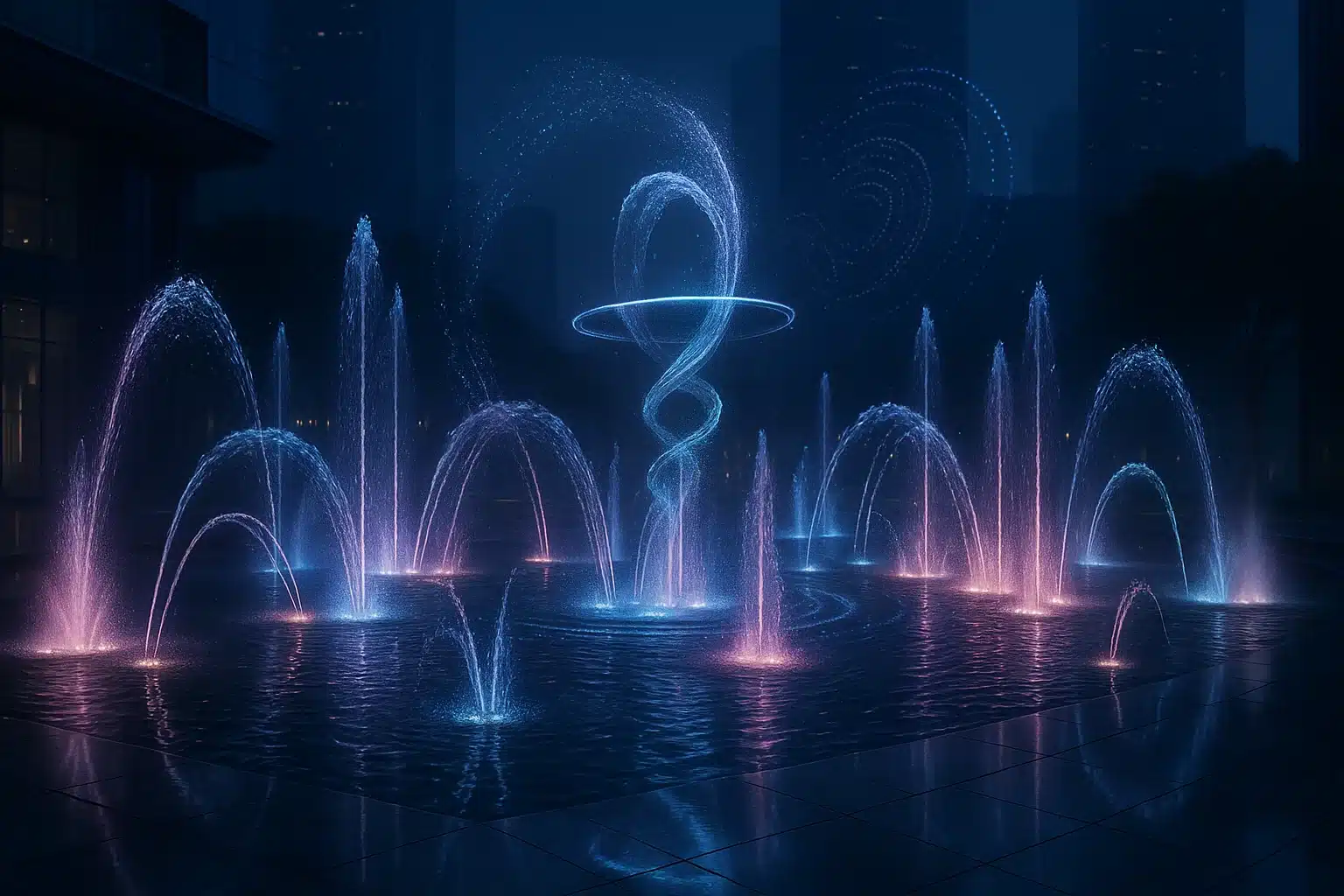
392.1.AI-Water-Shows

AI-Curated Water Shows: The Next Frontier in Choreographed Fountains

Introduction: Where Art Meets Artificial Intelligence

Fountainshave always fascinated humans. From ancient aqueducts to the dancing water displays of Las Vegas, our ability to shape and animate water has symbolized creativity, culture, and innovation. Now, artificial intelligence (AI) is taking this art form into uncharted territory.

Imagine water jets that respond to live music in real-time, predict audience mood shifts, and adapt lighting and motion with machine precision, all without human intervention. This is the dawn of AI-curated water shows, where data and design merge to create living spectacles.

AI isn’t just programming lights and pumps anymore; it’s composing performances, interpreting emotion, and transforming water into a new language of art and expression.

1. The Evolution of Choreographed Fountains

Before AI stepped in, choreographed fountains relied heavily on pre-programmed sequences. Engineers would map out every jet of water, every lighting cue, and every beat of music. Shows like the Bellagio Fountains in Las Vegas or the Dubai Fountain stunned audiences through precision and planning, not real-time adaptability.

Manual Precision Meets Limitations

Traditional systems could synchronize water jets and lights to a pre-recorded track. But these performances were static, reliant on months of design and rehearsal. The beauty was undeniable, but the spontaneity was missing.

Each performance was identical, and the human designers, no matter how skilled, could only explore a limited number of variations before the system’s complexity became overwhelming.

2. The AI Revolution in Entertainment Design

AI is rewriting the rules of performance art. By leveraging machine learning, computer vision, and real-time control systems, water shows are becoming dynamic, adaptive, and even self-improving.

An AI system can process sound frequencies, emotional tones, and spatial data at speeds no human can match. It learns from each performance, refining the choreography to make the next show even more captivating.

Key AI Technologies at Play

Neural Networks for Sound Analysis:
These systems break down music into micro-patterns, tempo, rhythm, and sentiment, to determine water movement that best matches the emotional energy of the moment.

Predictive Algorithms:
Using audience data, weather conditions, and environmental sensors, AI can anticipate optimal timing, height, and color changes for maximum visual impact.

Computer Vision:
Cameras analyze crowd reactions, adjusting elements like pacing, brightness, and transitions to maintain engagement levels in real time.

Natural Language Processing (NLP):
In interactive installations, voice recognition enables audiences to “speak” to the fountain, triggering sequences through simple prompts or emotional cues.

3. Designing with Data: How AI Curates a Water Show

Unlike traditional shows, AI-driven water performances are curated, not just choreographed. They evolve from data, creativity, and continuous feedback loops.

Step 1: Data Collection

AI systems pull in streams of information, musical structure, light reflection data, wind speed, and audience demographics. This information forms a living dataset that informs every splash and shimmer.

Step 2: Pattern Recognition

Machine learning models analyze these datasets to identify patterns in rhythm, emotion, and visual harmony. For example, softer ballads may inspire smoother arcs and pastel lighting, while upbeat electronic music might produce explosive, high-velocity jets.

Step 3: Autonomous Curation

Once trained, the AI becomes a curator. It decides how water behaves, when it dances, when it rests, and how it complements other sensory elements like light and sound.

Step 4: Real-Time Adaptation

During the show, sensors feed live data to the AI system. If the wind changes direction or an audience cheers louder, the system modifies the choreography instantly, no human intervention required.

4. AI as the New Choreographer

Human choreographers have long directed the motion of dancers, lights, and fountains. But AI adds a new layer: it choreographs with awareness.

AI can interpret variables humans might overlook, the precise timing between musical notes, the fluid dynamics of water under changing pressure, and even the audience’s emotional pulse through biometric data.

Case Study: The Adaptive Fountain

Imagine a city square fountain that syncs with live street musicians. The AI listens to the performance, detects tempo shifts, and adjusts its water and lighting accordingly. As the saxophonist plays a crescendo, water jets shoot higher; when the melody softens, the fountain settles into a gentle rhythm.

The show is unique every time, ephemeral art that exists only in that moment.

5. Merging Technology with Aesthetics

The challenge of AI-curated water shows isn’t just technical; it’s artistic. AI must understand not only data but also emotion and aesthetics. The goal is not efficiency, but beauty.

The Aesthetic Algorithm

Modern AI systems are trained on thousands of videos of human performances, from ballet to fireworks displays, learning what humans find visually satisfying.

They learn timing, contrast, symmetry, and emotional arcs, creating shows that feel intentional and emotionally resonant, even when generated autonomously.

Lighting as a Language

Lighting design plays an essential role in modern water shows. With AI, lighting becomes responsive. Each droplet can catch and refract light differently based on AI’s control of color temperature, intensity, and hue.

Imagine AI syncing thousands of LEDs to pulse with a heartbeat rhythm detected in the music, creating a multisensory emotional journey.

6. Beyond Entertainment: Smart Cities and Cultural Integration

AI-Curated Water Shows The Next Frontier in Choreographed Fountains

AI-curated water shows aren’t confined to amusement parks or luxury hotels. They’re becoming integral features in smart cities, merging public art, environmental data, and social engagement.

Urban Storytelling

In some cities, fountains tell stories of culture and history. AI enables these narratives to evolve dynamically, for instance, adjusting performances on national holidays, sports victories, or local festivals.

Eco-Friendly Engineering

AI optimization reduces water waste and energy consumption. By analyzing environmental conditions, systems can:

  • Adjust pressure to conserve water on windy days.
  • Optimize pump efficiency for lower energy use.
  • Synchronize with renewable power grids for sustainable operation.

Interactive Public Spaces

In public installations, AI allows for audience interaction. Motion sensors detect passersby, triggering personalized sequences, turning the urban fountain into a shared digital canvas.

7. The Role of Emotion and Human Experience

One might wonder: can a machine truly choreograph emotion? The answer lies in how AI interprets human input.

AI-curated fountains don’t feel emotions themselves, but they can recognize and respond to them. By analyzing tone, tempo, and crowd reactions, AI crafts performances that mirror human feeling, a form of emotional resonance.

From Spectacle to Experience

Audiences are no longer passive observers. They become participants, co-creating performances through their presence and reactions. This shift transforms water shows into immersive experiences that bridge the digital and physical worlds.

8. The Future: Generative AI and Predictive Art

The next frontier lies in generative AI, systems capable of inventing entirely new performances rather than optimizing existing ones.

By training on datasets of movement, light, and music, these models can generate unique water choreographies that no human has ever designed. Each show becomes an original work of art, created collaboratively between human intention and machine creativity.

Predictive Artistry

Future systems may anticipate audience emotions, adjusting before reactions occur. For instance, if AI predicts that a sequence will lose audience engagement, it could seamlessly introduce new rhythms or lighting patterns to re-capture attention.

9. Challenges and Ethical Considerations

With every innovation comes responsibility. AI-curated performances raise new questions about authorship, ethics, and authenticity.

Who Is the Artist?

If an AI creates a performance, who owns it, the programmer, the designer, or the machine itself? This philosophical question echoes debates in AI-generated music, painting, and literature.

Data Privacy

Interactive installations that collect audience data, facial expressions, movements, even voice, must ensure strict privacy controls. Transparency about how data is used is critical to maintaining public trust.

The Human Element

AI may enhance art, but it should not replace human creativity. The future lies in collaboration, not substitution, where AI amplifies imagination rather than imitates it.

10. Real-World Examples and Pioneers

The Dubai Fountain 2.0 (Hypothetical Future Vision)

Engineers are already exploring the integration of real-time AI control at landmarks like the Dubai Fountain. Future iterations could analyze weather, audience density, and even global events to select themes and choreographies that feel contextually relevant.

Disney’s Machine Learning Magic

Disney Research has experimented with AI-driven animation and robotics — a natural extension toward fountain choreography that reacts dynamically to story arcs in theme park shows.

Smart Fountains in European Smart Cities

Cities like Barcelona and Copenhagen are embedding AI into public art installations that respond to air quality, noise levels, and public activity — turning environmental data into visual art.

11. The Business of AI-Curated Experiences

Beyond artistry, AI-curated water shows are a new entertainment economy. They’re attracting investment from hospitality giants, event companies, and tourism boards eager to differentiate through experience design.

Cost Efficiency

AI reduces the need for manual reprogramming, cutting design cycles from months to hours. Automated optimization also slashes operational costs in power and maintenance.

Scalability

Cloud-based AI systems allow water shows to scale globally. A design perfected in one city can be shared, modified, and deployed instantly in another, creating a network of evolving performances across the world.

Marketing and Monetization

Data-driven fountains can serve as interactive marketing platforms — integrating brand stories, social media hashtags, and real-time engagement metrics to attract crowds and sponsors alike.

12. Philosophical Implications: When Machines Create Beauty

Can beauty be algorithmic? Philosophers and technologists alike are debating whether AI-generated art carries the same emotional weight as human-made art.

In the case of water shows, AI acts less as an artist and more as a medium — a bridge between data and human perception. The result is a partnership where machine precision enhances, rather than diminishes, the organic wonder of water.

AI’s ability to choreograph water reveals a profound truth: technology doesn’t eliminate humanity from art; it expands what’s humanly possible.

13. The Road Ahead: Fully Immersive Environments

The future of AI-curated custom fountains lies in multisensory integration. Imagine environments where sound, light, scent, and even temperature shift in perfect harmony.

Water could become a central storytelling element in augmented reality shows, responding to holographic projections and drone displays. AI would act as the conductor of this digital symphony, synchronizing every sensory note into a cohesive narrative.

Potential Innovations on the Horizon

  • AI-AR Integration: Fountains interacting with augmented reality headsets for personalized visual overlays.
  • Biometric Synchronization: Shows that adapt to audience heart rates and motion patterns.
  • Quantum Computing Influence: Near-instant choreography recalculations for hyper-complex shows.

Conclusion: The Dawn of Living Water

AI-curated water shows mark a turning point in the fusion of art and technology. What was once a static performance now breathes, adapting, learning, and feeling through algorithms.

In this new era, water is more than a reflective surface or a physical medium. It becomes an interface between human emotion and artificial intelligence, alive, aware, and ever-changing.

As cities, artists, and engineers collaborate to bring these visions to life, we may soon stand before fountains that don’t just entertain us but communicate, speaking in waves, light, and motion, curated by the intelligence we created.

FAQs:

An AI-curated water show uses artificial intelligence to autonomously choreograph and adapt water, light, and sound performances in real time. The AI analyzes data such as music, audience reactions, and environmental factors to create dynamic, responsive displays.
AI brings adaptability and personalization. Unlike pre-programmed shows, AI can respond to live inputs, optimize performance efficiency, and continuously improve its choreography through machine learning.
Yes. AI systems can minimize water and energy consumption by analyzing weather, crowd presence, and system efficiency. This makes them both environmentally friendly and economically efficient.