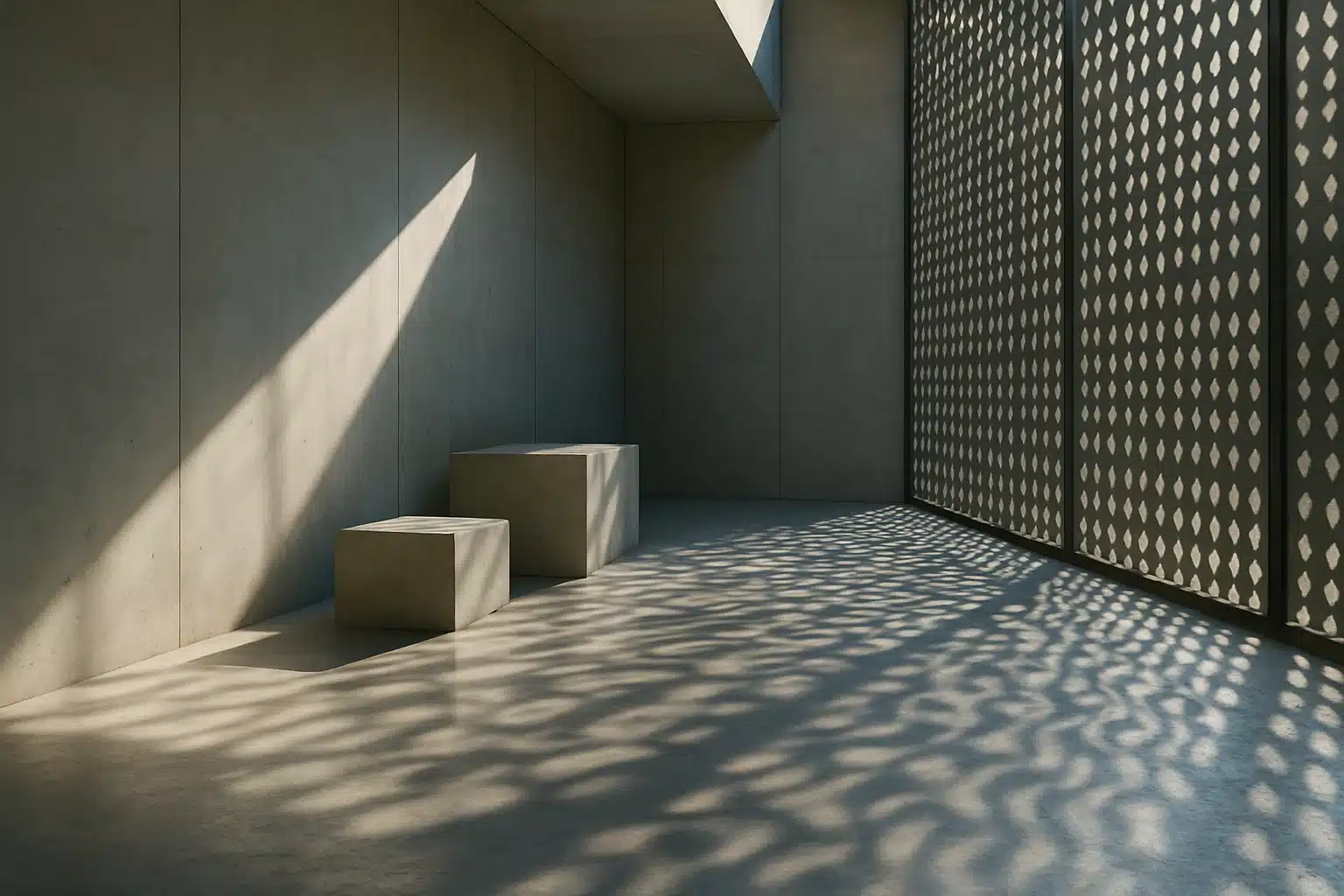
Shadows are often treated as secondary players in the world of architecture, subtle byproducts of massing and sunlight, momentary and fleeting. But to the designers who truly understand their expressive potential, shadows aren’t passive at all. They’re active strokes of a brush. They’re sculptural. They’re storytelling. When carefully manipulated, they become a medium, much like ink or watercolor, capable of washing over surfaces, shifting perception, and enriching space.
Shadows are architecture’s watercolors, and light is the invisible hand guiding their movement.
“Painting with water,” as a metaphor here, doesn’t literally imply using physical water but rather designing with an awareness of shadow as if it were a fluid medium. Like water, shadows flow, gather, ripple, recede, oscillate with time, and drape themselves over forms. They can be thick and opaque, or delicate and translucent. They can unify or divide, conceal or reveal. And most intriguingly, they can transform an ordinary structure into something emotional, dynamic, even poetic.
The Dance of Light and Form: Understanding the Basics
Every shadow begins with a relationship:
Light meets form, and the resulting bond produces a shape that spills across the ground, the wall, or the interior landscape.
The geometry of this relationship depends on:
- Light source direction
- Light intensity
- Surface reflectivity
- Material texture
- Distance between object and surface
This interplay gives shadows their distinct characteristics, sometimes crisp and sharp, other times hazy and soft. The sun, unlike artificial lights, is in constant motion, so the angle of light shifts continuously. This means shadows aren’t static pictorial elements; they’re temporal events.
- A shadow at 8 AM is not the same as a shadow at noon.
- A shadow in winter is not the same as one in midsummer.
- A shadow at the equator behaves differently than one at 55° latitude.
Architects and designers who treat shadows as intentional design tools become choreographers of time itself. They’re not just drawing elevations and plans, they’re sketching moments, crafting experiences hour by hour, season by season.
Why Shadows Behave Like Water
Water is fluid, reflective, and shaped by the surfaces it moves across. Shadows share these qualities metaphorically:
Shadows Flow
As the sun moves, shadows glide across surfaces like a tide moving in and out. Even the most rigid structures, columns, fins, louvers, produce shadow patterns that feel like liquid ribbons.
Shadows Pool
Under recesses, balconies, bridges, and cantilevers, shadows gather like dark pools. These areas provide visual “coolness,” balancing bright highlights.
Shadows Ripple
When light interacts with textured or perforated surfaces, think mashrabiya screens, brise-soleils, or laser-cut façades, the shadows dance, vibrating like ripples on water.
Shadows Evaporate
As light becomes more diffuse (toward evening, in fog, or close to cloudy skies), shadows lose their edges. They dissolve much like mist lifting off a lake.
By understanding shadows as a fluid medium, architects can craft experiences that feel natural, organic, and rhythmic, even when built from steel, stone, and concrete.
Designing with Light Angles: Key Principles to “Paint with Water”
1. Mapping Solar Movement
To use shadows intentionally, architects must first understand how sunlight behaves at a specific location. Key factors include:
- Latitude and longitude
- Seasonal sun path diagrams
- Altitude and azimuth angles
- Local obstructions (mountains, buildings)
The more precisely an architect understands the sun’s motion, the more deliberately they can place elements to cast shadows where desired.
A horizontal fin angled 30° upward will cast a vastly different shadow at 2 PM in July compared to the same fin in December. One produces long, sweeping shadows, the other shorter, more concentrated patches.
Good shadow design starts with solar literacy.
2. Using Structure as a Brush
Volumes, planes, and structural details are often treated as the “brushes” in this metaphor. Architects manipulate:
- Columns
- Canopies
- Screens
- Louvers
- Perforated panels
- Stair railings
- Roof overhangs
Each of these creates predictable shadow types:
- Vertical elements produce long horizontal strokes.
- Horizontal elements create vertical lines that shift with the time of day.
- Perforations scatter light like droplets.
- Curved surfaces create gradients and dynamic sweeps.
When an architect positions and sizes these elements with intention, the shadows behave like ink strokes, layering, blending, changing thickness depending on angle and intensity.
3. Choosing Surfaces That Respond Like Canvas
The “canvas” onto which shadows fall is just as important as the forms casting them. Smooth concrete will reveal crisply defined shadow lines, while rough stone diffuses edges. Highly reflective surfaces bounce light, reducing shadow intensity. Matte surfaces absorb it, deepening the effect.
Surface color also matters:
- Light colors brighten shadows and soften transitions.
- Dark colors deepen the contrast, making shadows dramatic.
- Warm tones shift the emotional feel of the light.
- Cool tones evoke calmness similar to water’s reflective properties.
An architect who treats the environment as a painter treats paper will create more evocative spatial compositions.
4. Creating Rhythms Through Repetition
Repetition is one of the most powerful ways to create movement in architecture. When multiple identical elements interact with sunlight, the resulting shadows form rhythmic stripes, patterns, and gradients across surfaces.
Think of:
- A colonnade at sunset
- A façade lined with vertical fins
- A pergola overlooking a courtyard
- A patterned screen filtering morning light
These produce rhythmic shadows reminiscent of waves moving across sand.
The eye perceives pattern as motion.
5. Embracing Seasonal Variations
Shadows change dramatically across seasons:
- Summer: shorter shadows due to higher sun altitude
- Winter: longer, more dramatic shadows
- Spring/Fall: transitional shadows with a more balanced ratio
Architects who design with seasonal variation in mind can create buildings that feel different throughout the year, not unlike a landscape that shifts with changing weather.
This is “painting with water” in the temporal sense.
The building becomes an evolving artwork.
Architecture Examples That Paint with Shadows
1. The Pantheon, Rome
One of the earliest examples of shadow manipulation, the Pantheon’s oculus allows a beam of sunlight to sweep across the interior like a spotlight. The light hangs in the dome’s geometry like a suspended drop of water, and as it moves, it animates the massive interior.
2. Mashrabiya Screens in Middle Eastern Architecture
These intricately carved wooden screens create lace-like shadows that shift depending on sunlight. They soften daylight while creating a cooling visual texture reminiscent of underwater light ripples.
3. Tadao Ando’s Concrete Churches
Ando’s work famously uses shadow as a theological device. At the Church of the Light, a cross-shaped cutout casts radiant beams that shift throughout the day, transforming the interior like a pool of illuminated water.
4. Japanese Traditional Architecture
Shoji screens scatter light softly, creating shadows that resemble watercolor washes. These spaces feel inherently fluid and calming, shaped by a deep cultural respect for shadow.
5. Contemporary Façades with Parametric Fins
Parametric architecture allows for dynamic fin placement that modulates sunlight. These create flowing shadow gradients that animate the building exterior rhythmically.
Shadows in Landscape Architecture
It’s not only buildings that paint with light, landscapes also use shadows to shape mood and experience.
- Trees cast dapples resembling shimmering reflections.
- Grasses create rippling patterns in the wind.
- Stone walls create pockets of coolness like shaded inlets.
Landscape architects often design pathways and resting spaces where shadows create comfort and rhythm, guiding movement intuitively.
Interior Shadows: Light as a Narrative Tool
Inside a building, natural light becomes even more controllable. Architects can:
- Cut openings at calculated angles
- Use patterned partitions
- Adjust ceiling heights
- Introduce courtyards
Interior shadows can feel intimate, like the quiet reflections in a still pool. They can highlight objects, frame views, and draw occupants from one area to another without words.
Shadows help choreograph a user’s journey.
The Psychological Effects of Shadow Design
Shadows don’t just shape surfaces, they shape emotion.
Calmness
Soft shadows evoke the tranquility of water. Spaces with gentle gradients feel peaceful and restorative.
Mystery
Deep shadows invite exploration. They create depth, drama, and narrative tension.
Warmth & Coolness
Bright sunlight feels warm; deep shadow feels cool. Architects use these contrasts to balance environmental comfort.
Focus
Spotlighting and contrast naturally guide human attention. Wherever the brightest or darkest point lies is where the eye goes first.
Understanding these psychological cues allows designers to guide user experience subtly but powerfully.
Tools & Methods for Shadow-Driven Design
1. Digital Simulation
Software such as:
- Rhino/Grasshopper
- Revit
- SketchUp with V-Ray
- Lumion
- Enscape
lets architects simulate solar angles with remarkable accuracy. They can test shadows hour by hour for any day of the year.
2. Physical Modeling
Cardboard models under desk lamps reveal surprising insights. Sometimes a simple physical model communicates shadow movement more intuitively than a 3D render.
3. Material Prototyping
Testing materials in natural light helps determine reflectivity, texture behavior, and shadow sharpness.
4. Field Studies
Observing real buildings and landscapes at different times helps architects cultivate intuition. Shadow sensitivity grows through practice.
Designing Architecture That Ages Gracefully
Good shadow design enables buildings to look better over time, not worse. Bright light exposes imperfections, but shadows soften them, offering atmospheric richness even as materials age.
- Consider weathering steel: its shadow depth increases as color darkens.
- Or stone surfaces: shadows highlight natural grain patterns over decades.
- Or wood slats: they create ever-changing patterns as they patina.
A building designed to dance with light ages like a living artwork.
Sustainability Through Shadow Design
Shadows aren’t just beautiful, they’re functional.
Cooling & Energy Efficiency
Shaded areas reduce heat gain, lowering HVAC loads. Well-placed fins and overhangs minimize direct sunlight in summer while allowing winter sun to enter.
Daylighting Optimization
Controlled shadows allow natural light penetration without glare, improving occupant comfort and reducing artificial lighting needs.
Human-Centric Design
People gravitate toward environments with balanced light and shadow. Too much uniform light feels sterile. Too much darkness feels oppressive. Balance is key.
Common Pitfalls in Shadow-Oriented Architecture
- Even experienced designers can miscalculate how shadows behave.
- Overly complex patterns may become distracting or create unwanted strobing effects.
- Ignoring seasonal changes may result in beautiful winter shadows but overly harsh summer glare.
- Relying too much on digital tools can yield inaccurate expectations, real materials behave differently.
Forgetting accessibility: overly dramatic shadows can obscure steps or increase fall risks.
Shadow design must walk a fine line between artistry and functionality.
The Future of Architectural Shadows
As we develop adaptive façades, kinetic shading systems, smart glass, and responsive materials, the ability to shape shadows in real time becomes possible.
Imagine façades that adjust louvers based on sun position, creating shadow patterns that always feel intentional. Imagine interiors where digital light projections complement natural shadows to “paint” with unlimited variation. Imagine urban environments where buildings communicate with sunlight to create healthier, cooler microclimates.
We are moving toward a world where shadow design becomes as crucial as structure.
Conclusion: Light as Ink, Shadows as Water
Architecture becomes magical when designers use light not merely to illuminate but to animate. When shadows are treated like liquid ink, flowing, pooling, dissolving, the built environment becomes a canvas of movement and emotion.
Whether you’re an architect, designer, or simply a lover of beautiful spaces, the next time you walk through a city or sit beside a window, pay attention to the shadows. Watch how they travel, how they stretch, how they soften. Notice how they transform the world around you.
In those quiet moments, you’ll see it clearly:
- Light is the brush.
- Shadows are the water.
- Architecture is the canvas.