Introduction
Few materials in the fountain designer’s vocabulary generate as strong an immediate response as Corten steel. Its rich, layered rust patina—amber, umber, and deep brown—textured with the biological complexity of oxidation, stands in striking contrast to the clean, reflective quality of water. The combination is visually compelling and architecturally distinctive.
Corten steel, a weathering steel also known by the ASTM designation A588 or the proprietary name COR-TEN®, is a high-strength low-alloy steel formulated so that its surface rust forms a stable, self-protecting oxide layer rather than the progressive, destructive corrosion associated with ordinary carbon steel.
For commercial fountain installations, Corten offers genuine aesthetic distinction and requires specific engineering and operational knowledge to perform as intended over the long term.
Why Are Corten Steel Fountains So Popular?
Corten steel fountains have become increasingly popular in commercial landscapes because they combine sculptural aesthetics with exceptional durability. Unlike painted or coated metals, Corten develops its own protective surface through controlled oxidation, creating a rich patina that evolves naturally over time.
For architects and landscape designers, Corten offers a distinctive appearance that pairs particularly well with natural stone, modern architecture, and outdoor environments. The material’s ability to age gracefully while requiring minimal surface maintenance makes it a compelling choice for many commercial fountain projects.
How Corten Steel Works
Standard carbon steel rusts in the presence of moisture and oxygen. The rust layer that forms is loose, porous, and non-protective. It continues to grow and eventually consumes the underlying metal.
Corten’s alloying elements, primarily copper, chromium, phosphorus, and nickel in small percentages, create a fundamentally different oxidation process.
After an initial weathering period, typically 18 to 36 months of natural wet-dry cycling, the rust layer becomes dense, adherent, and self-sealing. This stable patina layer reduces oxygen and moisture penetration and dramatically slows future corrosion.
In properly designed and installed applications, Corten steel loses a predictable and very small amount of thickness annually, typically between 0.001 and 0.003 inches per year under normal outdoor conditions.
For fountain elements designed with appropriate material thickness, this gradual loss is structurally insignificant over a service life measured in decades.
Why Corten Is Chosen for Commercial Fountain Applications
Aesthetic Authenticity
The Corten patina is not a coating, finish, or paint system. It is the material’s actual surface, formed naturally through oxidation.
This creates visual depth, variation, and texture that are difficult to replicate with powder coating, paint, or other applied finishes.
For designers seeking an industrial-modern, organic, or natural aesthetic, Corten offers an authenticity that few materials can match.
The appearance evolves with weather conditions, lighting changes, and age, creating a fountain that develops character over time rather than remaining static.
Material Strength
Corten is a high-strength structural steel with a yield strength significantly higher than that of standard mild steel.
This allows designers to fabricate fountain components with thinner profiles while maintaining structural performance.
Benefits include:
- Reduced visual bulk
- Cleaner architectural lines
- Greater design flexibility
- Improved structural efficiency
These characteristics make Corten particularly effective for large wall fountains, blade walls, water features, and sculptural installations.
Low Maintenance Profile
Once the stable patina has formed, Corten requires very little surface maintenance.
There is:
- No paint to chip
- No coating to scratch
- No finish to reapply
- No periodic refinishing requirements
The material maintains its own protective surface through its chemistry.
This makes Corten attractive for large-scale installations where maintenance access may be limited or where long-term maintenance costs are a concern.
While surface maintenance requirements are minimal, routine inspections and general fountain maintenance remain important for pumps, water quality systems, filtration equipment, and associated fountain infrastructure.
Corten Steel vs. Stainless Steel
| Characteristic | Corten Steel | Stainless Steel |
|---|---|---|
| Appearance | Rusted Patina | Reflective Metallic |
| Maintenance | Low | Low |
| Corrosion Resistance | Excellent in Proper Conditions | Excellent |
| Water Submersion | Limited | Ideal |
| Architectural Style | Organic / Industrial | Modern / Contemporary |
| Surface Evolution | Changes Over Time | Stable Appearance |
| Coastal Performance | Limited | Excellent |
While both materials are widely used in fountain construction, they serve different design goals.
Corten emphasizes natural aging, texture, and visual warmth. Stainless steel prioritizes clean lines, reflectivity, and superior performance in continuous water-contact environments.
Many successful fountain projects combine both materials. Corten provides the visible architectural expression while stainless steel handles submerged components and critical water-contact surfaces.
Engineering Considerations for Corten Fountain Installations
While Corten steel offers exceptional visual appeal and long-term durability, successful fountain installations require careful engineering and material planning.
Unlike many fountain materials, Corten introduces unique challenges related to rust runoff, water exposure, material compatibility, and detailing. Understanding these factors early in the design process helps prevent costly issues after installation.
The Rust Runoff Challenge
The most significant practical consideration with Corten steel fountains is rust-colored runoff.
During the initial weathering period, and to a lesser extent throughout the material’s life, rainwater and fountain water can carry iron oxide particles away from the Corten surface.
In fountain applications, this runoff enters the recirculating water system and may contact surrounding paving, coping materials, basin surfaces, and adjacent landscaping.
Without proper planning, this can result in persistent orange-brown staining.
Managing Rust Runoff
Successful Corten fountain projects typically include several runoff-management strategies:
- Selecting dark-colored paving materials
- Using stone materials that tolerate iron staining
- Separating weathering runoff from the primary fountain circulation system during initial weathering
- Designing controlled drainage paths
- Incorporating regular flushing during the early weathering period
- Avoiding runoff contact with sensitive architectural finishes
Material selection becomes especially important when specifying surrounding hardscape.
Materials That Perform Well Near Corten
- Dark granite
- Basalt
- Bluestone
- Weathered steel accents
- Dark architectural concrete
- Natural gravel systems
Materials That Require Caution
- Limestone
- Light-colored granite
- White concrete
- Light architectural precast
- Light sandstone
Light-colored surfaces adjacent to Corten fountains will often stain during weathering. This is not a defect in the material but a predictable result of its chemistry.
Design teams should account for this during material selection rather than attempting to eliminate the effect after installation.
Water Contact and Patina Development
One of the most misunderstood aspects of Corten steel is how it develops its protective patina.
The weathering process depends on alternating wet and dry cycles.
Why Constant Water Exposure Creates Problems
When Corten remains permanently submerged, the conditions necessary for stable patina formation do not occur.
As a result:
- Protective oxidation develops more slowly
- Corrosion rates may increase
- Appearance becomes inconsistent
- Long-term performance may be reduced
This is why Corten should generally not be used as the primary material for permanently submerged fountain basins.
Ideal Corten Fountain Applications
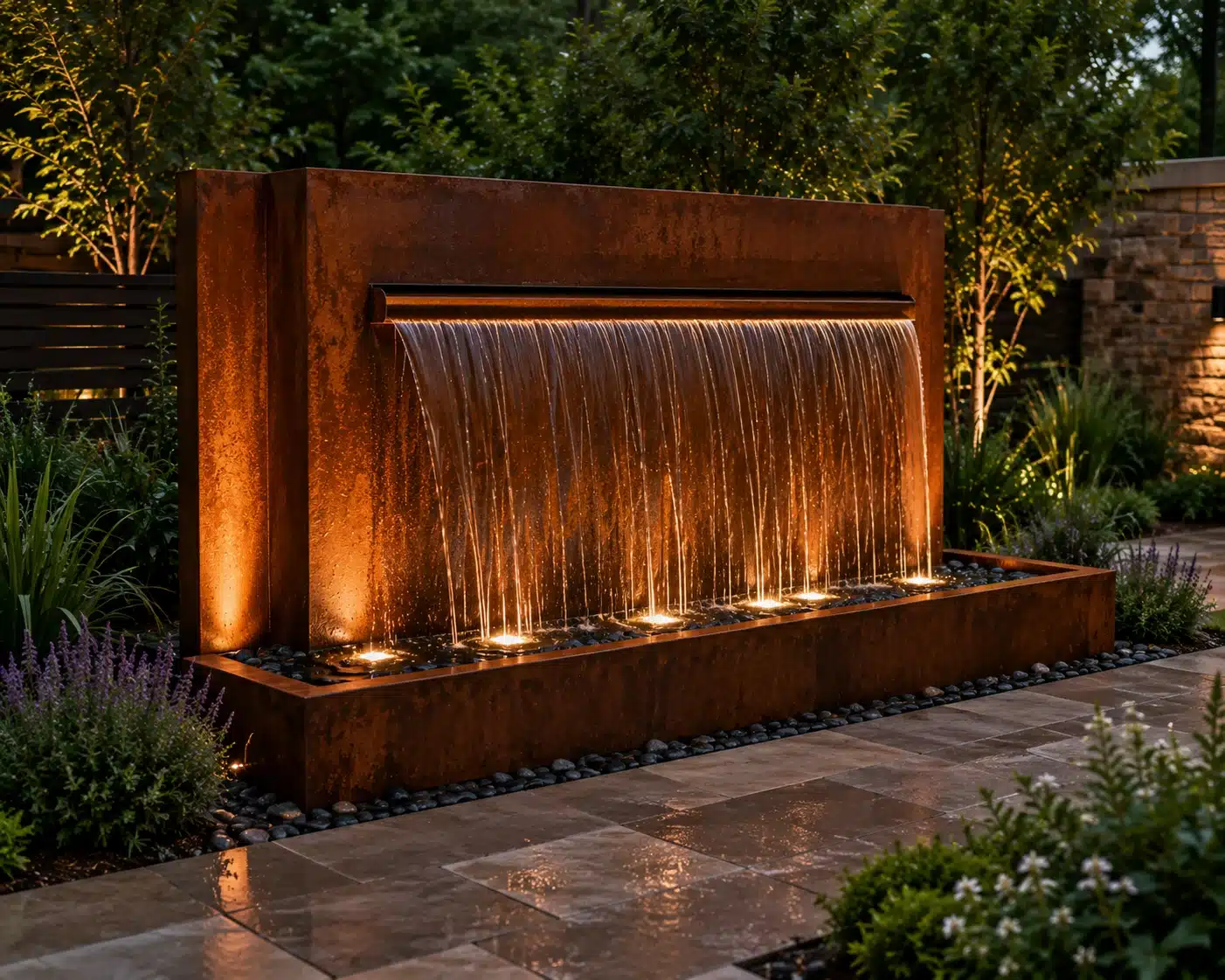
- Water walls
- Sheet-flow fountains
- Spillways
- Weirs
- Decorative fountain facades
- Basin surrounds
- Splash-exposed architectural panels
- Rill systems
[IMAGE: Corten steel water wall with concealed stainless steel basin and recirculation system]
Combining Corten with Stainless Steel
Many successful commercial fountain installations combine Corten steel with stainless steel.
- Corten provides the visible architectural character
- Stainless steel handles submerged conditions
- Waterproof performance improves
- Maintenance requirements are reduced
Galvanic Corrosion Considerations
Galvanic corrosion occurs when dissimilar metals come into direct contact in the presence of moisture.
Because fountains are wet environments, galvanic interactions must be considered carefully during design and construction.
Metals Requiring Isolation
- Stainless steel
- Aluminum
- Copper
- Brass
- Galvanized steel
Without isolation, one of the metals may corrode at an accelerated rate.
Recommended Isolation Methods
- Neoprene gaskets
- Plastic isolation washers
- Non-conductive spacers
- Coated interfaces
- Physical separation details
Proper isolation prevents unintended electrochemical reactions and supports long-term durability.
Structural Detailing Best Practices
Successful Corten installations rely heavily on proper detailing.
The goal is to encourage controlled weathering while preventing trapped moisture and accelerated corrosion.
Avoid Water Traps
Horizontal surfaces that collect standing water should be minimized whenever possible.
Standing water can:
- Delay stable patina formation
- Accelerate corrosion
- Increase staining
- Reduce material lifespan
Encourage Drainage
All hollow sections should include:
- Drain holes
- Ventilation openings
- Drainage pathways
- Accessible inspection points
Proper drainage helps maintain the wet-dry cycles necessary for healthy weathering.
Promote Air Circulation
Enclosed cavities that remain damp for extended periods can compromise Corten’s performance.
Designs should encourage:
- Natural airflow
- Moisture evaporation
- Ventilation of enclosed spaces
Fastener Selection
Fasteners play an important role in long-term performance.
Best practice is to specify:
- Stainless steel hardware
- Corrosion-resistant anchors
- Isolated connection points
Carbon steel fasteners should generally be avoided because they can corrode more rapidly than the surrounding Corten and create localized staining.
Specifying Corten for Commercial Fountain Applications
Successful specification begins with clearly defining material requirements.
Typical specification elements include:
Material Standard
Specify:
- ASTM A588
- ASTM A606 Type 4
These standards define recognized weathering steel formulations appropriate for architectural applications.
Material Thickness
Structural thickness should be determined by engineering calculations.
Many designers also include:
- Additional corrosion allowance of approximately 1/16 inch
This provides additional long-term durability without significantly affecting appearance.
Welding Requirements
Welds should utilize compatible filler metals designed for weathering steel applications.
Common specifications include:
- AWS ER80S-Ni1
- Equivalent weathering steel-compatible fillers
Using incompatible welding materials can create visible color variation and inconsistent weathering.
Surface Preparation
The specification should identify the desired appearance at installation.
Options may include:
- Natural mill scale
- Sandblasted finish
- Pre-weathered finish
- Accelerated patina treatment
Each option affects the initial appearance and weathering timeline.
Hardware Requirements
All fasteners, anchors, and exposed connection components should generally be specified as stainless steel to maximize durability and minimize corrosion-related issues.
Is Corten Right for Your Fountain Project?
Corten steel is one of the most distinctive materials available for fountain construction, but it is not the right solution for every project.
Its suitability depends on the desired aesthetic, surrounding materials, maintenance expectations, and environmental conditions.
Corten Is an Excellent Choice When:
- The design aesthetic favors raw, organic, industrial-modern, or natural materials
- The surrounding landscape includes stone, gravel, native planting, or architectural concrete
- Long-term surface maintenance is a priority
- The fountain includes water walls, spillways, weirs, or intermittent water-contact elements
- The project seeks a material that develops character and visual depth over time
- Architects want a material that evolves naturally rather than remaining static
In these applications, Corten often becomes a focal point, strengthening the connection among architecture, landscape, and water.
Corten Can Be Challenging When:
- Adjacent hardscape includes light-colored stone or concrete
- The design requires permanently submerged metal surfaces
- The project is located in a coastal or marine environment
- The client expects a completely uniform appearance
- The initial weathering and runoff period cannot be accommodated
Projects with these conditions may benefit more from stainless steel or other fountain materials.
Coastal Environment Considerations
Corten performs best in environments that allow stable patina development.
In coastal locations with elevated chloride exposure, weathering steel may continue to corrode rather than stabilize.
For oceanfront resorts, coastal mixed-use developments, and waterfront installations, stainless steel often provides a more reliable long-term solution.
Key Takeaway
Corten steel fountains offer a rare combination of architectural character, structural strength, and low long-term maintenance requirements.
Unlike painted or coated materials, Corten develops its own protective patina through controlled oxidation, creating a finish that evolves naturally over time and becomes one of the material’s most attractive design features.
Successful installations depend on understanding the engineering realities behind the aesthetic appeal. Runoff management, drainage design, material compatibility, water-contact conditions, and proper detailing all play critical roles in long-term performance.
When these considerations are addressed early in the design process, Corten can create some of the most visually distinctive and memorable fountain installations available.
Work With Fountains.com
Fountains.com designs and fabricates Corten steel water features, including wall fountains, rill systems, and multi-material installations that combine Corten steel with stainless steel, stone, and custom architectural finishes.
Our team understands both the visual potential and the engineering discipline required for successful weathering steel fountain installations.
Whether you’re exploring a contemporary architectural water wall, a corporate plaza fountain, or a large-scale outdoor installation, we can help determine whether Corten is the right material for your project.
We also design and fabricate custom fountains using a wide range of materials and engineering approaches tailored to each project’s requirements.
Explore our portfolio of metal fountains or contact our design team to discuss your next fountain project.
FAQs:
In most outdoor environments, the protective Corten patina stabilizes within 18 to 36 months.
The exact timeline depends on:
- Climate conditions
- Moisture exposure
- Drying cycles
- Environmental contaminants
Projects with regular wet-dry cycling often achieve stable patina development more quickly.
Corten is generally not recommended for environments with high chloride exposure.
Salt-laden air can interfere with the formation of the protective patina and may result in ongoing corrosion.
For coastal fountain applications, stainless steel is typically the preferred material.
Yes.
During the initial weathering period, runoff from Corten steel contains iron oxides that can stain adjacent surfaces.
This is why material selection and drainage planning are critical components of Corten fountain design.
Dark stone, weathered materials, and compatible paving systems typically perform best adjacent to Corten installations.
No.
One of Corten’s primary advantages is that it does not require painting or routine refinishing.
Once the stable patina has formed, the material maintains its own protective surface naturally.
Some projects may utilize temporary treatments during the weathering period, but long-term coatings are generally unnecessary.
Absolutely.
Many of the most successful installations combine Corten steel with:
- Stainless steel
- Natural stone
- Architectural concrete
- Glass
- Copper accents
These combinations allow designers to balance aesthetics, durability, and performance.
In some cases, yes.
However, indoor installations require careful consideration of humidity, runoff management, and patina development.
Many indoor projects use pre-weathered Corten surfaces to achieve the desired appearance while minimizing weathering-related concerns.
Ordinary rusted steel continues to corrode over time.
Corten steel is specifically engineered so that its oxidation process forms a dense, protective patina that significantly slows future corrosion.
This controlled weathering behavior is what makes Corten suitable for long-term architectural applications.