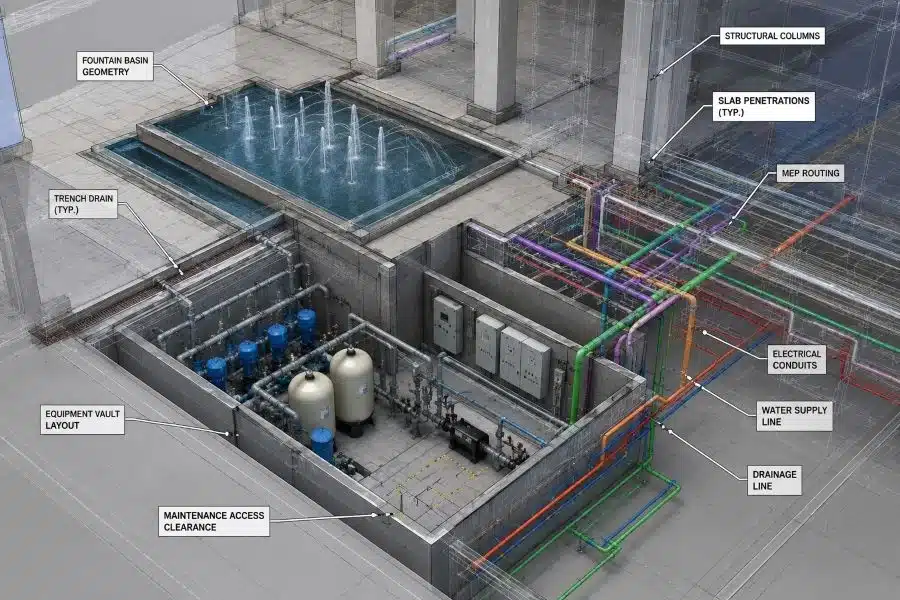
Commercial fountain systems require extensive coordination throughout design development and construction documentation.
Unlike standalone site furnishings, commercial fountain systems integrate hydraulics, waterproofing, structural engineering, electrical systems, programmable controls, specialized lighting, drainage systems, and specialty fabrication into one operational architectural system.
When fountain construction documents are incomplete or poorly coordinated, the consequences often appear later during permitting, construction, commissioning, or ongoing operation.
Across hospitality developments, luxury resorts, public plazas, civic spaces, corporate campuses, and upscale residential projects, incomplete fountain specifications frequently result in RFIs, waterproofing remediation, hydraulic inconsistencies, inaccessible equipment vaults, drainage conflicts, lighting coordination failures, delayed commissioning, excessive splash-out, change orders, and long-term maintenance complications.
For architects, developers, hospitality consultants, and commercial project teams, comprehensive fountain specifications function as risk-management tools that directly affect operational reliability, maintenance efficiency, lifecycle cost, owner satisfaction, and long-term architectural performance.
Whether the project involves engineered commercial fountains, hospitality water features, civic plaza fountains, or fully custom fountains, proper coordination should begin during schematic design and continue throughout construction documentation.
What Are Commercial Fountain Construction Documents?
Commercial fountain construction documents are coordinated architectural, structural, hydraulic, electrical, waterproofing, and operational specifications used to engineer, fabricate, install, commission, and maintain commercial fountain systems and architectural water features.
These documents typically include hydraulic calculations, pump schedules, equipment vault layouts, waterproofing assemblies, controls integration details, lighting specifications, utility rough-ins, commissioning procedures, and O&M documentation.
The quality of these specifications often determines whether a commercial fountain system performs reliably for decades or becomes a recurring operational liability.
Fountain Construction Document Checklist
Before issuing construction documents, verify that all major fountain coordination categories are addressed.
| Category | Items to Include in Construction Documents |
|---|---|
| CSI Division Coordination | Division ownership, specialty fountain sections, cross-trade coordination notes |
| Waterproofing | Membrane systems, penetration details, flood testing procedures, waterproofing warranty requirements |
| Pumps & Mechanical Systems | Pump schedules, TDH calculations, flow rates, valve schedules, maintenance access |
| Filtration & Water Treatment | Filter sizing, turnover rates, UV sterilization, chemical automation, autofill systems |
| Controls & Automation | PLC systems, BMS integration, monitoring sensors, alarm notifications |
| Lighting | IP68 submerged lighting, conduit routing, transformer locations, DMX controls |
| Structural Coordination | Dead-load calculations, anchoring details, slab penetrations, reinforcement coordination |
| MEP Coordination | Electrical loads, drainage, disconnects, utility rough-ins, conduit pathways |
| Equipment Vaults | Vault dimensions, ventilation, drainage, hatch sizing, equipment service clearances |
| Shop Drawings & Submittals | Hydraulic diagrams, product data, finish samples, equipment schedules, control diagrams |
| Commissioning | Pump startup, hydraulic balancing, leak testing, water chemistry verification, O&M manuals |
For final website implementation, this checklist should use a responsive HTML table with strong heading hierarchy, alternating row spacing, and mobile optimization.
Why Fountain Specifications Matter
Architectural fountain systems occupy a unique position within commercial construction because they rarely fit neatly into a single CSI division.
A modern commercial water feature design may involve reinforced concrete basin structures, waterproofing systems, stainless steel fabrication, hydraulic pump systems, filtration and water treatment systems, automation controls, electrical coordination, submerged lighting, equipment vaults, and overflow drainage infrastructure.
Inadequate fountain engineering specifications can affect every project consultant involved in the project lifecycle. Common consequences include waterproofing remediation, MEP conflicts, structural redesigns, equipment access limitations, increased RFIs, delayed commissioning, higher maintenance costs, and inconsistent fountain performance.
Detailed fountain specifications are essential for both visual and operational success in complex architectural water features.
Why Developers Prioritize Fountain Coordination
Developers increasingly evaluate fountain systems not only for aesthetics, but also for maintenance staffing, waterproofing liability, guest experience, energy efficiency, lifecycle reliability, and long-term asset value.
Poor coordination during design development frequently creates operational issues that continue affecting property management teams long after turnover.
Hospitality environments are especially sensitive because fountain performance directly influences guest perception and overall property experience.
Understanding Which CSI Divisions Apply
Commercial fountain specifications typically span multiple CSI divisions and require coordination between several consultants and contractors.
Division 03 — Concrete
Division 03 often includes fountain basin construction, equipment vault slabs, structural concrete supports, reinforcement coordination, slab depressions, and penetrations.
Provide structural engineers with complete dead-load calculations, including basin water volume, finish materials, operational loads, and specialty fabrication weights.
Since water weighs approximately 8.34 pounds per gallon, large fountain basins impose substantial structural demands.
Division 07 — Thermal and Moisture Protection
Waterproofing remains one of the most critical aspects of commercial fountain specifications.
Construction documents should clearly define waterproofing manufacturers, membrane systems, application thickness, compatible substrates, protection board requirements, expansion joint treatment, penetration detailing, flood testing protocols, and waterproofing warranty durations.
Allowing contractors to interpret waterproofing coordination independently often leads to long-term fountain failure.
Division 22 — Plumbing
Plumbing coordination typically includes water supply systems, overflow drains, blowdown systems, backflow prevention, chemical feed assemblies, and autofill systems.
Specifications should define required water flow rates, turnover calculations, water treatment requirements, and drainage capacity based on basin size and operating conditions.
Division 26 — Electrical
Electrical coordination should include pump panel power requirements, programmable lighting systems, disconnect locations, GFCI protection, conduit routing, junction box locations, transformer coordination, and automation interfaces.
Specify IP68-rated submerged lighting fixtures for underwater fountain applications requiring continuous immersion protection.
Division 44 — Specialty Fountain Systems
Many firms coordinate fountain systems under Division 44 or another specialty systems category, depending on office standards.
This section often includes hydraulic systems, nozzle assemblies, specialty fabrication, fountain controls, water feature equipment, and integrated fountain engineering requirements.
Core Commercial Fountain Specification Requirements
Performance-Based vs. Prescriptive Specifications
Performance-based specifications provide greater flexibility for engineered custom commercial fountains while maintaining operational standards.
Performance criteria may include water flow rates, total dynamic head (TDH), splash management requirements, noise limitations, water quality standards, lighting output, operating schedules, and energy-efficiency targets.
This approach allows fountain manufacturers and fountain design-build teams to engineer systems that satisfy operational requirements while preserving design intent.
Material Specifications
Material quality directly impacts durability, maintenance requirements, corrosion resistance, and long-term appearance.
Commercial water feature design specifications should define stainless steel grade, stone materials and finishes, basin liner systems, nozzle materials, weld finish standards, waterproofing compatibility, and coping edge details.
For metal fountains or coastal installations exposed to harsh environmental conditions, 316 stainless steel is generally recommended for superior corrosion resistance.
[IMAGE CAPTION: Close-up of stainless steel 316 fountain basin interior with welded seam detail and brushed finish.]
Pump and Mechanical System Specifications
Mechanical coordination is among the most technically demanding aspects of fountain engineering.
At a minimum, fountain construction documents should specify pump schedules, required flow rates, head pressure calculations, horsepower requirements, voltage requirements, VFD integration, isolation valves, balancing valves, strainer baskets, and maintenance clearances.
Why Pump Schedules Matter
Improper hydraulic calculations frequently lead to uneven water patterns, pump cavitation, excessive splash-out, high energy consumption, noisy operation, and premature equipment wear.
This is particularly important for precision fountain systems such as rain curtains, laminar jets, spillway installations, and interactive fountain systems.
Fountain Equipment Vault Coordination
The importance of the fountain equipment vault is often underestimated during design development.
In many mixed-use developments, equipment vault layouts become constrained late in design when parking structures, utility corridors, grease exhaust systems, and structural beams begin competing for below-grade space.
Equipment vault specifications should define minimum vault dimensions, ventilation requirements, sump drainage, access hatch sizing, service clearances, internal lighting, corrosion-resistant finishes, and equipment removal pathways.
All pumps, filters, valves, control panels, UV systems, and automation equipment should remain fully accessible for ongoing maintenance.
Many long-term maintenance issues originate not from fountain equipment failure itself, but from inaccessible valves, filters, and control panels that were never coordinated for service access during design development.
What Maintenance Access Should Architects Coordinate?
Architects should coordinate pump removal clearance, filter servicing access, UV system maintenance, ladder clearance, ventilation access, valve access, waterproofing inspection access, electrical panel clearance, autofill maintenance, and chemical treatment systems.
Some fountain vaults are designed only around installation dimensions without considering how major equipment components will eventually be removed and replaced years later.
Poor maintenance access remains one of the most common causes of operational frustration in commercial fountain systems.
Filtration and Water Treatment Systems
Filtration and water treatment systems should be fully coordinated during design development.
Specifications should define filtration type, turnover rates, UV sterilization systems, chemical automation, water chemistry targets, blowdown requirements, autofill assemblies, and backflow prevention requirements.
For large outdoor fountains in hospitality and public settings, automated treatment systems improve operational reliability while reducing maintenance demands.
Controls, Automation, and BMS Integration
Modern architectural fountain systems increasingly rely on advanced automation and monitoring platforms.
These systems may include sensor integration, leak detection, alarm notifications, programmable lighting synchronization, BMS integration, and energy management systems.
Building Management System integration allows facilities teams to remotely monitor pump status, water levels, chemical dosing, energy usage, operational alarms, and filtration system performance.
This improves operational efficiency while supporting long-term planning for fountain maintenance.
BIM, CAD, and Revit Coordination
Commercial fountain systems should be coordinated within the project’s digital modeling workflow.
Architects should align fountain specifications with CAD details, BIM models, Revit families, equipment layouts, utility rough-ins, structural penetrations, section drawings, and MEP coordination models.
Key BIM Coordination Areas
Equipment Layout Coordination
Coordinate pump systems, filtration assemblies, and control panels with equipment vault geometry and maintenance access requirements.
Utility Coordination
Align drainage piping, conduit pathways, and water supply routing with slab penetrations, structural reinforcement, waterproofing transitions, and adjacent MEP systems.
Architectural Interface Coordination
Ensure overflow edges, coping systems, slot drains, and finish transitions align with the architectural detailing package.
Coordination Requirements Between Consultants
Structural Coordination
Structural consultants should receive dead-load calculations, dynamic equipment loads, anchoring requirements, basin geometry, and equipment vault layouts.
Large commercial fountain systems can significantly affect slab thickness, reinforcement requirements, structural penetrations, and load distribution.
MEP Coordination
Begin MEP coordination early during design development.
Architects should coordinate electrical loads, disconnect locations, plumbing rough-ins, overflow systems, lighting circuits, conduit routing, and drainage systems.
Delaying coordination often results in RFIs, redesign exposure, and field modifications.
Fountain Manufacturer Coordination
Engage the fountain manufacturer during schematic design or early design development whenever possible.
Early fountain engineering coordination often resolves hydraulic conflicts, waterproofing interface issues, equipment access limitations, utility routing conflicts, and structural coordination issues.
Early collaboration during schematic design frequently prevents costly redesigns later during permitting, construction, and commissioning.
Real-World Coordination Example
A hospitality development team planned a suspended lobby fountain integrated into a podium slab system.
During design development, the fountain manufacturer identified conflicts involving the proposed equipment vault, structural beam geometry, utility routing, filtration service access, and conduit pathways.
Because these issues were identified before construction documents were finalized, the architect and structural engineer were able to revise the slab recess, relocate utility rough-ins, adjust conduit routing, improve maintenance access, and refine waterproofing coordination before construction began.
The result included reduced RFIs during construction, fewer waterproofing revisions, more accurate contractor pricing, improved maintenance accessibility, and reduced change-order exposure.
Early coordination between fountain design and construction frequently prevents costly conflicts.
What Is Fountain Commissioning?
Fountain commissioning is the process of testing, balancing, calibrating, programming, and verifying fountain system operation before final project turnover.
Shop Drawings, Submittals, and Commissioning
Clearly define required submittals and commissioning procedures in commercial fountain specifications.
Required Fountain Submittals
Typical fountain submittals include shop drawings, hydraulic diagrams, pump curves, product data sheets, lighting layouts, waterproofing documentation, equipment schedules, finish samples, and control system diagrams.
Commissioning Requirements
Commissioning specifications should include pump startup procedures, hydraulic balancing, lighting testing, water chemistry verification, leak inspections, automation testing, owner training, and operational testing periods.
Require complete O&M manuals before final acceptance.
These manuals should include maintenance schedules, seasonal shutdown procedures, startup protocols, spare parts lists, troubleshooting procedures, and emergency shutdown instructions.
Comprehensive documentation significantly improves long-term system reliability.
Long-Term Operational Cost Considerations
Developers and facilities teams increasingly evaluate commercial fountain systems based on operational efficiency and lifecycle performance.
Lifecycle planning should address maintenance staffing requirements, energy consumption, automation savings, filtration efficiency, seasonal shutdown procedures, water conservation, equipment replacement cycles, and long-term serviceability.
Well-coordinated fountain systems reduce operational downtime, emergency repairs, maintenance costs, water loss, and energy waste.
The most successful commercial fountain systems are typically the result of early collaboration between architects, fountain engineers, waterproofing consultants, MEP teams, contractors, and maintenance stakeholders.
Commercial Fountain Construction Document Checklist Resource
Maintaining a dedicated coordination checklist throughout design development and construction documentation benefits architects and spec writers alike.
A downloadable “Commercial Fountain Construction Document Checklist” can help teams track waterproofing coordination, structural approvals, MEP reviews, equipment access, lighting integration, submittal requirements, and commissioning procedures.
This type of resource is especially valuable for large commercial projects involving multiple consultants and phased review workflows.
Need Help Writing Fountain Specifications?
Fountains.com partners with architects, landscape architects, developers, hospitality designers, and commercial construction teams throughout the specification and coordination process for custom commercial fountains and architectural fountain systems.
Our team assists with CSI specification language, preliminary fountain engineering, pump schedules, hydraulic calculations, equipment vault layouts, waterproofing coordination, BIM and CAD coordination, shop drawings, construction-phase coordination, and commissioning planning.
Whether your project involves hospitality water features, mixed-use public plazas, resort fountains, or large-scale architectural water features, early technical coordination can significantly improve construction outcomes and operational performance.
Fountains.com regularly collaborates with architects, landscape architects, hospitality consultants, and contractors to support the technical design and construction of complex fountain systems from concept through turnover.
Fountains.com designs and builds custom commercial fountains, engineered water features, and fountain design-build systems nationwide.
Contact Fountains.com for assistance with specifications, preliminary engineering coordination, or a custom fountain consultation.