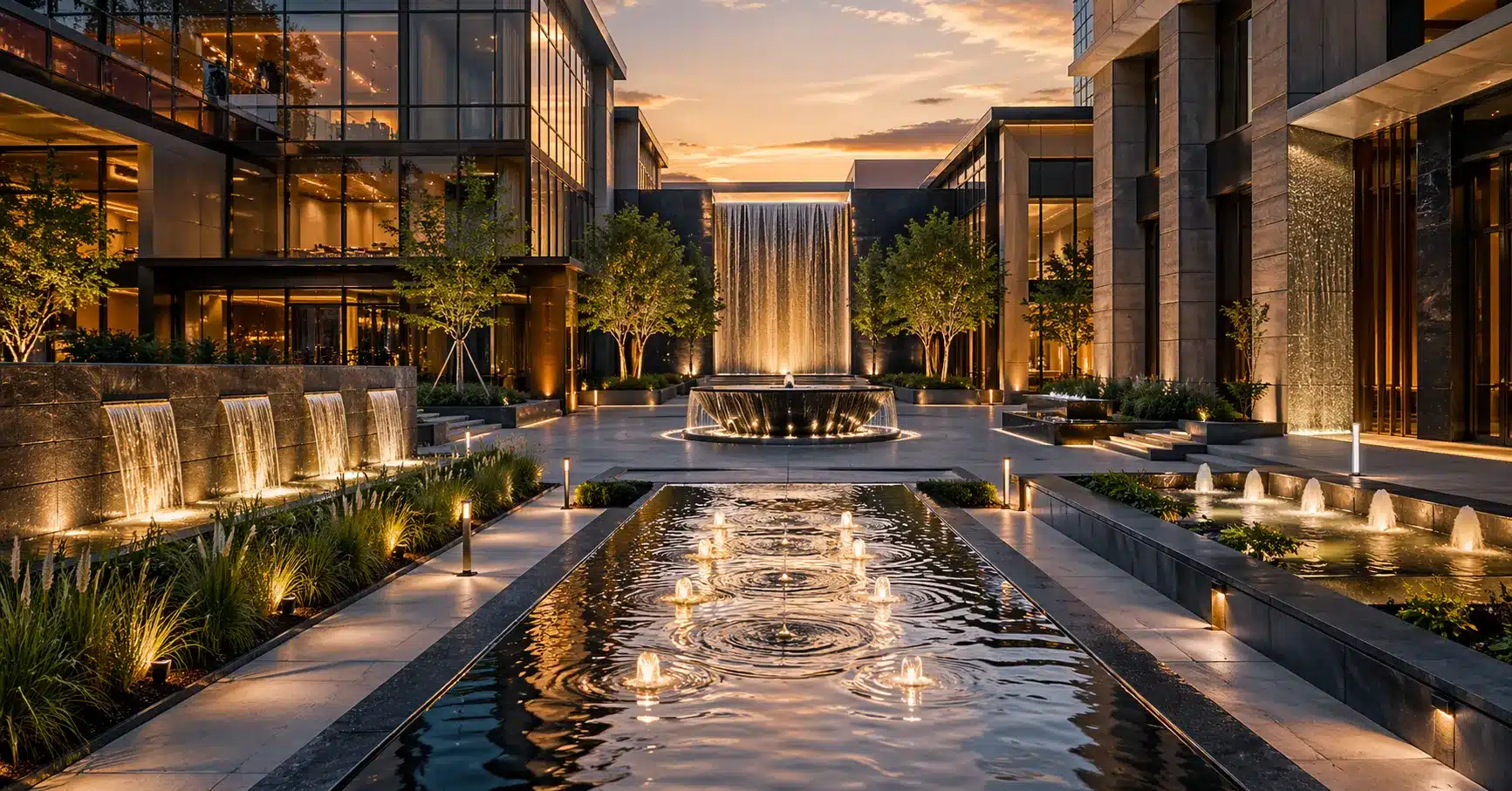
In large-scale developments, whether mixed-use complexes, corporate campuses, hospitality clusters, or residential communities, one challenge consistently rises to the surface: how do you make separate buildings feel like a single, cohesive place?
Architecture alone rarely solves this. Pathways guide movement, landscaping softens edges, and signage directs flow, but something more intuitive, more emotional, is often needed to unify the experience.
That’s where fountains come in.
More than decorative elements, fountains act as connective tissue. They shape movement, anchor identity, and create a shared sensory experience across otherwise disconnected structures. When thoughtfully designed, water features can stitch together multiple buildings into a seamless, memorable environment.
Let’s explore how.
The Role of Water in Spatial Connection
Water has a unique ability to guide human behavior without force. Unlike walls or barriers, it invites rather than restricts. A well-placed fountain can:
- Draw people toward a central axis
- Encourage lingering and interaction
- Provide visual continuity across distances
- Create landmarks that help with orientation
In multi-building developments, these qualities become incredibly valuable. Instead of relying solely on corridors, signage, or hardscape transitions, developers can use outdoor water fountains to subtly connect spaces in a way that feels natural.
Think of water as a thread, sometimes visible, sometimes implied, running through the entire development.
Creating a Unified Identity Across Buildings
One of the biggest risks in multi-building projects is fragmentation. Each structure may have its own architectural style, tenant identity, or functional purpose. Without a unifying element, the development can feel disjointed.
Fountains solve this by introducing a consistent design language.
Repetition with Variation
Instead of one large feature, many developments use a series of fountains:
- A grand entry fountain at the main plaza
- Smaller garden fountains along pedestrian pathways
- Vertical wall fountains near building entrances
- Interior indoor water fountains in lobbies
Each element differs in scale and function but shares materials, water behavior, or lighting style. This creates cohesion without monotony.
Signature Water Motif
Some developments go further by incorporating a signature water expression—like a rain curtain fountain or cascading linear streams, repeated in different forms throughout the property. This becomes part of the brand identity.
Visitors may not consciously recognize the pattern, but they feel the continuity.
Guiding Movement Through Water
In large developments, wayfinding is everything. People need to intuitively understand where to go, without constantly checking signs.
Fountains can act as directional cues.
Linear Water Features
A long, narrow water element can guide pedestrians along a primary route. This could take the form of:
- A shallow reflecting channel
- A series of synchronized jets
- A modern rain curtain water feature integrated into a walkway
These features subtly pull people forward, creating a sense of progression.
Nodes and Gathering Points
At key intersections, larger outdoor fountains can serve as hubs. These act like punctuation marks in the spatial narrative:
- “Meet me by the fountain” becomes a natural phrase
- Visitors use them as mental anchors
- Movement slows, encouraging interaction
This combination, linear flow plus nodal gathering, creates a rhythm across the site.
Enhancing Transitions Between Indoor and Outdoor Spaces
Multi-building developments often involve constant transitions: exterior plazas, interior lobbies, semi-covered corridors, and open-air courtyards.
Fountains can smooth these transitions.
Threshold Design
Placing wall fountains or vertical water features near entrances creates a sensory bridge:
- The sound of water signals arrival
- Visual movement draws attention inward
- Temperature and humidity subtly shift
Inside, indoor fountains continue the experience, maintaining continuity between environments.
Interior Continuity
In high-end developments, water doesn’t stop at the door. Instead, it evolves:
- Exterior jets transition into interior reflecting pools
- Outdoor cascades become indoor floor fountains
- Open-air features inspire sculptural tabletop fountains in lounges or waiting areas
This continuity reinforces the idea that all buildings belong to a single ecosystem.
Social Connectivity: Designing for Interaction
Beyond physical connection, fountains foster social interaction.
Natural Gathering Spaces
People are drawn to water. It’s instinctive.
In multi-building environments, this translates into:
- Informal meeting points
- Rest areas between destinations
- Spaces for events or performances
A well-designed fountain plaza becomes the heart of the development.
Multi-Sensory Engagement
Fountains engage multiple senses:
- Sight: movement, reflection, light
- Sound: masking noise, creating calm
- Touch: mist, proximity, cooling effect
This multi-sensory experience encourages people to stay longer—and return more often.
Environmental and Microclimate Benefits
In large developments, especially in warm climates, outdoor comfort is critical. Fountains contribute in subtle but meaningful ways.
Cooling Effects
Evaporation from outdoor water fountains can reduce ambient temperature in surrounding areas. While not a replacement for mechanical cooling, it enhances comfort in plazas and walkways.
Noise Management
Water sound can mask unwanted noise from traffic, HVAC systems, or crowds. This is especially useful in dense, multi-building settings.
Visual Softening
Hard architecture, glass, steel, concrete, can feel imposing. Water introduces movement and softness, balancing the environment.
Designing at Different Scales
The effectiveness of fountains as connective tissue lies in their scalability.
Macro Scale: Landmark Features
Large, iconic fountains establish identity:
- Central plaza installations
- Entry features visible from a distance
- Signature sculptural water elements
These define the development as a whole.
Meso Scale: Pathway Features
Mid-sized fountains connect buildings:
- Courtyard features
- Linear channels
- Clustered jet arrays
They guide movement and create continuity.
Micro Scale: Intimate Elements
Smaller features add detail:
- Tabletop fountains in shared lounges
- Compact indoor water fountains in reception areas
- Decorative garden fountains in pocket spaces
These reinforce the water narrative at a human scale.
Material and Design Consistency
For fountains to truly connect multiple buildings, consistency in design is key.
Materials
Using similar materials across all water features creates visual unity:
- Stone or concrete finishes
- Stainless steel or bronze accents
- Glass panels for rain curtain fountains
- Lighting
Lighting plays a major role in nighttime cohesion:
- Matching color temperatures
- Coordinated lighting sequences
- Subtle illumination that highlights water movement
- Water Behavior
Even the way water moves can be consistent:
- Gentle cascades
- Vertical sheets
- Rhythmic jets
This creates a recognizable “language of water” throughout the site.
Case Scenarios: Where This Approach Shines
Mixed-Use Developments
Retail, office, and residential buildings often coexist. Fountains help unify these diverse functions into a single experience.
Corporate Campuses
Large campuses benefit from water features that guide employees between buildings while creating moments of relaxation.
Hospitality Clusters
Hotels, convention centers, and entertainment venues can use fountains to create a sense of arrival and continuity.
Residential Communities
In multi-building housing developments, outdoor fountains and shared water features enhance community identity and property value.
The Emotional Impact of Water
Beyond function and design, fountains tap into something deeper.
Water is universally associated with:
- Calm and relaxation
- Movement and life
- Reflection and contemplation
In a multi-building development, this emotional layer becomes the glue that holds everything together. It transforms a collection of structures into a place people feel connected to.
Strategic Placement: The Key to Success
Not every fountain needs to be large or complex. What matters most is placement.
Entry Points
Set the tone immediately with a strong water feature at the main entrance.
Intersections
Use fountains where pathways meet to create natural gathering points.
Transitions
Place features at thresholds between indoor and outdoor spaces.
Hidden Moments
Include smaller, quieter water elements in less trafficked areas for discovery and retreat.
Balancing Impact and Practicality
While fountains offer immense benefits, they must be designed with practicality in mind:
- Efficient water management systems
- Durable materials suited to the environment
- Easy maintenance access
- Sustainable operation
Modern fountain design integrates technology to ensure long-term performance without compromising aesthetics.
Looking Ahead: The Future of Connected Design
As developments grow larger and more complex, the need for cohesive design strategies increases. Fountains will continue to play a vital role, not just as decorative elements, but as infrastructure for human experience.
We’re already seeing trends like:
- Interactive water features that respond to movement
- Integrated lighting and digital controls
- Hybrid indoor-outdoor installations
- Sculptural rain curtain water features that double as architectural elements
These innovations push fountains beyond ornamentation into the realm of experiential design.
Conclusion
In multi-building developments, connection is everything. Without it, even the most impressive architecture can feel fragmented.
Fountains offer a powerful solution.
They guide movement, unify design, enhance comfort, and create emotional resonance. From large-scale outdoor water fountains to intimate indoor fountains, each element contributes to a cohesive whole.
When designed thoughtfully, water becomes more than a feature, it becomes the thread that ties everything together.