Introduction: Where Movement Meets Stillness
Modern life is defined by flow, of people, information, traffic, and noise. Cities pulse, offices hum, homes multitask, and public spaces rarely rest. Yet within this constant motion, humans instinctively seek pause. We look for moments of calm that allow us to breathe, think, and reset. Increasingly, one of the most powerful design tools bridging these two needs, movement and rest, is water.
Fountains are more than decorative objects. Whether they appear as outdoor water fountains anchoring a plaza, indoor fountains softening a corporate lobby, or tabletop fountains bringing calm to a desk, they function as sensory buffers. They mediate between public and private, between noise and quiet, between speed and stillness.
This article explores how fountains and water features operate as sensory thresholds, subtle yet profound elements that transform how we experience space. From large-scale outdoor fountains guiding pedestrian flow to intimate indoor water fountains creating moments of pause, we’ll examine their psychological, acoustic, visual, and spatial impact. Along the way, we’ll also look at specific fountain types, wall fountains, rain curtain fountains, floor fountains, garden fountains, and more, and how each contributes uniquely to human-centered design.
Understanding Sensory Buffers in Spatial Design
Before diving into fountains specifically, it’s important to understand the concept of a sensory buffer.
A sensory buffer is any environmental element that absorbs, redirects, or softens sensory input. In architecture and landscape design, buffers help manage transitions: from loud to quiet, busy to calm, open to intimate. Common examples include trees, screens, lighting changes, and textured materials. Water, however, is uniquely effective because it engages multiple senses simultaneously.
Water features:
- Mask unwanted noise with natural sound
- Soften visual hardness with movement and reflection
- Regulate emotional states through rhythmic motion
- Signal transition zones without walls or barriers
Fountains accomplish all of this while remaining universally appealing. Humans across cultures and eras have gravitated toward water as a source of comfort, orientation, and meaning. In contemporary design, fountains reclaim this ancient role in highly intentional ways.
The Psychology of Water: Why Fountains Calm Us
Biophilia and the Human-Water Connection
Biophilia, the innate human affinity for nature, helps explain why water fountains have such a strong emotional impact. Flowing water signals safety, sustenance, and continuity at a subconscious level. Even in dense urban environments, a simple water feature can reconnect people to these primal cues.
Research consistently shows that exposure to water:
- Lowers cortisol (stress hormone) levels
- Improves focus and mood
- Encourages longer dwell times in public spaces
- Enhances perceived comfort and safety
This is why outdoor fountains are so often the heart of successful plazas, courtyards, and campuses. People naturally gravitate toward them, not necessarily to interact, but simply to be near.
Rhythmic Sound as a Mental Reset
The sound of water fountains plays a crucial role in their buffering effect. Unlike mechanical noise, water produces non-repetitive, organic sound patterns. This type of auditory input is known to be non-threatening and attention-restorative.
In practice, this means:
- Outdoor water fountains can mask traffic noise without silence
- Indoor water fountains can soften HVAC or office sounds
- Tabletop fountains can provide white-noise-like benefits in personal spaces
The result is not silence, but a gentle auditory envelope that allows the mind to relax without disengaging completely.
Fountains in Public Spaces: Guiding Flow Without Force
Outdoor Fountains as Spatial Anchors
In public environments, outdoor fountains often serve as visual and social anchors. They give people a reason to slow down, orient themselves, or gather. Unlike signage or barriers, fountains guide behavior indirectly.
A well-placed outdoor water fountain can:
- Define entrances and thresholds
- Mark central gathering points
- Separate circulation paths from resting zones
- Encourage lingering without congestion
Because fountains attract attention naturally, they help organize space without dictating it.
Creating Pause Within Movement
Transit hubs, shopping centers, and urban streetscapes are designed for flow—but even these environments benefit from moments of pause. Outdoor water fountains placed along pedestrian routes act as micro-rest stops. People may not sit or stop entirely, but their pace changes. Their attention shifts. Their nervous system resets.
This is the essence of a sensory buffer: not stopping the flow, but softening it.
Private and Semi-Private Spaces: Fountains as Personal Sanctuaries
Indoor Water Fountains in Transitional Interiors
In offices, hotels, spas, and healthcare facilities, indoor fountains are often positioned in liminal zones, lobbies, corridors, waiting areas. These are spaces where people experience uncertainty, anticipation, or mild stress.
Indoor water fountains in these settings:
- Reduce perceived wait times
- Create a sense of hospitality and care
- Mask conversations for acoustic privacy
- Signal a shift from public to semi-private
Wall fountains are particularly effective here. Mounted vertically, they take up minimal floor space while creating a strong visual and auditory presence. The wall fountain becomes a calm backdrop, not an obstacle.
Tabletop Fountains and Micro-Environments
At the smallest scale, tabletop fountains bring the buffering effect of water into personal environments, desks, bedrooms, meditation corners. Though modest in size, their impact can be profound.
Tabletop fountains:
- Create a psychological boundary in shared spaces
- Support focus during work or study
- Enhance relaxation rituals at home
In open-plan offices or shared living environments, a small indoor fountain can serve as a portable pause, allowing individuals to reclaim a sense of personal space.
Outdoor Gardens: Where Nature and Design Merge
Garden Fountains as Emotional Centers
Garden fountains have long been central to landscape design, from classical courtyards to modern residential yards. In gardens, fountains do more than decorate—they shape experience.
A garden fountain:
- Establishes a focal point
- Encourages stillness and reflection
- Enhances biodiversity (birds, pollinators)
- Amplifies the feeling of enclosure and safety
In private gardens, outdoor fountains often mark the transition from the external world to a personal retreat. Crossing into a garden with a water feature feels like entering a different rhythm of time.
Layering Water Features for Depth
In larger outdoor environments, multiple water features can be layered to create a gradient of experience. A prominent outdoor water fountain may greet visitors, while subtler water elements, rills, wall fountains, or rain curtain water features, guide them deeper into quieter zones.
This layering reinforces the idea of fountains as buffers, each one slightly reducing stimulation and increasing intimacy.
Rain Curtain Fountains: Water as Architecture
Defining Space Without Walls
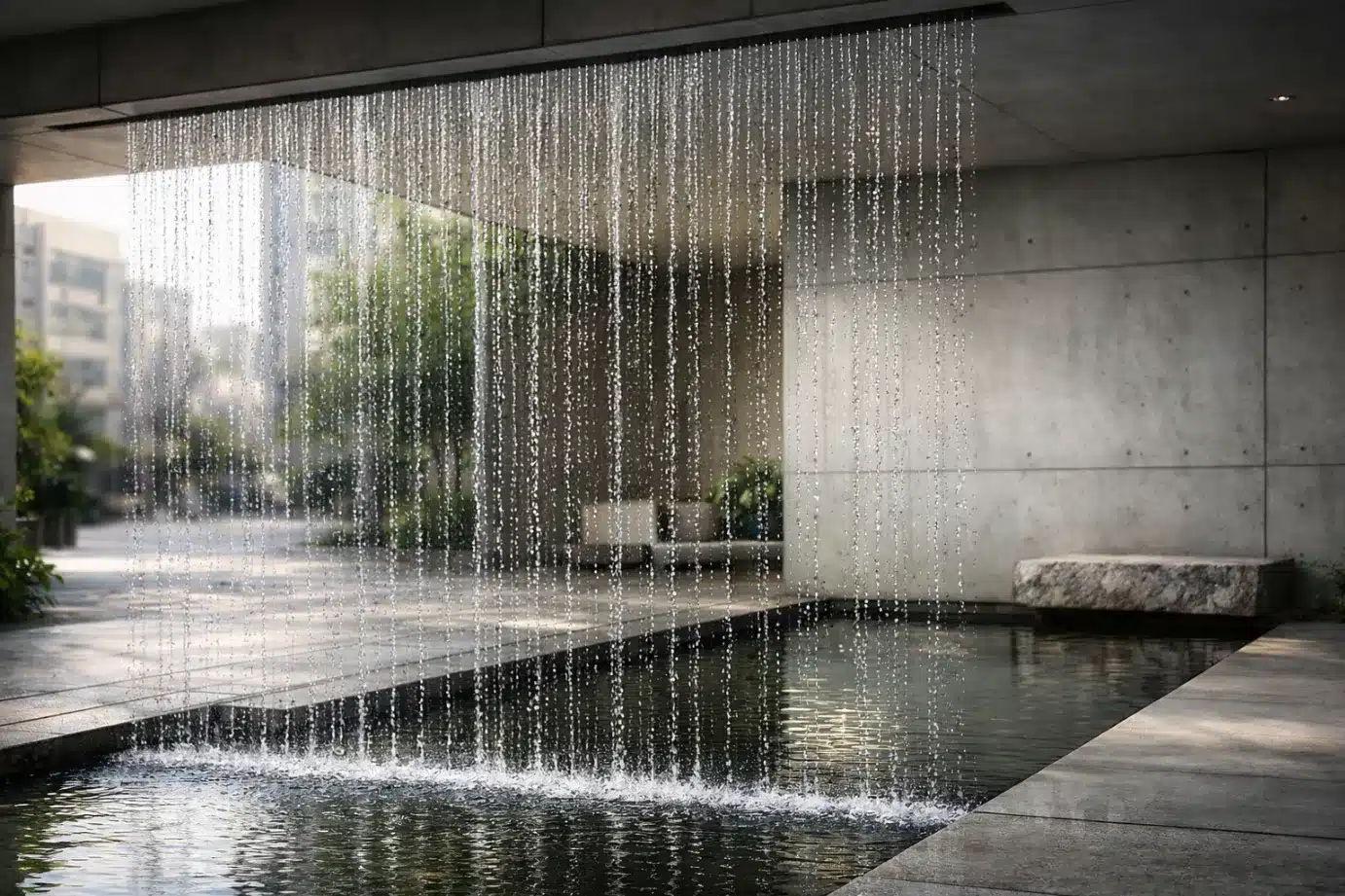
A rain curtain fountain is one of the most literal expressions of water as a sensory threshold. Falling sheets of water create a semi-transparent boundary, visible, audible, but permeable.
Rain curtain fountains and rain curtain water features are increasingly popular in:
- Hotel lobbies
- Corporate headquarters
- Museums and galleries
- Luxury residential spaces
They function as spatial dividers without closing off sightlines or airflow. Walking near a rain curtain fountain feels like approaching a different zone, even if you never cross through it.
Emotional and Symbolic Impact
Rain curtain water features evoke ritual, cleansing, and transition. They slow people down instinctively. In this way, they are powerful tools for marking entrances, meditation areas, or VIP zones, spaces where a pause is not just desired, but meaningful.
Floor Fountains: Movement Underfoot
Integrating Water Into Circulation
Floor fountains, often interactive or flush with walking surfaces, blur the line between circulation and experience. Unlike traditional fountains that sit apart from movement, floor fountains invite engagement.
In public plazas and cultural spaces, floor fountains:
- Encourage playful interaction
- Break monotony in large paved areas
- Create dynamic sensory experiences
- Signal shared, inclusive spaces
Designing for Safety and Flow
Well-designed floor fountains maintain accessibility and safety while still offering sensory richness. The sound and motion of water soften hard surfaces, making large spaces feel more human-scaled.
Indoor Fountains at Home: Designing for Daily Recovery
The Home as a Sensory Ecosystem
Homes are no longer just private, they are workplaces, gyms, classrooms, and sanctuaries. Indoor fountains help balance these competing roles by carving out zones of calm.
Indoor water fountains in residential settings can:
- Separate workspaces from living areas
- Support mindfulness and relaxation
- Improve indoor ambiance and air perception
Wall fountains in living rooms, indoor floor fountains in entryways, or small tabletop fountains in bedrooms all contribute to a layered sensory environment.
Creating Ritual Through Water
Daily rituals, morning coffee, evening wind-down, meditation, benefit from sensory cues. The sound and movement of water can anchor these rituals, making pause intentional rather than accidental.
Sustainability and Sensory Responsibility
Closed-Loop Systems and Modern Efficiency
Modern fountains are far more sustainable than many assume. Most contemporary water fountains operate on closed-loop systems, recycling the same water continuously. Energy-efficient pumps and smart controls further reduce environmental impact.
When designed responsibly, fountains can be:
- Low-water-use features
- Energy-efficient sensory tools
- Long-lasting architectural investments
Psychological Sustainability
Beyond environmental concerns, fountains support psychological sustainability, the long-term mental well-being of people who use a space. In an age of burnout and overstimulation, this is not a luxury, but a necessity.
Fountains as Silent Communicators
Perhaps the most remarkable quality of fountains is their subtlety. They do not demand attention, yet they hold it. They do not instruct behavior, yet they shape it. As sensory buffers, fountains communicate permission: permission to slow down, to linger, to breathe.
Whether through grand outdoor fountains in civic spaces, refined indoor fountains in professional environments, or intimate tabletop fountains at home, water features quietly negotiate the boundary between public flow and private pause.
In doing so, they remind us that good design is not just about movement or efficiency—but about humanity.