...
Airport-Fountain

Fountains in Airports: Designing Calm for Transitional Architecture

Airports are among the most complex architectural environments humans regularly experience. They are not destinations in themselves, yet millions of people pass through them every day carrying expectations, anxieties, excitement, fatigue, and urgency. This unique emotional cocktail is precisely why airports are often described as transitional architecture, spaces designed not for lingering, but for movement, flow, and transformation.

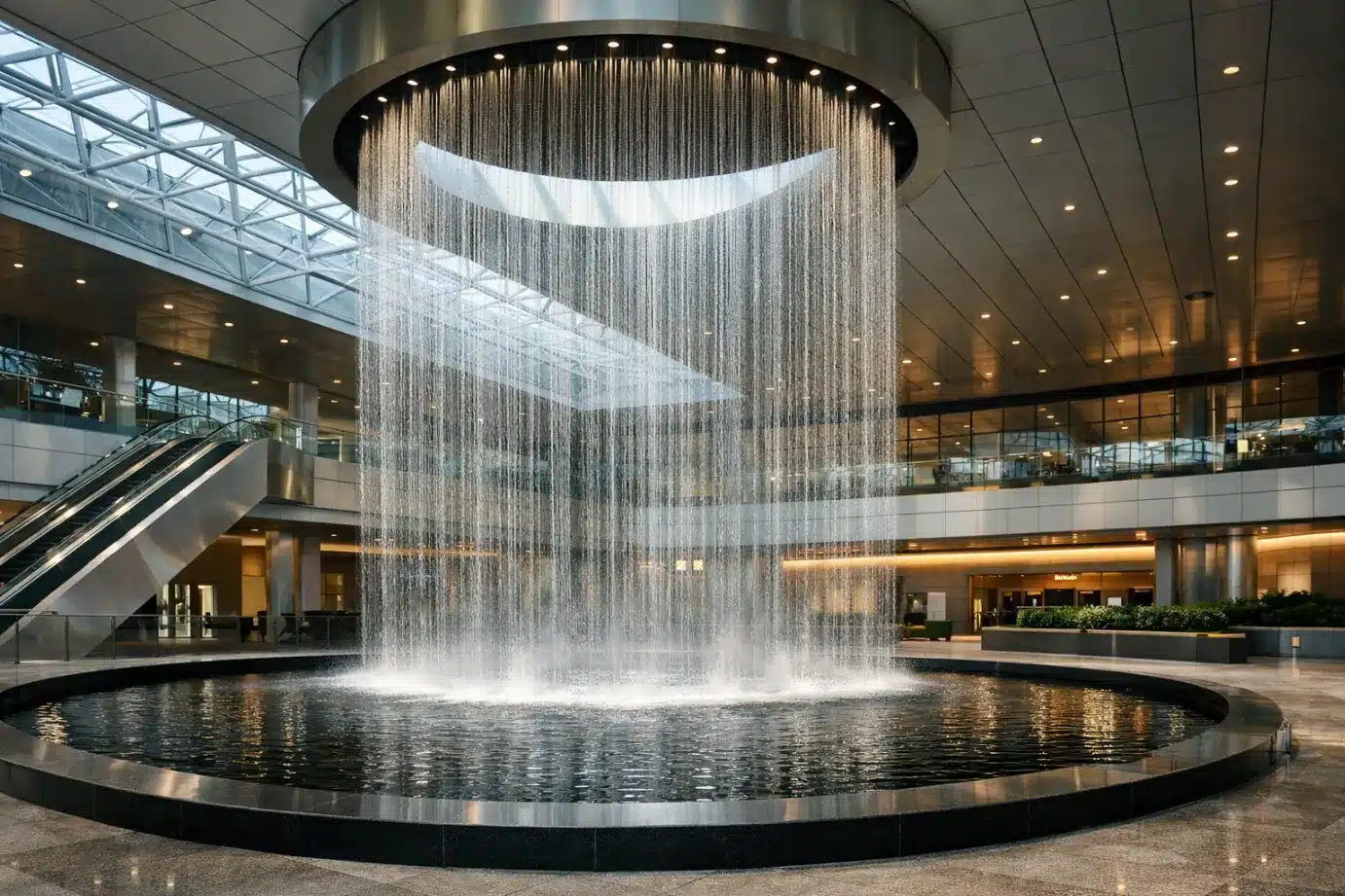
Within this context, fountains and water features play a surprisingly powerful role. Far beyond decoration, fountains in airports function as psychological anchors, acoustic buffers, spatial organizers, and even brand statements. Whether it’s a monumental indoor water fountain cascading through a terminal atrium or a subtle rain curtain water feature guiding passengers toward security, water introduces calm into an otherwise stressful environment.

This article explores how fountains, ranging from indoor fountains and wall fountains to rain curtain fountains and floor fountains, are thoughtfully integrated into airport design to create serenity, orientation, and emotional balance. We’ll also examine how principles from garden fountains, outdoor fountains, and even tabletop fountains inform large-scale public water features.

Airports as Transitional Architecture

The Emotional Landscape of Airports

Airports are:

  • Loud and acoustically chaotic
  • Visually dense with signage, screens, and advertising
  • Emotionally charged with stress, anticipation, and time pressure
  • Physically expansive and often disorienting

Passengers are constantly transitioning, from land to air, from public to secure zones, from waiting to rushing. This makes airports fundamentally different from museums, offices, or shopping centers.

The Need for Psychological Anchors

In transitional architecture, people subconsciously look for elements that provide:

  • Orientation – landmarks that help them understand where they are
  • Calm – moments of emotional decompression
  • Continuity – sensory consistency across large spaces

This is where water features and fountains excel.

Why Fountains Work So Well in Airports

Biophilic Design and the Human Nervous System

Biophilic design, the integration of natural elements into built environments, is proven to reduce stress, lower heart rates, and improve mood. Water, in particular, has a unique neurological impact:

  • The sound of moving water masks disruptive noise
  • Visual motion creates soft fascination, reducing mental fatigue
  • Reflections enhance light and spatial perception

In high-stress environments like airports, these benefits are amplified.

Acoustic Control Through Water Features

Airports are acoustically challenging due to:

  • Rolling luggage
  • Public announcements
  • Mechanical systems
  • Large crowds

Indoor water fountains and wall fountains introduce white noise that softens these harsh sounds. A rain curtain fountain, for example, creates a consistent acoustic veil that makes spaces feel quieter without actually reducing decibel levels.

Types of Fountains Commonly Used in Airports

Indoor Water Fountains as Central Landmarks

Large indoor fountains often serve as the heart of a terminal. These features:

  • Act as visual anchors in expansive halls
  • Provide intuitive meeting points (“meet me by the fountain”)
  • Reinforce architectural identity

Unlike small indoor fountains found in offices or homes, airport-scale indoor water fountains are engineered for durability, safety, and long operational hours.

Rain Curtain Fountain Installations

A rain curtain fountain is one of the most dramatic water features used in modern airports. Water falls in a continuous sheet, often from ceiling to floor, creating:

  • A visual barrier without physical obstruction
  • A sense of vertical connection across levels
  • A calming, meditative effect

These fountains are particularly effective in security transition zones, where passengers experience heightened anxiety.

Wall Fountains for Narrow Corridors

Wall fountains are ideal for:

  • Long corridors
  • Moving walkways
  • Transitional hallways between terminals

These fountains provide visual interest without consuming valuable floor space. Their linear design supports directional movement while still delivering the calming benefits of water.

Floor Fountains in Grand Atriums

Floor fountains, where water emerges directly from the ground plane, are often used in large atriums or pre-security plazas. These fountains:

  • Emphasize scale and openness
  • Create playful yet elegant visual rhythm
  • Encourage lingering without obstructing flow

In airports, floor fountains are carefully designed with non-slip surfaces and precise water control.

Outdoor Fountains and Arrival Experiences

The airport experience begins long before passengers enter the terminal.

Outdoor Water Fountains as First Impressions

Outdoor fountains at airport entrances establish emotional tone. They:

  • Signal arrival and departure
  • Provide a sense of place tied to regional identity
  • Offer visual relief in vehicle-heavy environments

Integrating Outdoor Water Fountains with Landscape Design

Outdoor water fountains are often combined with:

  • Native plantings
  • Sculptural elements
  • Seating and pedestrian pathways

This fusion transforms arrival zones from purely functional spaces into memorable civic landscapes.

Fountains in Airports

Wayfinding Through Water

Water Features as Spatial Guides

Humans instinctively remember landmarks better than signs. A distinctive fountain can:

  • Mark terminal entrances
  • Signal transitions between zones
  • Help passengers reorient after long walks

Unlike static signage, water features engage multiple senses, making them easier to remember.

Sequential Water Design

Some airports use a series of related water features—such as wall fountains leading to a central rain curtain fountain—to create a narrative path through the terminal.

Branding and Identity Through Fountains

Signature Water Features

Iconic fountains become synonymous with airports, much like famous sculptures in city squares. A well-designed indoor fountain can:

  • Appear in marketing materials
  • Become a social media landmark
  • Reinforce the airport’s design language

Cultural Storytelling

Water features often reflect local culture:

  • Desert airports may use minimalist water features emphasizing scarcity
  • Coastal airports may incorporate flowing, wave-like designs
  • Historic regions may reference traditional garden fountains

Sustainability and Water Management

Closed-Loop Systems

Most indoor fountains and water features operate on closed-loop systems that continuously filter and recirculate water.

Smart Controls

Advanced sensors adjust flow rates based on:

  • Time of day
  • Passenger volume
  • Ambient noise levels

Material Choices

Durable materials reduce maintenance and extend lifecycle, aligning fountains with long-term sustainability goals.

Lessons from Small-Scale Fountains

Tabletop Fountains and Human Scale

Tabletop fountains teach designers about:

  • Sound tuning
  • Flow rhythm
  • Visual balance

These principles scale up beautifully in large indoor fountains.

Garden Fountains as Emotional Precedents

Garden fountains demonstrate how water creates refuge, enclosure, and tranquility, qualities airports desperately need despite their size.

Future Trends in Airport Fountain Design

  • Interactive digital water features, including programmable rain curtains
  • Light-integrated fountains responding to movement
  • Seasonal or cultural programming
  • Wellness-focused fountains in quiet rooms, meditation zones, and biophilic lounges

Conclusion: Designing Calm in Motion

Airports will always be places of movement, urgency, and transition. But through thoughtful design, they don’t have to be places of stress. Fountains, whether monumental indoor water fountains, elegant wall fountains, immersive rain curtain fountains, or welcoming outdoor fountains, offer a rare ability to slow perception without slowing movement.

By engaging the senses, anchoring space, and soothing the nervous system, water features transform airports from purely functional infrastructures into humane, emotionally intelligent environments. In the architecture of transition, fountains are not luxuries, they are necessities.

FAQs:

Fountains reduce stress, improve acoustics, support wayfinding, and create memorable landmarks in complex, high-traffic environments.
Yes. Most modern airport fountains use closed-loop systems, smart controls, and efficient filtration to minimize water use.
Indoor water fountains, wall fountains, and rain curtain water features are especially effective due to their calming visuals and minimal spatial intrusion.