Introduction: When Water Becomes a Curatorial Medium
Museums are no longer quiet repositories of objects alone. They are immersive environments where architecture, sound, light, and movement work together to shape how visitors think and feel. In this expanded understanding of museum design, fountains and other water features have emerged as powerful yet understated tools. When thoughtfully designed, water does not distract from art or artifacts, it deepens contemplation, slows the pace of movement, and creates a sensory threshold between the outside world and the interior realm of reflection. Across cultures and centuries, water has symbolized memory, renewal, and time itself. Museums, as institutions dedicated to preserving human memory, are uniquely positioned to harness this symbolism. From monumental outdoor water fountains welcoming visitors at the entrance, to subtle indoor fountains tucked into quiet galleries, water has the capacity to transform how a space is perceived and experienced. This article explores how fountains in museums are designed, why they matter, and how different types, from wall fountains and floor fountains to the dramatic rain curtain fountain, contribute to contemplation rather than spectacle. Along the way, we’ll look at practical design considerations, psychological impacts, and emerging trends that are shaping the future of museum water design.The Psychological Power of Water in Cultural Spaces
Before diving into specific fountain types, it’s important to understand why water is so effective in museums.Water and the Contemplative Mind
Studies in environmental psychology consistently show that moving water has a calming effect on the human nervous system. The sound of flowing water masks distracting noise, lowers stress levels, and encourages slower, more deliberate movement. In museums—spaces often associated with cognitive engagement, this calming effect allows visitors to linger longer and engage more deeply with exhibits. Unlike music or spoken audio, water sound is nonverbal and culturally neutral. It supports contemplation without imposing narrative. This makes water fountains especially suitable for museums that serve diverse audiences.Temporal Symbolism
Museums deal with time: ancient pasts, modern moments, and imagined futures. Flowing water visually reinforces this temporal dimension. A rain curtain water feature, for example, can evoke the steady passage of time, while a still reflecting pool suggests preservation and memory. Designers often use these metaphors intentionally, aligning water movement with curatorial themes.Outdoor Fountains: The Threshold Experience
Outdoor Water Fountains as Spatial Anchors
The first encounter a visitor has with a museum often happens outside. Outdoor fountains and outdoor water fountains serve as visual anchors that signal entry into a special place. Unlike decorative plazas or purely sculptural elements, water introduces motion and sound that immediately differentiate the museum environment from the surrounding city. Large museums frequently integrate garden fountains into landscaped forecourts or sculpture gardens. These fountains help organize space, guide foot traffic, and provide areas for rest and reflection before or after a visit.Blending Landscape and Architecture
In museum campuses, outdoor fountains often act as mediators between architecture and landscape. A linear fountain aligned with a building axis can reinforce architectural order, while a naturalistic water feature may soften modern structures and make them more approachable. Importantly, outdoor water fountains in museums are rarely playful or interactive in the way civic fountains might be. Instead, they favor restrained movement, slow cascades, shallow rills, or mirrored surfaces, to support contemplation rather than excitement.Indoor Water Fountains: Quiet Presence, Powerful Impact
Why Museums Embrace Indoor Fountains
While outdoor fountains establish arrival, indoor water fountains shape the internal rhythm of the museum visit. They are often placed in atriums, transitional corridors, or meditation rooms, where visitors pause between galleries. Unlike outdoor installations, indoor fountains demand precision. Sound levels, humidity, lighting, and safety must all be carefully controlled. When done well, however, indoor water becomes almost architectural, an extension of walls, floors, and ceilings rather than a separate feature.Sound as Spatial Design
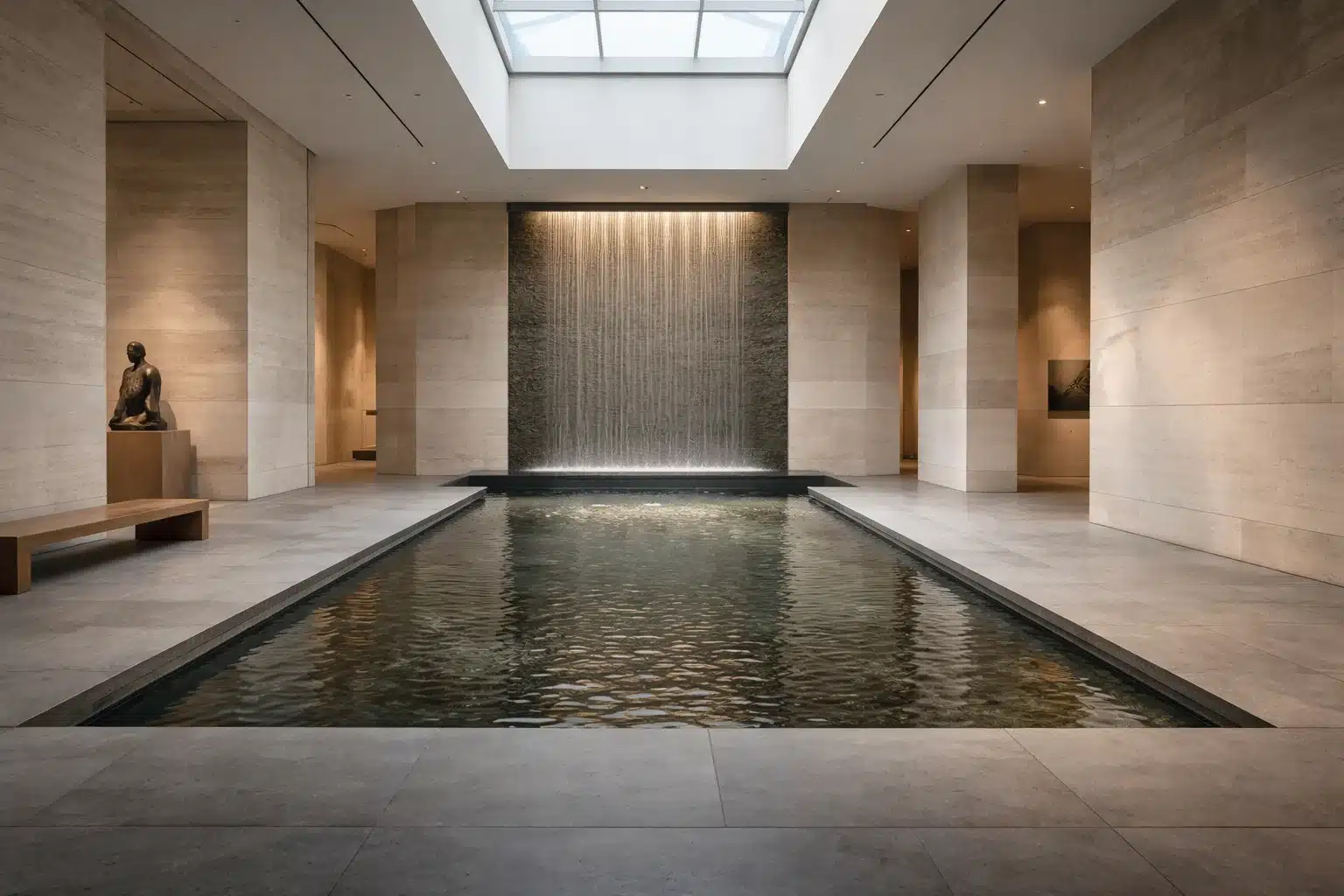
In large atriums, a vertical wall fountain can subtly modulate acoustics, absorbing echoes while adding a gentle auditory layer. In smaller spaces, a minimal basin with slow-moving water may be nearly silent, contributing visually without competing with nearby exhibits. Museums often avoid overly animated water indoors. Instead, designers favor laminar flows, thin sheets, or trickling surfaces that read as calm and intentional.Wall Fountains: Vertical Canvases of Flow
Architectural Integration
Wall fountains are among the most popular water features in museums because they integrate seamlessly with architecture. By treating water as a surface rather than an object, designers can create features that feel inherent to the building. Stone, glass, metal, and textured concrete are common substrates. Water flowing over these materials highlights their texture and materiality, reinforcing the museum’s architectural language.Narrative and Material Expression
In history or anthropology museums, wall fountains may incorporate inscriptions, symbolic patterns, or materials sourced from relevant cultures. In contemporary art museums, they often appear as minimalist planes, emphasizing light and movement over ornament. Because wall fountains are vertical, they take up minimal floor space—an important consideration in galleries where circulation and accessibility are paramount.Floor Fountains: Water at the Visitor’s Level

Grounded and Immersive
Floor fountains create a direct, physical relationship between visitors and water. Whether flush with the ground or slightly recessed, these fountains invite a sense of proximity that wall or ceiling-mounted features do not.
In museums, floor fountains are typically non-interactive but visually engaging. A shallow sheet of water across stone flooring can reflect light and architecture, subtly altering perception as visitors walk nearby.
Safety and Subtlety
Designing floor fountains in museums requires careful attention to slip resistance, drainage, and accessibility. As a result, these fountains tend to be understated. Their success lies in restraint, visitors may not immediately recognize them as fountains, yet still feel their calming presence.
Rain Curtain Fountains: Drawing with Water
The Drama of Controlled Movement
A rain curtain fountain or rain curtain water feature is one of the most visually striking options available to museum designers. Thin streams of water fall in parallel lines, creating a semi-transparent veil that can divide or define space without solid walls.
In museums, rain curtains are often used in entry halls or between thematic zones. They create a sense of transition, passing through or alongside the falling water marks a shift in narrative or mood.
Light, Shadow, and Symbolism
Rain curtain fountains interact beautifully with light. Natural daylight or carefully positioned artificial lighting can transform falling water into a shimmering surface that changes throughout the day.
Symbolically, rain curtains can suggest purification, passage, or revelation. When used thoughtfully, they become experiential moments that visitors remember long after leaving the museum.
Garden Fountains and Museum Courtyards
Outdoor Reflection Spaces
Many museums include internal courtyards or sculpture gardens that function as places of rest. Garden fountains in these spaces offer visual relief and reinforce the connection between art, nature, and contemplation.
Unlike civic garden fountains, museum versions often prioritize geometry and stillness. Rectangular pools, circular basins, or linear channels echo architectural forms and encourage quiet observation.
Seasonal and Environmental Considerations
Garden fountains must adapt to seasonal changes while maintaining aesthetic consistency. Museums increasingly favor water features that can operate year-round or transform gracefully in colder months, ensuring that outdoor spaces remain contemplative even when fountains are inactive.
Small-Scale Water Features: Tabletop and Intimate Fountains
Tabletop Fountains in Museum Settings
While tabletop fountains are more common in residential or office environments, they occasionally appear in museum libraries, staff areas, or small meditation rooms. Their scale allows for intimate engagement without dominating the space.
In educational or wellness-focused museums, tabletop fountains may be used in quiet zones to encourage mindfulness and focus.
The Value of Scale
Not every museum water feature needs to be monumental. Small-scale fountains demonstrate that contemplation is not dependent on size but on intention. Even minimal water movement can profoundly influence atmosphere when placed thoughtfully.
Water Features as Part of Sustainable Design
Responsible Water Use
Modern museums are acutely aware of sustainability. Contemporary water fountains are designed with recirculating systems, efficient pumps, and filtration technologies that minimize water waste.
Rainwater harvesting and greywater reuse are increasingly common, allowing outdoor fountains to operate with minimal environmental impact.
Water and Climate Adaptation
As museums respond to climate change, water features are being reconsidered not just as aesthetic elements but as microclimate tools. Outdoor water fountains can help cool surrounding areas, while indoor fountains may assist with humidity control when properly engineered.
Collaboration Between Curators, Architects, and Fountain Designers
Beyond Decoration
In successful museum projects, fountains are not afterthoughts. They are conceived early in the design process, with input from curators, architects, engineers, and fountain specialists.
This collaboration ensures that water features align with curatorial narratives rather than competing with them. A fountain may echo the themes of an exhibition, mirror the geometry of display cases, or reinforce circulation patterns.
Customization Over Catalog Solutions
Museums rarely rely on off-the-shelf fountain designs. Custom indoor water fountains, wall fountains, and rain curtain systems allow for precise control over scale, sound, and appearance, critical factors in contemplative environments.
The Future of Fountains in Museums
As museums continue to evolve, so too will their relationship with water. Digital integration, programmable flows, and responsive lighting are expanding the expressive potential of fountains. Yet the core principle remains unchanged: restraint.
The most effective museum fountains do not shout for attention. They whisper. They slow visitors down, create moments of pause, and support the quiet dialogue between viewer and object.
Whether through expansive outdoor fountains, serene indoor fountains, or innovative rain curtain water features, water will continue to play a vital role in shaping museum experiences, enhancing contemplation through movement, sound, and symbolism.
FAQs:
Fountains provide multisensory engagement, visual movement and calming sound, without imposing narrative. This makes them ideal for enhancing contemplation while respecting the primacy of exhibits.
Yes, when properly designed. Modern indoor fountains use controlled circulation, non-slip materials, and humidity management systems to meet strict museum safety and conservation standards.
Wall fountains and rain curtain fountains are among the most popular because they integrate seamlessly with architecture while offering strong visual and contemplative impact.