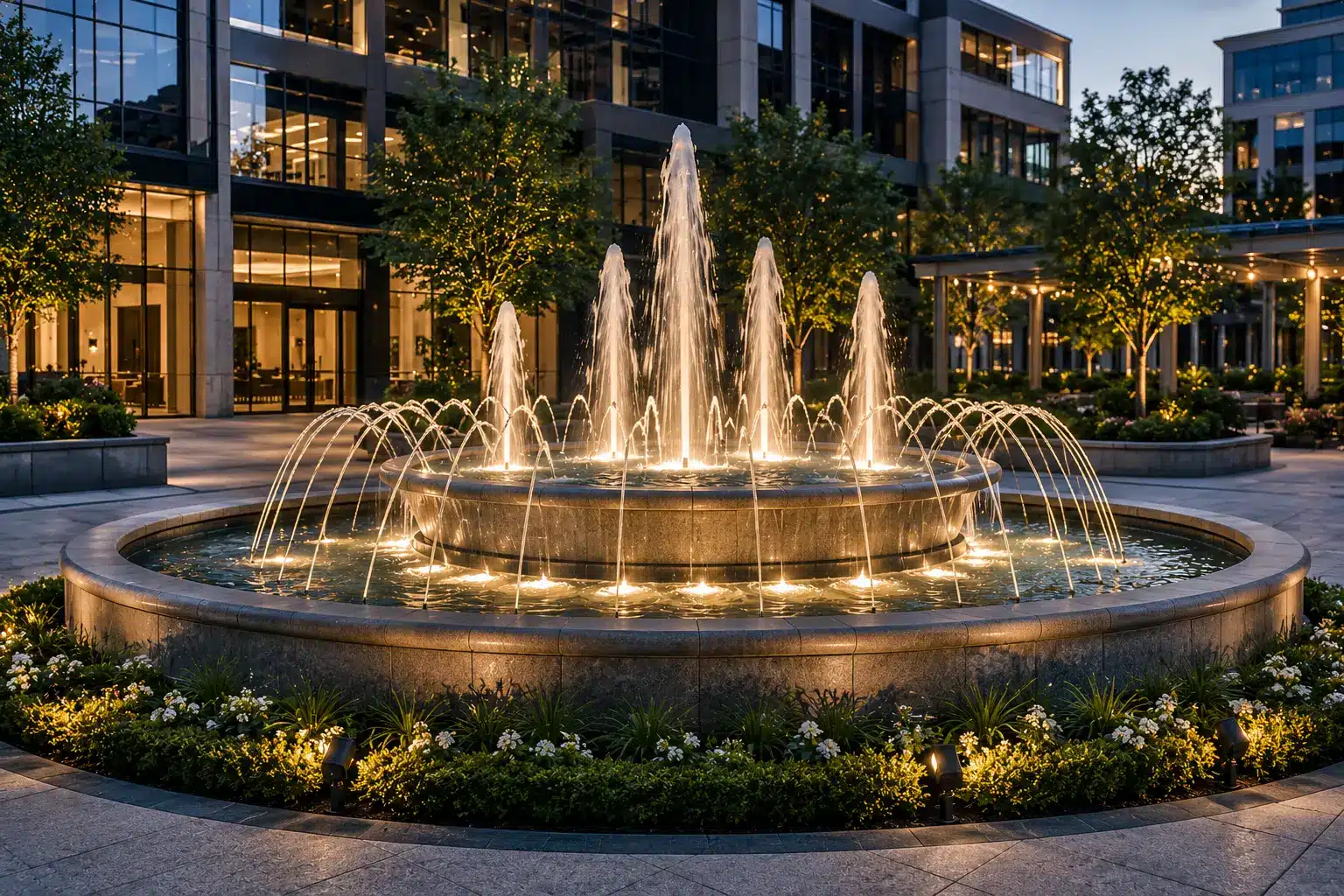
Water conservation is a key priority in modern commercial development. As industry professionals seek to reduce potable water use, greywater integration is becoming a preferred method for supplying make-up water to commercial fountain systems.
Commercial fountains lose water through evaporation, splash, overflow, and maintenance procedures such as blowdown. Traditionally, potable municipal water replaces these losses. Greywater systems provide an alternative by capturing water from sinks, showers, and laundry facilities, treating it to approved standards, and reusing it as non-potable make-up water.
When properly designed and permitted, greywater integration reduces freshwater demand, supports sustainability initiatives, and contributes to green building certifications such as LEED®, WELL, and SITES®. However, successful implementation requires more than connecting an alternative water source. Local regulations, treatment standards, plumbing design, water quality management, and long-term maintenance are all critical.
Many modern commercial fountains now include non-potable water connections, enabling owners to improve water efficiency while maintaining reliable performance and high water quality.
Quick Answer
Greywater integration uses treated non-potable water from sinks, showers, and laundry facilities to replace make-up water lost through evaporation, splash, and blowdown in commercial fountain systems. When permitted and properly treated, greywater can significantly reduce potable water use while supporting sustainability goals and green building certifications.
Greywater Integration at a Glance
Topic | Summary |
Water Source | Sinks, showers, bathtubs, laundry |
Primary Fountain Use | Make-up water only |
Treatment Required | Yes |
Potable Water Replacement | Partial or supplemental |
Regulatory Approval | Required |
Sustainability Benefit | High |
Typical Applications | Commercial developments, hotels, campuses, mixed-use projects |
Greywater systems do not replace the recirculating water inside the fountain. Instead, they replenish the water naturally lost during normal operation.
Is Greywater Right for Your Project?
Greywater reuse is not suitable for every commercial fountain. Feasibility depends on local regulations, greywater availability, building type, and project sustainability goals.
Project Type | Recommendation |
LEED-Certified Development | Excellent candidate |
Mixed-Use Commercial Property | Highly recommended |
Luxury Hotel | Excellent candidate |
Corporate Campus | Strong candidate |
Country Club | Case-by-case evaluation |
Small Decorative Fountain | Often unnecessary |
Projects with consistent greywater generation and large fountains typically achieve the greatest long-term benefits.
Why Greywater Matters
Freshwater resources are becoming increasingly valuable in many regions.
Population growth, prolonged droughts, stricter regulations, and rising utility costs have prompted commercial property owners to reconsider water use across their facilities.
While decorative fountains represent only part of a property’s water use, replacing potable make-up water with treated greywater can significantly contribute to conservation efforts.
Greywater integration offers several important benefits:
- Reduces potable water consumption
- Supports sustainable building design
- Helps achieve LEED®, WELL®, and SITES® credits
- Lowers long-term water costs
- Demonstrates environmental responsibility
- Improves water resilience during drought conditions
- Supports ESG (Environmental, Social, and Governance) initiatives
As sustainability expectations evolve, many developers now consider greywater systems early in project planning instead of treating them as optional upgrades.
What Is Greywater?
Greywater is wastewater generated from non-toilet plumbing fixtures such as:
- Bathroom sinks
- Showers
- Bathtubs
- Laundry equipment
Unlike blackwater, which includes wastewater from toilets and kitchens, greywater typically contains lower levels of pathogens and organic contaminants.
However, untreated greywater is not suitable for commercial fountain use.
Raw greywater contains:
- Soap residues
- Hair
- Skin cells
- Organic matter
- Personal care products
- Bacteria
Without treatment, these contaminants quickly degrade fountain water quality, encourage biological growth, and pose health risks.
Properly treated greywater passes through several filtration and disinfection stages before entering the fountain’s make-up water system.
Understanding Fountain Make-Up Water
One common misconception is that greywater fills the entire fountain basin.
In practice, commercial fountains operate as closed-loop recirculating systems.
The same water continuously circulates through:
- Pumps
- Filters
- Piping
- Fountain nozzles
- Water treatment equipment
Only water lost through normal operation must be replaced.
These losses include:
- Evaporation
- Wind drift
- Splash
- Blowdown
- Routine maintenance
Greywater replaces only the lost volume, reducing reliance on potable water without altering fountain operation.
Many custom fountains for sustainable commercial developments include dedicated non-potable make-up water connections to support future greywater integration where allowed.
Planning Before Design Begins
Greywater integration should be addressed early in the design process.
Before specifying treatment equipment or plumbing connections, project teams should evaluate:
- Local plumbing regulations
- Health department requirements
- Municipal water utility policies
- Building greywater generation rates
- Fountain make-up water demand
- Sustainability certification goals
- Available equipment space
- Long-term maintenance capabilities
Addressing these factors early enables project teams to coordinate the greywater system within the overall building infrastructure, avoiding later retrofits.
Regulatory Requirements for Greywater Reuse
Regulatory compliance is the most important factor when designing a greywater system for a commercial fountain.
Unlike many building systems with consistent national standards, greywater regulations vary widely between states, counties, municipalities, and local water authorities.
Some jurisdictions actively encourage non-potable water reuse, while others restrict or prohibit the use of greywater for decorative fountains altogether.
Before beginning design, project teams should obtain written guidance from:
- Local plumbing authorities
- Health departments
- Building officials
- Water utilities
- Environmental agencies (where applicable)
Assuming greywater is permitted because it is used elsewhere can lead to costly redesigns or permit delays.
Successful projects start with regulatory confirmation, not equipment selection.
How a Greywater System Works
A commercial greywater system follows a carefully controlled treatment process before supplying make-up water to a fountain.
A typical system includes the following stages:
- Greywater Collection
Water is collected from approved fixtures, including:
- Bathroom sinks
- Showers
- Bathtubs
- Laundry facilities
Kitchen wastewater and toilet waste are excluded because they are classified as blackwater.
- Primary Treatment
Collected greywater passes through screening and settling equipment that removes:
- Hair
- Lint
- Sand
- Large debris
- Suspended solids
Removing coarse material protects downstream equipment and improves overall system efficiency.
- Secondary Treatment
Biological and filtration processes further improve water quality.
Common technologies include:
- Membrane Bioreactors (MBR)
- Sand filtration
- Cartridge filtration
- Media filtration
These systems reduce:
- Biological Oxygen Demand (BOD)
- Total Suspended Solids (TSS)
- Turbidity
- Tertiary Treatment
Before entering the fountain make-up system, greywater undergoes final disinfection.
Typical methods include:
- Ultraviolet (UV) sterilization
- Chlorination
- Ozone treatment
- Combined UV and chlorine systems
These processes reduce bacteria and pathogens to levels required by local regulations.
- Storage and Distribution
After treatment, water is stored inside dedicated non-potable storage tanks.
These tanks must display permanent labeling such as:
NON-POTABLE WATER
DO NOT DRINK
The treated water is supplied only to the fountain make-up water connection through a separate piping system.
Water Quality Standards
Greywater treatment must consistently produce water that meets local regulatory requirements.
Although standards vary by jurisdiction, common performance targets include:
- Low turbidity
- Reduced Biological Oxygen Demand (BOD)
- Low Total Suspended Solids (TSS)
- Pathogen reduction
- Consistent disinfectant residual where required
Routine laboratory testing and water quality monitoring ensure ongoing compliance.
Many commercial fountains using non-potable water maintain enhanced monitoring programs in addition to standard water treatment.
Cross-Connection Prevention
Protecting the potable water supply is the top safety priority in any greywater installation.
Greywater piping must remain permanently separated from potable water systems.
Proper cross-connection protection includes:
- Separate piping systems
- Purple identification piping is required where indicated.
- Permanent non-potable labeling
- Approved backflow prevention assemblies
- Air gaps are required.
- Routine inspections
- Cross-connection testing
Failure to maintain proper separation can introduce non-potable water into drinking water systems and create a serious public health risk.
For this reason, cross-connection prevention is a major focus during permitting and inspection.
Matching Greywater Supply to Fountain Demand
Not all buildings generate enough greywater to support a commercial fountain.
Successful system design starts with a water balance analysis.
Engineers evaluate:
- Daily greywater production
- Seasonal occupancy
- Daily fountain make-up demand
- Evaporation losses
- Blowdown volume
- Splash losses
- Storage requirements
For example, a building producing 600 gallons of treated greywater per day cannot reliably supply a fountain that requires 1,800 gallons of daily make-up water.
When greywater production cannot fully satisfy demand, potable water serves as a supplemental backup supply.
This hybrid approach ensures reliability and maximizes water conservation.
Example: Mixed-Use Commercial Development
A mixed-use office and retail development pursuing LEED Gold certification incorporated a greywater reuse system during initial construction.
Greywater collected from office restrooms and fitness center showers passed through:
- Membrane filtration
- UV sterilization
- Treated storage tanks
The treated water supplied about 70% of the plaza’s architectural fountain’s annual make-up water requirement.
The project reduced potable water consumption while supporting the owner’s sustainability objectives and contributing toward LEED Water Efficiency credits.
This example shows how coordination among architects, MEP engineers, and fountain specialists can successfully integrate greywater into a modern custom fountain installation.
Common Design Mistakes
Greywater systems require careful coordination from the earliest design stages.
Common mistakes include:
- Assuming greywater reuse is automatically permitted
- Undersizing treatment equipment
- Ignoring seasonal variations in water demand
- Poorly sized storage tanks
- Inadequate water quality monitoring
- Improper cross-connection protection
- No potable water backup
- Delaying regulatory consultation until permitting
Addressing these issues early reduces construction delays and improves long-term system reliability.
Sustainability and Long-Term Value
Greywater integration offers benefits beyond water conservation.
Properly designed systems help:
- Reduce potable water consumption.
- Lower utility costs
- Improve water resilience
- Support ESG initiatives
- Contribute toward LEED®, WELL®, and SITES® certifications
- Reduce environmental impact
- Demonstrate responsible resource management.
As water availability becomes a key design consideration, integrating alternative water supplies into commercial developments provides long-term operational and environmental benefits.
Planning for Future Water Resilience
Commercial developments are now designed with future water challenges in mind.
Population growth, climate variability, and changing regulations continue to increase pressure on municipal water supplies.
Planning greywater integration during initial construction allows buildings to adapt to future conservation requirements and avoid costly retrofits.
Many modern outdoor fountains now include dedicated non-potable water connections, providing flexibility if owners choose to install greywater systems in the future.
Work With Fountains.com
Each commercial development has unique sustainability goals, water availability, and regulatory requirements.
Successful greywater integration requires close collaboration among architects, MEP engineers, plumbing consultants, sustainability specialists, and fountain designers.
At Fountains.com, we help project teams assess the suitability of greywater integration and design fountain systems that operate safely, efficiently, and in compliance with codes.
Whether you are planning a sustainable mixed-use development, corporate campus, hospitality project, or civic plaza, our team can help integrate water-efficient solutions that support long-term performance.
Explore our:
Contact our team to discuss if greywater integration is the right solution for your next commercial fountain project.
Frequently Asked Questions
This depends on your state, county, and local municipality. Some jurisdictions permit treated greywater for decorative fountain make-up water, while others restrict or prohibit its use. Always obtain written approval before beginning design.
Typically, no. Greywater is used only as make-up water to replace losses from evaporation, splash, and blowdown. The fountain remains a closed-loop recirculating system.
Yes. Because treated greywater may contain more organic content than potable water, operators often increase water quality monitoring and adjust chemical treatment programs as needed.
Routine fountain maintenance is especially important when using alternative water sources.
Yes. In regions with high water costs or frequent evaporation losses, replacing potable make-up water with treated greywater can reduce long-term utility expenses and support sustainability objectives.
Most commercial systems include a potable water backup connection with approved backflow prevention devices. This ensures reliable fountain operation during periods of low greywater availability.
Key Takeaway
Greywater integration provides commercial fountain owners with an effective way to reduce potable water use while supporting sustainability goals and green building initiatives. When permitted and properly treated, greywater can safely replace make-up water lost through evaporation, splash, and blowdown without compromising fountain performance.
By evaluating regulations early, designing robust treatment systems, ensuring proper cross-connection prevention, and planning for long-term maintenance, architects, developers, and engineers can create commercial fountain installations that conserve water, reduce operating costs, and support resilient, environmentally responsible developments.