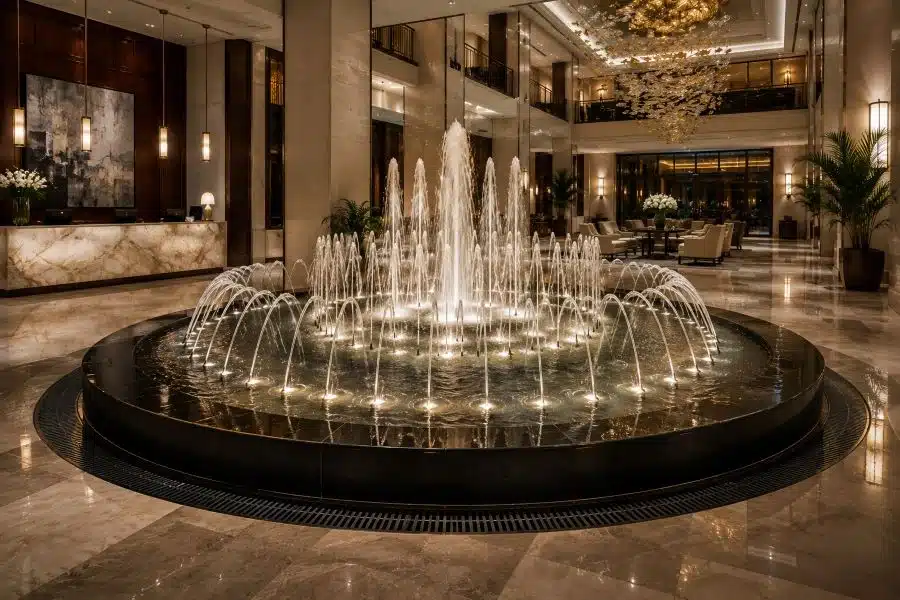
Commercial fountains are among the most technically demanding systems integrated into modern architecture and commercial construction.
Unlike decorative features, commercial fountain systems combine structural engineering, hydraulics, waterproofing, electrical coordination, controls integration, lighting, drainage, automation, and ongoing maintenance planning into a single operational architectural asset.
When fountain construction documents are poorly coordinated, the consequences often appear later during permitting, construction, commissioning, turnover, and facility operations. Across hospitality developments, mixed-use public plazas, civic environments, luxury resorts, retail destinations, and commercial campuses, incomplete commercial fountain specifications often result in RFIs, waterproofing remediation, inaccessible equipment vaults, hydraulic inconsistencies, excessive splash-out, drainage conflicts, delayed commissioning, and operational inefficiencies.
For architects, developers, landscape architects, and commercial project teams, properly coordinated fountain specifications are not simply documentation requirements. They function as risk-management tools that directly affect constructability, lifecycle cost, maintenance efficiency, operational reliability, and owner satisfaction.
Whether the project involves interactive plaza fountains, hospitality water features, engineered commercial fountains, or fully custom fountains, successful outcomes depend on early collaboration between architects, fountain engineers, structural consultants, MEP teams, waterproofing specialists, contractors, and operations stakeholders.
What Are Commercial Fountain Specifications?
Commercial fountain specifications are coordinated architectural, hydraulic, structural, electrical, waterproofing, controls, and operational requirements used to engineer, fabricate, install, commission, and maintain architectural fountain systems.
Comprehensive fountain construction documents typically include hydraulic calculations, pump schedules, equipment vault layouts, waterproofing assemblies, controls integration details, utility rough-ins, lighting specifications, commissioning procedures, and O&M documentation. The quality of these specifications often determines whether a fountain system performs reliably for decades or becomes a recurring operational liability.
Fountain Construction Document Checklist
Before issuing construction documents, project teams should confirm that all major coordination categories have been addressed.
| Category | Items to Include in Construction Documents |
|---|---|
| CSI Division Coordination | Applicable CSI divisions, specification ownership, cross-trade coordination notes |
| Waterproofing | Membrane systems, flood testing requirements, penetration detailing, warranty durations |
| Pumps & Mechanical Systems | Pump schedules, head pressure calculations, flow rates, redundancy requirements |
| Filtration & Water Treatment | UV systems, chemical treatment systems, autofill assemblies, overflow management |
| Controls & Automation | BMS integration, programmable fountain controls, automation sequences |
| Lighting | IP68 submerged lighting specifications, transformer locations, conduit routing |
| Structural Coordination | Dead-load calculations, slab penetrations, reinforcement coordination |
| MEP Coordination | Electrical loads, disconnects, make-up water, drainage coordination |
| Equipment Vaults | Vault dimensions, ventilation, drainage, maintenance clearances |
| BIM / CAD Coordination | Revit families, clash detection, sleeve coordination, utility rough-ins |
| Shop Drawings & Submittals | Hydraulic diagrams, finish samples, O&M manuals, equipment schedules |
| Commissioning | Startup procedures, balancing, testing, owner training |
For final website implementation, this checklist should use a responsive HTML table with strong heading hierarchy, alternating row spacing, and mobile optimization to improve usability and engagement.
Why Commercial Fountain Coordination Fails So Often
Fountain systems are frequently underestimated during early design phases because the visible architectural feature represents only a small portion of the infrastructure required for reliable operation.
During schematic design, project teams naturally focus on visual composition, plaza integration, material palettes, guest experience, and basin geometry. However, the systems hidden below grade often require significantly more coordination than anticipated.
A fountain basin that appears visually minimal above grade may conceal recirculating hydraulic systems, filtration assemblies, UV sanitation equipment, automation controls, overflow systems, drainage infrastructure, lighting transformers, ventilation systems, and dedicated equipment vaults.
In many mixed-use developments, utility routing conflicts emerge late in design when grease exhaust systems, parking ventilation, drainage piping, retail infrastructure, and fountain systems begin competing for limited below-grade space.
As a result, fountain systems are frequently compressed into undersized vaults, creating service limitations, maintenance access problems, and operational inefficiencies that persist throughout the life of the property.
This is one reason experienced fountain design-build teams are commonly engaged during schematic design rather than after architectural layouts are finalized.
What Separates Successful Commercial Fountain Projects From Problematic Ones
Successful fountain projects typically share several characteristics: early involvement of fountain engineers, coordinated waterproofing systems, accessible equipment vault layouts, accurate hydraulic calculations, integrated BIM coordination, realistic maintenance planning, and disciplined commissioning procedures.
Projects that struggle operationally often experience the opposite conditions, including late-stage coordination, incomplete waterproofing details, inaccessible filtration systems, undersized vaults, unrealistic maintenance assumptions, and poorly coordinated utility penetrations.
Many operational failures originate in decisions made during schematic design and construction documentation, rather than in the fountain equipment itself.
Why Developers Prioritize Fountain Coordination
Developers increasingly evaluate fountain systems not only for aesthetics, but also for operational cost, maintenance staffing requirements, waterproofing liability, energy efficiency, guest experience, and asset performance.
Poor coordination during design development frequently creates operational liabilities that continue affecting ownership groups and property management teams years after turnover.
Hospitality environments are particularly sensitive because fountain performance directly influences guest perception and overall property experience.
Why Architects Engage Fountain Consultants During Design Development
Architects increasingly engage fountain consultants early because commercial water feature design affects multiple building systems simultaneously.
Early fountain engineering coordination helps teams resolve slab depth requirements, hydraulic feasibility, splash management, waterproofing compatibility, utility routing, equipment vault sizing, lighting coordination, and maintenance planning before construction documents are finalized.
Projects such as hospitality developments, civic plazas, and mixed-use environments require especially careful coordination because hydraulic systems, drainage infrastructure, and waterproofing assemblies frequently intersect with structural and MEP systems.
In many resort and mixed-use developments, redesign exposure occurs late in the process because hydraulic and waterproofing requirements were not coordinated early enough during design development.
Recommended CSI Division Coordination
Commercial fountain systems rarely fit neatly into a single CSI division. Most architectural fountain systems require coordinated documentation across multiple disciplines.
| CSI Division | Scope |
|---|---|
| Division 03 | Fountain basin construction |
| Division 05 | Structural steel supports |
| Division 07 | Waterproofing systems and sealants |
| Division 22 | Plumbing and drainage |
| Division 23 | Mechanical systems |
| Division 26 | Electrical systems and lighting |
| Division 32 | Exterior improvements and utilities |
| Division 44 | Specialty fountain equipment |
Commercial fountain systems rarely fit neatly into a single CSI division. Most architectural fountain systems require coordinated documentation across multiple disciplines.Because fountain systems cross multiple trades, specification ownership should be clearly defined within the construction documents.
Responsibility should be coordinated for waterproofing interfaces, utility rough-ins, startup procedures, controls integration, commissioning coordination, testing requirements, final programming, and equipment certification.
Mechanical Systems and Fountain Hydraulics
Hydraulic coordination affects not only fountain performance, but also splash management, operational efficiency, equipment longevity, and maintenance accessibility.
Even visually simple decorative fountains depend on carefully balanced hydraulic performance. Improper calculations often lead to unstable water effects, inconsistent nozzle pressure, excessive splash-out, pump cavitation, high operating costs, premature equipment wear, and unstable laminar flow.
These issues are especially noticeable in precision metal fountains and stainless steel spillway systems, where even minor hydraulic inconsistencies are visually apparent.
What a Commercial Fountain Pump Schedule Should Include
A properly coordinated pump schedule should identify design flow rates, total dynamic head (TDH), operating pressure, motor horsepower, VFD requirements, redundancy requirements, maintenance clearances, electrical loads, startup sequencing, and acceptable noise limitations.
Hydraulic balancing should also account for wind exposure, evaporation, splash behavior, seasonal operation, nozzle consistency, and programmable water effects.
Fountain Equipment Vault Design Considerations
Equipment vaults are among the most overlooked aspects of commercial fountain specifications, yet they often determine the serviceability of the entire installation.
Poorly coordinated vaults commonly create inaccessible valves, difficult pump replacement conditions, inadequate drainage, excessive humidity, overheating, confined-space concerns, and difficult UV servicing access.
Many fountain maintenance problems originate not from fountain equipment failure itself, but from pumps, controls, and filtration systems concealed behind architectural finishes that were never properly coordinated for service access.
What Equipment Vaults Should Include
Commercial fountain equipment vaults should coordinate maintenance clearances, ventilation systems, floor drainage, humidity management, equipment removal paths, safe ladder access, lighting access, electrical separation, and future retrofit flexibility.
Large hospitality fountain systems increasingly require dedicated service zones that allow maintenance teams to work without disrupting guest-facing environments.
What Maintenance Access Should Architects Plan For?
Maintenance planning should address pump removal clearance, filter servicing access, UV maintenance access, ventilation access, waterproofing inspection areas, valve access, electrical panel clearance, autofill maintenance, and chemical treatment systems.
Some vaults are designed only around initial installation dimensions without considering how pumps, UV systems, filtration equipment, or controls will eventually be removed and replaced years later.
Poor maintenance access remains one of the most common causes of operational frustration in commercial fountain systems.
Waterproofing Requirements for Fountain Basin Construction
Waterproofing failures remain one of the most expensive remediation issues in commercial fountain construction.
Many leaks do not appear immediately during commissioning. Instead, they emerge months later due to structural movement, thermal cycling, maintenance access, waterproofing stress, and seasonal expansion and contraction.
Commercial fountain waterproofing should never be left to generalized contractor interpretation. Construction documents should clearly define approved membrane systems, compatible substrates, penetration detailing, expansion joint treatment, protection board requirements, flood testing procedures, and waterproofing warranty requirements.
Flood Testing Requirements
Flood testing should occur before finish materials are installed whenever possible.
Typical specifications require 24- to 72-hour flood testing, documented water-level measurements, independent inspection verification, photographic documentation, and clearly defined leak remediation procedures.
Waterproofing warranty requirements should also establish installer qualifications, approved application methods, repair responsibility, and coverage duration.
ADA, Accessibility, and Public Safety Coordination
ADA compliance and public safety coordination are frequently overlooked in decorative fountain systems.
Public-facing outdoor fountains should coordinate accessible circulation routes, slip-resistant paving, trench drain placement, flush transitions, wheelchair turning clearances, splash-zone management, nighttime visibility, and public safety lighting.
Projects such as civic plazas, hospitality environments, mixed-use developments, and interactive fountain installations require especially careful circulation planning because pedestrian traffic and splash conditions directly affect public safety and compliance with accessibility requirements.
Accessible circulation routes should remain unobstructed by splash patterns, uneven paving, protruding fountain edges, or drainage conflicts.
Programmable Fountain Lighting, Controls Integration, and Automation Systems
Most commercial fountain systems utilize IP68-rated submerged lighting designed for continuous underwater operation.
Construction documents should coordinate fixture locations, conduit routing, transformer placement, maintenance access, junction box locations, voltage requirements, programmable lighting controls, and DMX sequencing.
BMS Integration and Smart Fountain Controls
Modern fountain controls increasingly integrate with building automation systems (BMS), allowing facilities teams to remotely monitor pump status, water levels, energy usage, chemical alerts, filtration status, leak detection, automation faults, and lighting schedules.
Smart automation improves operational efficiency, diagnostics, maintenance visibility, seasonal scheduling, and lifecycle management.
This level of coordination is particularly important for hospitality developments and resort water features operating continuously in public-facing environments.
BIM, CAD, and Revit Coordination
Modern fountain design-build workflows increasingly depend on BIM coordination.
Large hospitality and mixed-use developments frequently require fountain systems to participate in federated BIM workflows to reduce clashes before construction begins.
Architects should coordinate fountain systems alongside BIM models, CAD details, Revit families, sleeve coordination, utility rough-ins, penetration schedules, equipment maintenance zones, and below-grade utilities.
Key BIM Coordination Areas
Equipment Vault Layouts
Vault dimensions should account for maintenance clearances, ventilation systems, drainage coordination, equipment replacement pathways, and retrofit flexibility.
Utility Coordination
Electrical conduits, drainage systems, and water supply lines should coordinate with structural reinforcement, slab penetrations, waterproofing transitions, and adjacent MEP systems.
Fountain Edge Coordination
Overflow edges, trench drains, and coping systems should align with architectural finishes, drainage slopes, plaza paving systems, and waterproofing assemblies.
Strong BIM coordination significantly reduces construction-phase RFIs, redesign exposure, field modifications, and coordination conflicts.
Common Commercial Fountain Specification Mistakes
Several coordination problems repeatedly appear across commercial fountain projects.
Undersized Equipment Vaults
Vaults often lack sufficient service clearance for pump replacement, filter servicing, UV maintenance, and access for automation.
Poor Splash Management
Improper hydraulic balancing frequently causes water migration onto adjacent paving and circulation areas.
Incomplete Waterproofing Notes
Missing penetration details and transition requirements remain common causes of persistent leaks.
Inaccessible Controls and Valves
Poor maintenance access creates operational inefficiencies that continue affecting facilities teams after turnover.
Unrealistic Maintenance Assumptions
Complex recirculating fountain systems require ongoing operational management and preventative maintenance planning.
Incomplete Pump Schedules
Missing hydraulic data frequently causes field adjustments and inconsistent performance during commissioning.
What Is Fountain Commissioning?
Fountain commissioning is the process of testing, balancing, calibrating, programming, and verifying fountain system operation before final project turnover.
Why Fountain Commissioning Often Fails
Commissioning is frequently compressed near project turnover, leaving insufficient time for hydraulic balancing, lighting programming, splash calibration, controls testing, water treatment setup, and operator training.
Common commissioning failures include inconsistent nozzle pressure, unstable water effects, untreated water conditions, automation faults, poor splash management, and lighting sequencing issues.
Successful commissioning should include startup testing, hydraulic balancing, control programming, lighting calibration, leak inspection, water treatment setup, owner training, and the delivery of a complete O&M manual.
Shop Drawings, Submittals, and O&M Documentation
Commercial fountain submittals should extend far beyond basic equipment cut sheets.
Typical submittal packages include fountain shop drawings, hydraulic diagrams, equipment schedules, lighting layouts, waterproofing compatibility documentation, structural coordination details, finish samples, and control system diagrams.
Why O&M Manuals Matter
Complete O&M manuals should include startup procedures, seasonal shutdown instructions, maintenance intervals, troubleshooting procedures, water chemistry requirements, spare parts lists, and emergency shutdown protocols.
This level of documentation is especially important for owners responsible for ongoing fountain maintenance planning.
FAQs:
Commercial fountain systems typically require coordination across multiple CSI divisions, including 03, 07, 22, 26, and 44, depending on project scope and office standards.
Comprehensive fountain construction documents generally include hydraulic calculations, pump schedules, waterproofing assemblies, equipment vault layouts, controls integration details, commissioning procedures, and O&M documentation.
A fountain equipment vault is a dedicated service space that houses pumps, controls, filtration systems, valves, UV systems, and the operational infrastructure required for commercial fountain systems.
Fountain consultants are most effective when engaged during schematic design or early design development before major structural, hydraulic, and waterproofing decisions are finalized.
Fountain commissioning is the process of testing, calibrating, balancing, programming, and verifying fountain system performance before final turnover.
Most commercial fountain waterproofing specifications require flood testing durations of 24 to 72 hours, depending on basin size and project requirements.
Maintenance access planning should address pump replacement, filtration servicing, valve access, ventilation, waterproofing inspection, electrical panels, and equipment removal pathways.
Yes. BIM coordination significantly improves clash detection, utility coordination, maintenance planning, and construction-phase efficiency for commercial fountain systems.
Real-World Coordination Example
A luxury mixed-use hospitality development planned a large rain curtain fountain integrated into a stone feature wall near the main lobby entrance.
During design development, the project team identified conflicts involving structural beam depths, drainage elevations, waterproofing transitions, conduit penetrations, maintenance access, and ventilation requirements.
Because these issues were identified before construction documents were finalized, the architect and fountain consultant were able to revise slab recess depths, relocate conduit runs, redesign waterproofing transitions, improve service access, and coordinate maintenance clearances before construction began.
The result included fewer RFIs, reduced change-order exposure, improved constructability, and significantly better operational access.
This type of early coordination frequently prevents problems that become exponentially more expensive during construction.
Long-Term Operational Reliability Depends on Documentation Quality
Commercial fountain systems are long-term operational assets.
Well-coordinated fountain systems reduce maintenance costs, energy consumption, equipment failures, water loss, operational downtime, and waterproofing risks.
Lifecycle planning should address equipment replacement access, automation upgrades, seasonal shutdown procedures, chemical management, filtration efficiency, maintenance staffing, and retrofit flexibility.
The most successful fountain systems are typically the result of early collaboration between architects, fountain engineers, waterproofing specialists, structural consultants, and maintenance stakeholders.
Early fountain engineering coordination frequently reduces RFIs, redesign exposure, waterproofing conflicts, and operational issues.
Proper commercial fountain specifications do more than support construction. They help protect operational reliability, owner satisfaction, and the project’s long-term architectural integrity.
Download the Fountain Construction Document Checklist
Architects, landscape architects, developers, and spec writers often benefit from maintaining a dedicated commercial fountain coordination checklist throughout design development and construction documentation.
A downloadable “Fountain Construction Document Checklist” PDF can help project teams coordinate:
- waterproofing requirements
- hydraulic systems
- equipment vault layouts
- MEP coordination
- BIM integration
- maintenance access
- commissioning procedures
This type of resource is particularly valuable for hospitality developments, civic plazas, mixed-use environments, and technically complex architectural water features.
Need Help Writing Commercial Fountain Specifications?
Fountains.com works with architects, landscape architects, developers, hospitality consultants, and commercial construction teams throughout the specification and coordination process for engineered water features and custom commercial fountains.
Our team assists with CSI specification language, preliminary fountain engineering, pump schedules, hydraulic calculations, waterproofing coordination, BIM coordination, equipment vault planning, shop drawings, construction-phase coordination, and commissioning planning.
Whether your project involves hospitality water features, civic plaza fountains, mixed-use developments, or large-scale architectural water features, early fountain coordination can significantly reduce construction risk while improving operational performance.
Fountains.com regularly collaborates with architects, landscape architects, hospitality consultants, and contractors to support the technical design of fountain systems from concept through turnover.
Contact Fountains.com to discuss fountain specification assistance, preliminary engineering coordination, or a custom fountain consultation.