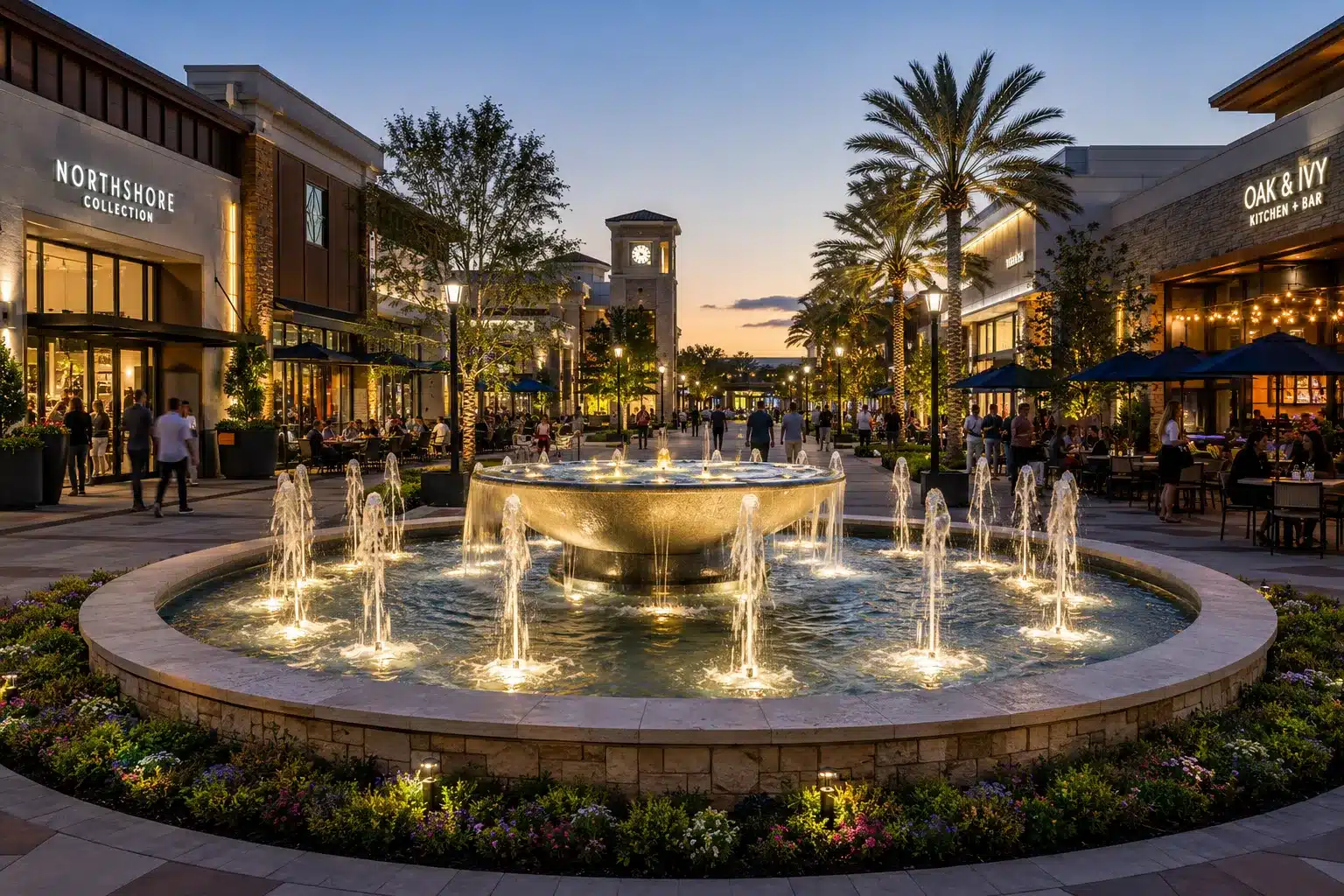
In large-scale commercial, hospitality, civic, and mixed-use developments, a key design challenge is ensuring visitors can navigate the site easily. People rely on visual cues to orient themselves and understand spatial connections, whether in a retail district, hotel campus, university, healthcare facility, corporate headquarters, or public plaza.
Signage, paving patterns, lighting, and architecture all aid navigation, but fountains are among the most effective placemaking and wayfinding tools. Well-placed water features create visual destinations, reinforce circulation routes, establish gathering spaces, and help visitors intuitively understand a site’s hierarchy.
Successful commercial fountains do more than enhance aesthetics. They organize movement, improve the visitor experience, strengthen destination identity, and support long-term placemaking goals.
In many award-winning developments, water features serve as core elements of public realm design, shaping how visitors experience, navigate, and remember a space.
Why Circulation Planning Matters
Successful circulation planning improves visitor experience, reduces confusion, increases dwell time, and strengthens the overall performance of a development.
When visitors can easily understand a site, they are more likely to explore, engage with businesses, stay longer, and develop positive impressions. Poor circulation planning leads to frustration, confusion, and missed engagement opportunities.
This challenge is greater in large mixed-use developments where retail, hospitality, residential, office, and entertainment uses intersect. Without clear spatial hierarchy, visitors often struggle to locate destinations and understand how areas connect.
Strategically positioned fountains address these challenges by serving as memorable landmarks that visitors use for orientation.
In large developments, fountains are key elements of public realm design, organizing movement and enhancing the visitor experience. When integrated into site planning, they serve as visual anchors that improve circulation efficiency and support placemaking objectives.
Quick Answer
Commercial fountains improve circulation by creating visual landmarks, reinforcing primary pedestrian routes, defining transitions between zones, highlighting decision points, and establishing arrival sequences. When incorporated early in site planning, fountains improve wayfinding, strengthen spatial hierarchy, and reduce reliance on directional signage.
Commercial Fountain Circulation Planning Checklist
Before finalizing fountain placement, evaluate:
✓ Primary pedestrian circulation routes
✓ Major arrival sequences
✓ Key decision points and intersections
✓ Gathering and social spaces
✓ Visibility from major entrances
✓ Accessibility and ADA compliance
✓ Daytime and nighttime visibility
✓ Maintenance access requirements
✓ Relationship to surrounding architecture
✓ Long-term placemaking goals
Projects that consider these factors early typically achieve better wayfinding and improved visitor experiences.
Benefits of Using Fountains for Wayfinding
Benefit | Result |
Improved Navigation | Easier visitor orientation |
Stronger Identity | Creates memorable destinations |
Reduced Signage Dependence | Supports intuitive wayfinding |
Enhanced User Experience | Combines function and aesthetics |
Acoustic Zoning | Helps separate activity areas |
Increased Dwell Time | Encourages gathering and interaction |
Stronger Placemaking | Reinforces destination identity |
Better Visitor Flow | Organizes movement patterns |
How Can Fountains Improve Circulation and Wayfinding?
Commercial fountains help organize pedestrian movement by creating visual landmarks, marking circulation axes, defining transitions between zones, highlighting decision points, and providing memorable orientation references.
Unlike traditional wayfinding systems, fountains engage multiple senses. Visitors notice movement, hear water, observe reflections, and recognize these landmarks from a distance.
Because fountains are easier to remember than many architectural elements, they often serve as the primary reference points people use when navigating unfamiliar environments.
For designers aiming to improve circulation and aesthetics, few site elements offer as much functional value as a strategically located water feature.
Water as an Axis Marker
One of the most effective uses of a fountain is as an axis marker.
When placed at the end or intersection of a primary circulation route, a fountain creates a visual destination that draws visitors forward.
A fountain at the end of a pedestrian corridor immediately organizes the visual field, establishes hierarchy, provides orientation, and signals a significant destination ahead.
This principle has been used throughout history, from Roman civic spaces to formal European gardens, because it aligns with fundamental human spatial behavior.
Today, large commercial fountains continue to serve as axis markers in mixed-use developments, civic plazas, hospitality properties, and corporate campuses.
Water Features as Arrival Markers
Arrival experiences are among the most important moments within any development.
Many successful projects position fountains at primary entrances, hotel drop-off areas, civic gathering spaces, and major public plazas. These installations immediately communicate arrival while establishing the character of the destination.
In hospitality developments, arrival fountains often define the guest experience before visitors enter the building. They help communicate luxury, sophistication, and a sense of place while strengthening destination branding.
A thoughtfully designed fountain becomes more than a water feature. It becomes part of the property’s identity.
Large outdoor fountains are particularly effective when aligned with primary sightlines, ensuring they remain visible from key approach routes.
Water Features as Social Anchors
Beyond directing movement, fountains naturally become gathering places.
Visitors frequently choose fountains as meeting points because they are visually distinctive, memorable, and easy to locate. This behavior is remarkably consistent across retail centers, civic spaces, hospitality environments, and mixed-use developments.
As a result, fountains often perform multiple functions simultaneously. They support navigation, encourage social interaction, and strengthen placemaking.
Many of the most successful developments intentionally position water features within gathering spaces because these installations naturally encourage visitors to pause, interact, and spend more time within the environment.
Large-scale custom fountains often become permanent landmarks that define a property’s identity for decades.
Fountains as Placemaking Tools
Beyond circulation and wayfinding, fountains play an important role in placemaking.
Successful developments are not remembered solely for their buildings or tenant mix. They are remembered for the experiences they create.
Commercial fountains help establish destination identity by creating memorable focal points that visitors associate with a specific location. A well-designed water feature can become a community gathering place, a social media backdrop, a meeting point, and a recognizable landmark that reinforces the overall character of a development.
For landscape architecture teams, fountains provide an opportunity to combine circulation planning, visual hierarchy, public realm design, and placemaking within a single design element.
Whether integrated into a civic plaza, hospitality environment, mixed-use district, or corporate campus, water features help transform ordinary spaces into memorable destinations.
Many developers use fountains as signature elements that support branding objectives while simultaneously improving visitor experience and navigation.
Water as a Zone Boundary
Beyond marking circulation axes, fountains can define transitions between spaces of different character and use.
A water feature positioned between two environments creates a threshold that visitors experience rather than consciously interpret. Unlike signs or paving changes, water engages multiple senses simultaneously, making transitions more memorable and intuitive.
A narrow rill crossing a pathway, for example, signals movement from one zone to another. Visitors instinctively recognize that they are entering a different environment even when no signage is present.
In retail environments, water features often mark the transition between public streets and curated shopping districts. In mixed-use developments, fountains may separate active public plazas from quieter residential or hospitality spaces.
This ability to create psychological boundaries without physical barriers is one reason water remains such a valuable site-planning tool.
Water as a Decision Point Signal
Large developments often create wayfinding challenges at major intersections where visitors must choose between multiple routes.
Positioning a fountain at these decision points creates a memorable landmark that helps visitors understand the circulation network and reconstruct their route later.
A fountain at a major intersection quickly becomes a reference point:
- Turn left at the fountain.
- Meet at the fountain.
- The restaurant is across from the fountain.
- The hotel lobby is behind the fountain.
These natural references improve navigation without increasing signage.
When planning fountain locations, designers should identify major circulation nodes early in the design process. These locations often provide the greatest wayfinding value and the strongest return on investment from a placemaking perspective.
In many mixed-use developments, circulation conflicts occur where retail, dining, hospitality, and residential uses intersect. Strategically placed fountains can help organize movement through these complex nodes while reducing confusion and improving overall pedestrian flow.
Why People Naturally Navigate Toward Water
Humans are naturally attracted to movement, sound, and visual contrast.
Moving water combines all three.
Environmental psychology research consistently demonstrates that people rely on distinctive landmarks when navigating unfamiliar environments. Water features often become the most memorable elements within a development because they engage multiple senses simultaneously.
Unlike static landscape elements, fountains continuously attract attention through movement, reflection, and sound. This makes them highly effective orientation points.
As a result, visitors frequently use fountains as meeting locations, navigation references, and destination markers without any instruction from designers or property managers.
For large developments where visitor orientation is critical, this natural attraction to water becomes a powerful planning advantage.
Water as an Acoustic Screen
Commercial fountains can also support circulation planning by creating acoustic separation between spaces.
In developments containing multiple uses, different zones often require different sound environments. Dining terraces, quiet courtyards, retail promenades, hospitality lounges, and public gathering spaces all have unique acoustic requirements.
Water features positioned between these zones help mask ambient noise while preserving visual openness.
A water wall, narrow cascade, or linear rill can significantly reduce the perceived levels of traffic noise, mechanical equipment noise, and crowd activity. This allows designers to create distinct spatial experiences without introducing walls or barriers that interrupt circulation.
Acoustic zoning is particularly valuable in dense urban developments where multiple uses occupy adjacent spaces.
This combination of circulation support and environmental comfort is one reason many developers view fountains as multifunctional investments rather than purely decorative amenities.
Example: Fountain Placement in a Mixed-Use Development
Consider a mixed-use development containing retail, restaurants, office space, residential units, and public gathering areas.
A central fountain at the intersection of the primary pedestrian routes serves as both a visual destination and a navigation tool. Visitors use it as a meeting point, retailers benefit from increased foot traffic, and first-time visitors quickly understand how the development is organized.
Additional water features can reinforce secondary circulation paths, define transitions between public and private spaces, and create gathering areas that encourage visitors to remain on-site longer.
When integrated early into site planning, custom fountains can reduce reliance on extensive wayfinding signage while strengthening the overall visitor experience.
Example: Hospitality Development
Hospitality projects provide some of the clearest examples of how fountains influence circulation and wayfinding.
A luxury hotel may position a fountain at the primary arrival sequence, creating an immediate visual destination that guides guests from the entry drive toward the lobby. The fountain establishes a sense of arrival while helping first-time visitors intuitively find their way.
Secondary water features can then reinforce circulation paths leading to restaurants, event spaces, spa facilities, and outdoor gathering areas. Because guests naturally orient themselves using memorable landmarks, fountains often become central reference points throughout the property.
In many hospitality developments, fountains contribute simultaneously to guest experience, wayfinding, destination branding, and placemaking. This combination of functional and experiential value makes them one of the most effective site-planning tools available to designers.
Where Should Fountains Be Located Within a Development?
Not every location delivers the same circulation value.
The most effective fountain locations typically include:
- Primary arrival plazas
- Main pedestrian axis terminations
- Major circulation intersections
- Civic gathering spaces
- Retail destination nodes
- Hotel drop-off zones
- Public courtyards
- Mixed-use transition areas
When evaluating potential locations, designers should prioritize visibility, pedestrian flow patterns, sightlines, accessibility requirements, and long-term maintenance access.
A strategically positioned fountain often delivers more value than a larger fountain located away from major circulation routes.
Integrating Fountains Into the Overall Wayfinding Strategy
While fountains can function as standalone landmarks, they are most effective when integrated into a comprehensive wayfinding strategy.
Architects and planners frequently coordinate water features with:
- Signage systems
- Landscape design
- Architectural focal points
- Lighting design
- Paving patterns
- Gathering spaces
- Primary entrances
This coordinated approach reinforces the site’s spatial hierarchy and helps visitors intuitively understand its organization.
Successful wayfinding rarely relies on a single element. Instead, it combines multiple environmental cues to create a cohesive visitor experience.
Designing for Spatial Legibility
For fountains to support circulation effectively, they must be spatially legible.
A fountain intended to terminate an axis must be visible from the approach route. A fountain intended to mark a decision point must be visible before visitors reach the intersection. A water feature intended to define a transition should clearly intersect the circulation path rather than run parallel to it.
Visibility, scale, orientation, and placement should all be evaluated during site planning.
Successful circulation planning requires close collaboration between architects, landscape architects, lighting designers, civil engineers, and fountain specialists.
Sightlines, accessibility requirements, nighttime visibility, maintenance access, and visitor behavior should all influence fountain placement decisions.
Projects that integrate fountain planning during schematic design typically achieve stronger outcomes than those that add water features after major circulation patterns have already been established.
Commercial Fountain Circulation Planning Checklist
Before finalizing fountain locations, evaluate:
✓ Primary pedestrian routes
✓ Major decision points
✓ Arrival sequences
✓ Gathering spaces
✓ Visibility from key entrances
✓ Accessibility and ADA compliance
✓ Daytime and nighttime visibility
✓ Maintenance access requirements
✓ Relationship to surrounding architecture
✓ Long-term placemaking goals
✓ Public realm design objectives
✓ Destination branding opportunities
Projects that address these considerations early typically achieve stronger navigation, improved visitor experiences, and more successful public spaces.
The Business Value of Spatially Strategic Fountains
For developers, fountains provide value that extends far beyond aesthetics.
A strategically placed fountain can improve navigation, strengthen placemaking, increase visitor comfort, encourage longer dwell times, and create memorable experiences that contribute to the overall success of a development.
Water features are among the most effective placemaking tools available because they create destinations that people naturally associate with a specific location.
In many large developments, commercial water features become signature landmarks that support both navigation and long-term placemaking goals. These installations often become recognizable visual assets that strengthen destination identity while improving the overall visitor experience.
Long-term success also depends on proper fountain maintenance planning. A well-maintained water feature continues to function as an effective landmark, gathering space, and placemaking element throughout its operational life.
The benefits extend to:
- Visitor engagement
- Tenant satisfaction
- Property perception
- Destination branding
- Social media visibility
- Public-space activation
- Community interaction
- Visitor retention
Many of the most successful developments use fountains as core components of their public-realm design strategies.
Many developments also use sculptural architectural water features as signature landmarks that support branding and wayfinding simultaneously. These installations often become defining visual assets for the property while helping visitors navigate large and complex environments more intuitively.
Large commercial fountains often become the most photographed and recognizable elements within a property.
Real-World Coordination Considerations
Successful fountain placement requires coordination across multiple disciplines.
On large mixed-use projects, circulation conflicts frequently emerge where retail promenades, hospitality zones, residential components, entertainment venues, and public gathering spaces intersect. Strategically positioned fountains often help visually organize these complex environments while preserving open sightlines and supporting intuitive navigation. This ability to improve spatial clarity without introducing physical barriers is one reason fountains remain valuable tools in contemporary site planning and landscape architecture.
Architects, landscape architects, civil engineers, lighting designers, accessibility consultants, and fountain specialists must evaluate how water features interact with pedestrian circulation, emergency egress routes, utilities, site drainage, accessibility requirements, maintenance access, and long-term operational needs.
For landscape architecture teams, fountains offer a unique opportunity to integrate circulation planning, visual hierarchy, destination branding, public realm design, and placemaking into a single feature.
Early coordination helps avoid redesigns and maximize the fountain’s functional value.
When fountains are considered late in the design process, opportunities to improve circulation and wayfinding are often lost. Conversely, projects that integrate fountain planning early often achieve stronger visitor experiences, more cohesive site organization, and better long-term performance.
Common Fountain Placement Mistakes
Many circulation-focused fountain projects underperform because the fountains are treated as decorative objects rather than navigation tools.
Successful wayfinding depends as much on placement as it does on fountain design. Even visually impressive water features can fail to support circulation objectives if they are positioned without considering sightlines, pedestrian movement patterns, and visitor behavior.
Common mistakes include:
- Positioning fountains outside primary pedestrian sightlines
- Locating water features behind dense landscaping or architectural obstructions
- Failing to coordinate nighttime visibility and lighting
- Ignoring accessibility and gathering-space requirements
- Placing fountains away from key decision points and circulation intersections
- Prioritizing aesthetics without considering visitor navigation
- Underestimating maintenance access requirements
Projects that avoid these mistakes typically achieve stronger wayfinding performance, better visitor experiences, and greater long-term placemaking value.
When fountains are planned as integral components of circulation strategy rather than standalone decorative features, they become significantly more effective tools for organizing movement and creating memorable destinations.
Work With Fountains.com
Early coordination often reduces redesign exposure, improves circulation outcomes, strengthens public realm design objectives, and helps maximize the long-term value of a fountain investment.
Fountains.com designs commercial, custom, and architectural water features that support both aesthetic and functional site-planning objectives.
We collaborate with architects, landscape architects, developers, planners, and design teams to integrate fountains into circulation strategies, arrival sequences, gathering spaces, and public realm design.
Our team helps incorporate commercial fountains into site planning, wayfinding strategies, placemaking initiatives, destination branding programs, and public-space design from the earliest stages of development.
Whether your project involves a mixed-use development, civic plaza, hospitality property, retail destination, university campus, healthcare facility, corporate headquarters, or residential community, we can help create water features that improve navigation, enhance the visitor experience, and strengthen the destination’s identity.
Explore our collection of outdoor fountains or contact our team to discuss your project goals.
Frequently Asked Questions
Fountains engage multiple senses through movement, sound, reflection, and visual prominence. Because they are easier to remember than many architectural elements, visitors naturally use them as orientation points.
Yes. Well-designed fountains encourage visitors to pause, gather, take photographs, socialize, and spend more time within a development.
Absolutely. Early planning allows circulation paths, utilities, sightlines, accessibility requirements, drainage systems, and maintenance access to be coordinated efficiently.
Ideally during schematic design. Early coordination produces better circulation outcomes, fewer redesigns, and stronger placemaking opportunities.
The fountain should remain clearly visible from the entry point of the circulation axis. The required size depends on the viewing distance, site scale, surrounding architecture, and landscape conditions.
Yes. Placement and sensory impact are often more important than scale. Even relatively small water features can effectively signal transitions between spaces.
Water features improve wayfinding by creating memorable landmarks that help visitors orient themselves, identify destinations, recognize decision points, and navigate large developments more intuitively.
While they do not eliminate the need for directional signs, fountains often reduce reliance on them by creating intuitive visual landmarks that visitors naturally remember.
Commercial fountains are particularly effective in mixed-use developments, hospitality properties, retail districts, civic plazas, university campuses, healthcare campuses, corporate headquarters, and large public spaces where visitors must navigate multiple destinations.
Large plaza fountains, reflecting pools, water walls, linear rills, interactive fountains, and custom architectural water features are among the most effective options.
Fountains support placemaking by creating memorable landmarks, encouraging social interaction, reinforcing destination identity, and contributing to the overall character of a development. They often become gathering places that strengthen visitor engagement and create lasting impressions.
Fountains are frequently used as focal points within public realm design because they help organize circulation, create gathering spaces, improve visitor comfort, reinforce visual hierarchy, and strengthen a development’s identity. Their ability to combine aesthetics, functionality, and wayfinding makes them valuable components of successful public spaces.