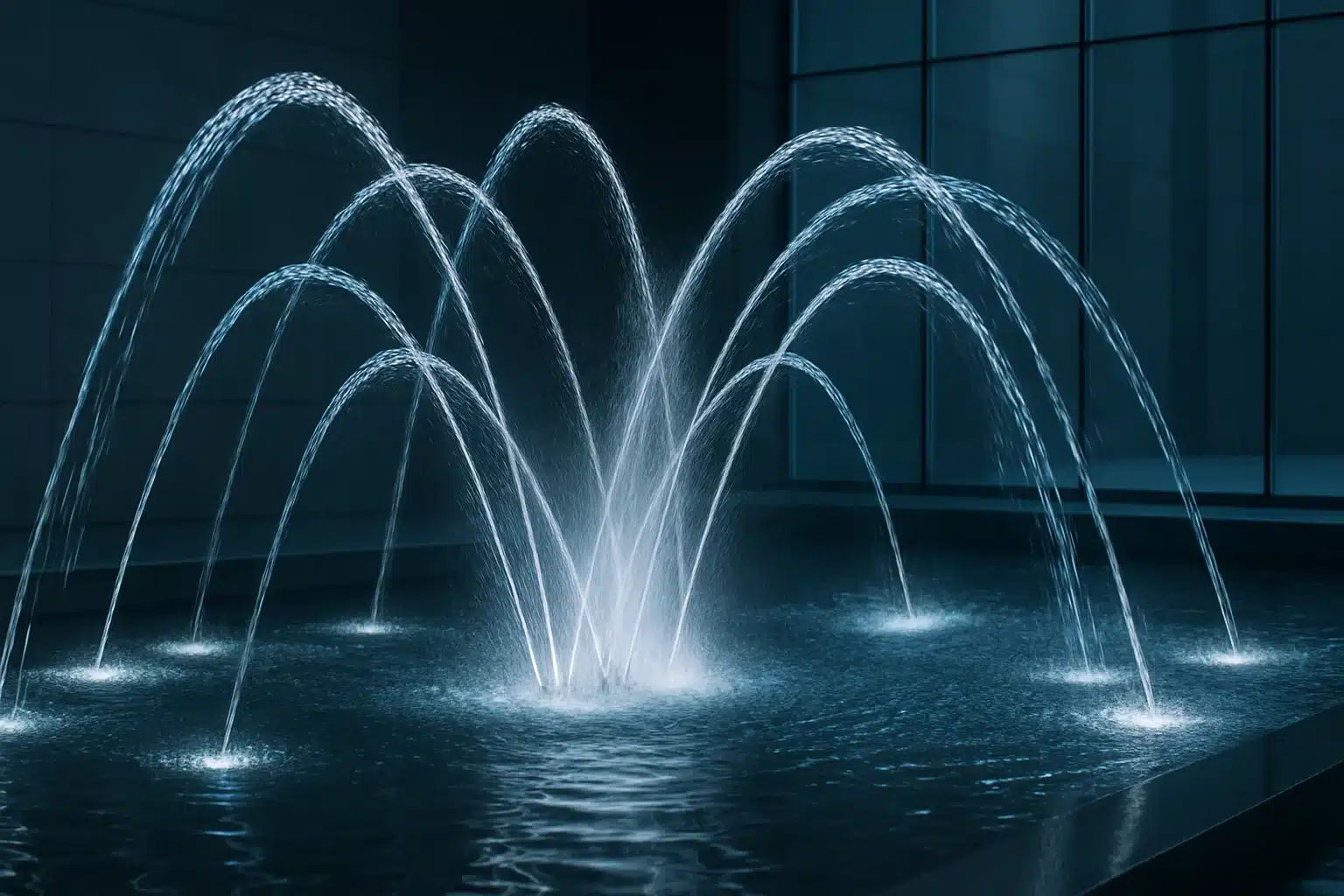
Water has always been a symbol of life, motion, and transformation. From ancient fountains etched in marble courtyards to futuristic water shows pulsing with LED light and synchronized jets, designers have long recognized something mesmerizing about moving water. But in recent decades, this fascination has evolved into an entirely new design language: kinetic poetry, the art of choreographing water as if it were a dancer.
In this long-form exploration, we’ll dive into how designers, architects, engineers, and technologists are transforming water into a dynamic storytelling medium. We’ll look at the tools that make it possible, the aesthetic philosophies that guide it, and the sensory experiences that bring people back to the water’s edge again and again. Whether it’s the swirling arcs of a public fountain, the hypnotic pulse of a water wall in a corporate lobby, or immersive installations that invite viewers to shape the flow with gestures, water is becoming both canvas and performer.
1. The Origins of Water Choreography: From Ancient Ritual to Modern Art
Though the technology behind today’s digital fountains and responsive water features is cutting-edge, the urge to choreograph water isn’t new at all.
In ancient civilizations, Egyptian, Persian, Roman, water displays were architectural marvels and social symbols. Fountains created simple arcs and cascades that brought beauty to public spaces. In Islamic garden design, water was used to reflect the heavens and create calm rhythmic sounds that guided meditative movement. In the Renaissance, fountains became grand gestures of power and craftsmanship, as seen in the elaborate water theatres of Italy.
But even these early works shared elements of choreography:
- Repetition and variation — water spouts arranged in patterns
- Rhythm — cascades and intervals
- Human interaction — paths designed for visitors to move with or around the water
Modern kinetic poetry embraces these same principles but adds something radically new: precision control and responsive intelligence, allowing designers to treat water like a programmable material.
2. What Is Kinetic Poetry? A Fusion of Art, Technology & Motion
Kinetic poetry goes beyond simple fountain displays. It treats water as a dynamic medium, shaped in real time through intentional patterns, cues, and narratives. Think of it this way:
If water is the dancer, then the designer is the choreographer, and technology is the stage manager that makes every motion possible.
At its core, kinetic poetry involves three distinct layers:
A. The Artistic Layer (The Concept)
This defines the emotional or experiential goals:
- Should the water feel playful or meditative?
- Should it mimic natural movement or defy expectations through geometric precision?
- Should it respond to passersby, light, or sound?
- Kinetic poetry is not merely about movement, it’s about meaning.
B. The Technological Layer (The Tools)
Modern designers have an expanding toolbox:
- Digital controllers allowing millisecond timing
- Programmable hydraulic pumps for varying pressure and height
- Valves that open and close like percussion instruments
- Sensors that track motion, temperature, or sound
- Projection mapping that blends visuals with water’s surface
- LED systems that illuminate each droplet
- These innovations transform water from a natural element into a programmable one.
C. The Spatial Layer (The Environment)
Water choreography doesn’t live in isolation. Designers shape the surroundings to enhance the experience:
- Architectural framing
- Materials that reflect or diffuse water
- Soundscapes
- Viewing paths
- Integrated lighting design
When these elements converge, the water becomes part of a larger ecosystem of sensory storytelling.
3. The Rhythm of Water: Understanding How Movement Becomes Meaning
Just like dance, water choreography relies on rhythm. But what creates rhythm in water? Three main forces:
A. Gravity
The constant pull creates:
- Natural arcs
- Cascading patterns
- Droplet grouping and breakup
Designers often work with gravity, but kinetic poetry sometimes aims to make water appear weightless, using upward jets or suspended droplets.
B. Pressure
Changes in pressure produce dramatic shifts in height, velocity, and thickness of water streams. The variation can mimic:
- Breathing (soft, steady pulses)
- Percussion (sharp, sudden bursts)
- Waves (oscillating arcs)
C. Light
Light turns water into something sculptural. With the right angle, illumination creates:
- Sparkling textures
- Silhouettes
- Chromatic gradients
Reflections that ripple across walls and floors
In kinetic poetry, light and water are inseparable partners.
4. Tools of the Trade: The Technology Behind Water Choreography
Behind every “dancing” water installation is a marriage of engineering and artistry.
1. Digital Controllers
These are the “conductors” of the water symphony. They:
- Time valve openings
- Control pump cycles
- Synchronize lighting
- Respond to inputs from sensors or software
2. Solenoid Valves
These valves open and close in milliseconds, letting designers “cut” streams of water into shapes or patterns. Think of them as the fingertips of the installation.
3. High-precision Pumps
These allow fine control over pressure, volume, and flow. A subtle change can transform a gentle arc into a dramatic column.
4. Nozzles
There are dozens of nozzle types:
- Laminar for smooth, glass-like arcs
- Aerated for foamy, textured streams
- Fan-shaped for manifolds
- Rotating for dynamic spirals
- Each nozzle type influences the personality of the water.
5. Projection and Lighting
Using LEDs, lasers, or projection-mapped visuals, designers add storytelling layers onto water surfaces. This creates immersive environments where water becomes screen, mirror, and sculpture all at once.
6. Sensors
Interactive water features respond to:
- Motion (people walking near the fountain)
- Temperature (hot days trigger cooling mists)
- Sound (water pulses to music or voices)
- Mobile devices (user-controlled fountains via apps)
This responsiveness transforms installations into living systems.
5. Water as Performer: Case Studies in Kinetic Poetry
A. The Dubai Fountain
One of the most iconic examples of water choreography, this fountain combines:
- 6,600 lights
- 50 color projectors
- Over a thousand water effects
- Jets shooting up to 500 feet
The movement is set to music, creating a synchronized “dance” that draws millions of visitors each year.
B. Rain Room (Random International)
This immersive art installation uses water, sensors, and spatial design to create the illusion of walking through rain without getting wet. The choreography is reactive—you are the dancer, and the water moves because of you.
C. Changi Airport’s Rain Vortex
The world’s tallest indoor waterfall is a masterpiece of kinetic poetry. Water plummets through a glass dome, but the choreography changes depending on time of day, lighting condition, and special events.
D. Small-scale Kinetic Installations
Designers and artists increasingly create tabletop fountains, digital water clocks, and responsive water sculptures for homes, museums, and corporate spaces. These smaller experiences are intimate expressions of kinetic poetry.
6. The Psychology of Moving Water: Why It Feels Like a Dance
Humans are deeply responsive to movement, rhythm, and natural elements. Water choreography taps into instinctive emotional responses. Studies show that the sound and sight of moving water:
- Reduces stress
- Improves focus
- Stimulates creativity
- Enhances spatial perception
When choreographed, the movement becomes a narrative that draws the eye and calms the mind. Even short exposures can trigger meditative states.
This is why kinetic poetry is increasingly used in:
- Hotels
- Museums
- Corporate lobbies
- Airports
- Therapeutic environments
- Urban regeneration projects
It blends art and wellness in a uniquely multisensory form.
7. Designing for Experience: How Creators Shape Human-Water Interaction
Kinetic poetry is deeply human-centered.
1. The Journey Approach
Designers think about how people move through a space:
- What do they see first?
- What sounds do they hear?
- How does their perspective change as they approach the water?
2. Emotional Cues
Some installations evoke joy through playful arcs and bursts. Others aim for serenity through slow trickles and soft lighting.
3. Interactivity
Interactive water systems create a feedback loop:
- Step closer → water parts
- Raise a hand → jets rise
- Speak → water ripples
- Touch a surface → pattern changes
This makes visitors co-creators of the choreography.
4. Inclusivity
Designers increasingly consider:
- Wheelchair-accessible interactions
- Multi-sensory features for people with sensory differences
- Safety for all ages
- Water becomes a universal design medium.
8. Sustainability: The Responsible Dance
Water-based installations must balance beauty with environmental responsibility. Modern kinetic poetry integrates:
- Closed-loop systems that reuse water
- Filtration technologies that minimize waste
- Smart systems that adjust usage during off-peak hours
- Rainwater harvesting
- Energy-efficient pumps and LED lighting
- Sustainability is part of the choreography.
9. The Future of Kinetic Poetry: Where Water Design Goes Next
Looking ahead, several trends will shape the next era of water choreography:
- A. AI-Generated Choreography
- AI can analyze:
- Music tempo
- Crowd movements
- Weather patterns
…and generate water patterns in real time.
B. Augmented Water
Projection mapping, AR overlays, and real-time graphic effects will merge digital and physical water.
C. Wearable Interaction
Imagine bracelets or phone apps that let users “conduct” water like an orchestra.
D. Micro-scaled Installations
Small, affordable kinetic water sculptures could bring poetic water movement into everyday domestic spaces.
E. Bio-integrated Water Systems
Future designs may incorporate plant life, microclimates, or ecosystem-like behaviors.
The boundary between water, art, and technology will continue to blur.
Conclusion:
Water as the Ultimate Storyteller
Kinetic poetry is more than spectacle, it’s an evolution in how we think about water. Designers have unlocked the ability to choreograph water with the precision of dance and the emotion of music. They are telling stories through motion, sound, light, and reflection. They are inviting people not just to look at water, but to feel it, interact with it, and reflect alongside it.
When water moves with intention, it draws us into a shared dance, one where technology enables elegance, architecture sets the stage, and water itself becomes a living, breathing performer.