CYBER MONDAY: 10% off ALL FOUNTAINS. Use CYBER10 at checkout
401.1.Parametric-Fountains

Parametric Fountains: Algorithm-Driven Designs for the Future

Water has captured the human imagination for thousands of years, its movement, sound, and reflective qualities playing essential roles in art, architecture, and public space design. Among the many ways we harness water for beauty, fountains have long been a symbol of innovation, culture, and technological progress. From ancient Roman aqueduct-fed basins to Renaissance masterpieces and modern choreographed water shows, fountains have evolved alongside human creativity.

Today, a new era of fountain design is emerging: parametric fountains, driven by algorithms, computational modeling, and digital fabrication. These aren’t merely decorative installations; they represent a fusion of mathematics, engineering, fluid dynamics, and art. Algorithmic tools are reshaping the possibilities of water-based installations, enabling precision, sustainability, customization, and forms once impossible to imagine.

In this blog post, we’ll explore what parametric fountains are, how they work, why they’re transforming contemporary design, and what the future holds for these mesmerizing digital-age water features.

What Are Parametric Fountains?

In simple terms, parametric fountains are water features whose form, flow behavior, and operation are defined by adjustable parameters within a computational model. Rather than sketching a fountain in 2D or manually sculpting a form, designers use algorithms to generate complex geometries and water behaviors.

These parameters might include:

  • Water pressure and flow rate
  • Jet angles, intervals, or heights
  • Geometric rules for nozzles, basins, or sculptural structures
  • Environmental factors (wind, temperature, sunlight)
  • User or sensor inputs

Interactive components such as lights or motion triggers

Using tools like Grasshopper, Dynamo, Processing, TouchDesigner, and advanced CFD (computational fluid dynamics) simulators, designers can test endless fountain variations virtually, optimizing for aesthetics, performance, and sustainability.

The result is a highly adaptable, efficient, and visually striking water feature that can respond to its environment or its users in real time.

A Brief History: How We Arrived at Algorithm-Driven Water Features

Fountain design has always depended on the technology of its era.

1. Ancient and Classical Periods

Early fountains relied on gravity-fed systems and natural water sources. Their beauty lay in stone craftsmanship rather than dynamic motion.

2. Renaissance and Baroque

Advances in hydraulics allowed for pressurized jets, cascading systems, and theatrical water displays, think the Palace of Versailles or Villa d’Este.

3. Industrial Revolution

Mechanical pumps enabled water circulation independent of natural sources, opening doors for urban fountains in modern cities.

4. Digital Revolution

The last 20 years brought LED integration, musical synchronization, and large-scale choreographed water shows (e.g., the Dubai Fountain).

5. Today: Parametric and Algorithmic Design

Now, fountain geometry and behavior can be entirely computationally driven, transcending traditional mechanical limitations. This evolution parallels progress in:

  • parametric architecture
  • computational fluid design
  • interactive urban technology
  • digital fabrication

This shift has introduced a new creative frontier: fountains not just designed by hand, but generated by code.

How Parametric Design Transforms Fountain Creation

Parametric fountains benefit from a powerful combination of computational logic and fluid simulation, offering advantages that were previously out of reach.

1. Infinite Customization

Parametric tools allow designers to adjust variables on the fly. Need a taller jet, different lighting patterns, or a new basin shape? Change a slider or parameter, and the entire model updates dynamically.

This enables:

  • rapid prototyping
  • client collaboration
  • tailored solutions for unique locations
  • design scalability across multiple sites

2. Precision and Efficiency

Computer algorithms can optimize:

  • water pressure distribution
  • nozzle spacing
  • splash reduction
  • pump power efficiency
  • drainage and filtration strategies

The result is a fountain that functions beautifully while consuming fewer resources.

3. An Integration of Art and Mathematics

By leveraging generative algorithms, designers can create forms inspired by:

This gives parametric fountains a distinct “digital naturalism”—forms that look organic yet are mathematically orchestrated.

4. Dynamic Interaction and Real-Time Responsiveness

Many parametric fountains aren’t static; they react to:

  • motion (via sensors)
  • sound (audio-reactive jets)
  • weather conditions
  • time-of-day cycles
  • user interactions through mobile apps or kinetic triggers

This creates installations that feel alive, making public spaces more engaging and experiential.

Examples of Algorithm-Driven Fountain Concepts

Parametric fountains can take many shapes and forms. Here are a few emerging typologies:

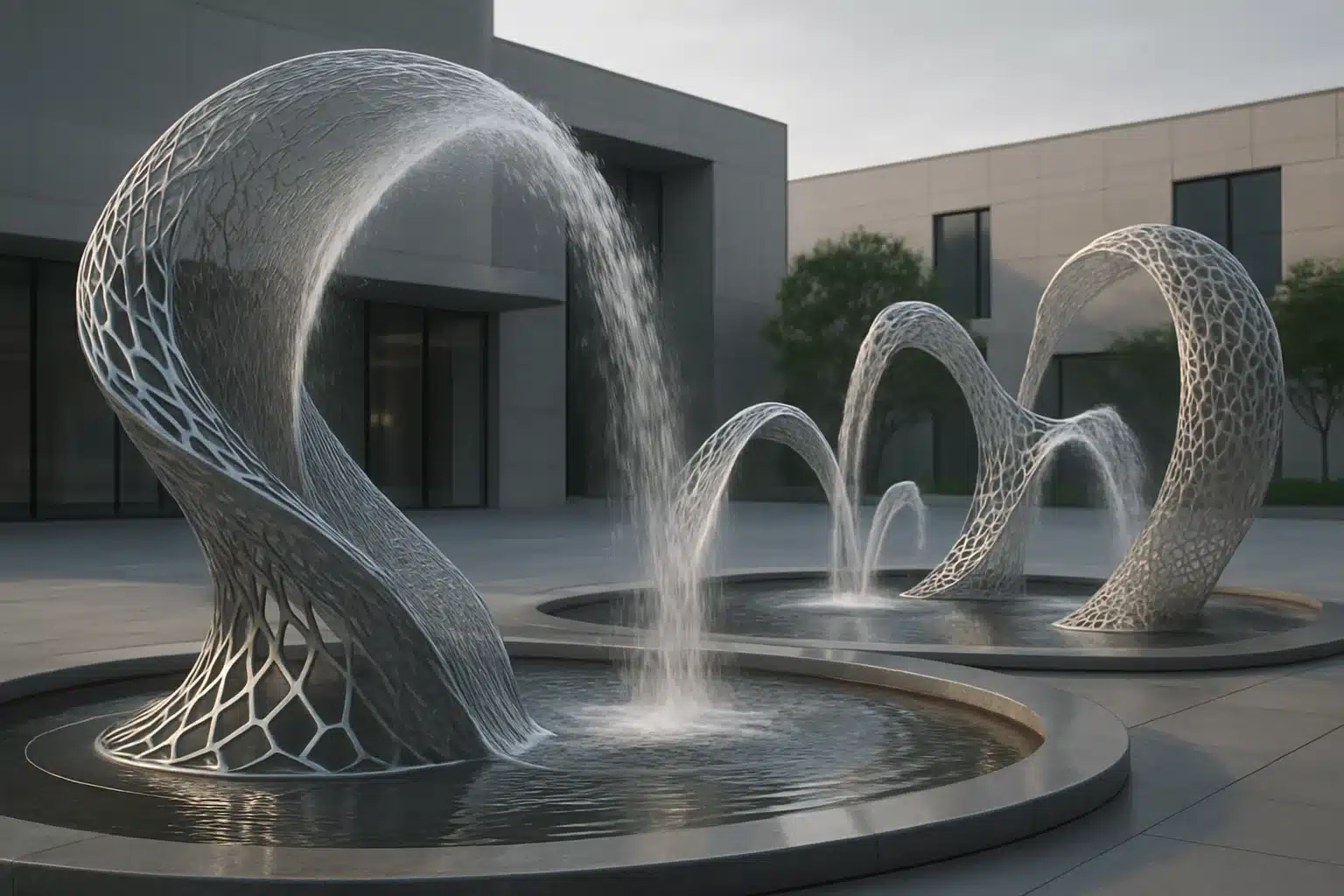
1. Voronoi or Cellular Basin Fountains

Using Voronoi patterns, basins can be divided into organic, cell-like compartments, each hosting its own nozzle. Designers can vary cell sizes to create topographies that shape water flow in mesmerizing ways.

2. Kinetic Algorithmic Jet Arrays

Rows of digitally controlled nozzles create patterns of water that change dynamically. Algorithms choreograph rising and falling jets like a water-based LED display.

3. Wave Interference Fountains

By overlapping circular wavefronts generated by multiple jets, designers create dynamic interference patterns. Parametric models can optimize these effects for maximum visual harmony.

4. Spiral and Helical Water Structures

Using parametric curves, fountains can take on spiraling forms—jets arranged along helical rails or basins sculpted into logarithmic spirals.

5. 3D-Printed Parametric Sculptures with Integrated Water Flow

Digital fabrication techniques allow sculptural elements to be printed with internal channels, optimizing water paths and creating seamless fluid movement across surfaces.

Technology Behind Parametric Fountains

To bring these designs to life, multiple technological systems work in sync.

1. Parametric Modeling Software

Tools like:

  • Rhino + Grasshopper
  • Autodesk Dynamo
  • Blender Geometry Nodes
  • Houdini FX

These allow fluid geometry exploration and accurate digital prototyping.

2. CFD Simulation

Computational fluid dynamics helps predict:

  • water arc behavior
  • splash zones
  • wind interference
  • turbulence

This ensures the final installation performs as expected.

3. Digital Fabrication

CNC milling, robotic carving, and large-scale 3D printing make complex geometries manufacturable. Materials may include:

  • stone
  • metal
  • high-performance concrete
  • composites
  • translucent polymers

4. IoT Integration

Smart controllers allow fountains to respond in real time. These may include:

  • pressure sensors
  • weather stations
  • audio inputs
  • camera-based motion detection
  • programmable lighting systems

5. Automation and Machine Learning

Some experimental fountains use machine learning to:

  • optimize water usage
  • minimize splash in windy conditions
  • choreograph patterns based on crowd movement

We’re entering an era where fountains are not just programmed, they learn.

Sustainability Benefits of Parametric Fountain Design

While fountains often raise concerns about water use, algorithmic design provides powerful tools for creating eco-efficient water features.

1. Reduced Water Consumption

Optimization of jet anatomy, trajectory, and splash radius can significantly cut evaporation and waste.

2. Smarter Pump Usage

Algorithms can adjust pump output based on:

  • time of day
  • occupancy levels
  • weather conditions (especially wind)
  • This reduces electricity consumption.

3. Improved Filtration and Recirculation

Parametric basin geometry enhances:

  • flow distribution
  • debris capture
  • water turnover rate
  • overall water hygiene

4. Material Efficiency

Parametric modeling helps fabricate only what is needed using minimal materials. Generative optimization also reduces structural weight.

5. Integration with Recycled Water Systems

Fountains can be designed to run on:

  • captured rainwater
  • greywater sources
  • closed-loop recirculation systems

As sustainability becomes a priority across industries, parametric fountains provide a powerful framework for designing greener public installations.

The Aesthetic Advantages: Why Parametric Fountains Feel Futuristic

Parametric fountains have a distinctive look, one that feels organic yet futuristic. This is because algorithmic forms often mirror nature itself.

You’ll see influences from:

  • coral structures
  • honeycomb patterns
  • branching river deltas
  • fluid waveforms
  • spiral galaxies

But the execution appears digital and modern, giving the installations a dual character: natural yet computational.

Combined with LED lighting, reflective materials, and dynamic jet movement, parametric fountains can create experiences that feel immersive, almost like living art.

Use Cases: Where Parametric Fountains Are Making an Impact

1. Public Plazas and Parks
Interactive water plazas that respond to users are becoming landmarks in major cities.

2. Commercial and Retail Complexes

Parametric fountains create strong visual identity, enhancing brand narratives and visitor engagement.

3. Museums, Art Installations, and Exhibitions

Artists and architects use algorithmic fountains as immersive sculptural experiences.

4. Residential Luxury Spaces

Parametrically designed courtyard fountains, rooftop water features, and wellness environments are rising in demand.

5. Hospitality Venues

Hotels, resorts, and spas leverage dynamic fountain installations to enhance atmosphere and create memorable guest experiences.

Challenges in Parametric Fountain Implementation

As promising as they are, parametric fountains involve complexity.

1. High Technical Expertise Needed

Requires multidisciplinary collaboration between:

  • architects
  • computational designers
  • hydraulic engineers
  • manufacturers
  • lighting and control specialists

2. Cost Considerations

Advanced fabrication and integration systems may increase initial costs—even if long-term efficiency offsets them.

3. Maintenance Complexity

More moving parts and digital systems mean more specialized maintenance protocols.

4. Real-World Environmental Variability

Wind, debris, and contamination require responsive systems and robust engineering.

Yet as technology advances and costs decrease, these challenges are becoming easier to overcome.

The Future of Parametric Fountain Design

We are on the cusp of a revolution in water feature design. Here’s what the future might look like:

1. Fully Autonomous Fountains

AI-controlled systems that self-adjust for performance, sustainability, and crowd interaction.

2. Real-Time Generative Choreography

Fountains that generate entirely new patterns in real time using algorithmic randomness and procedural generation.

3. Holographic Water Displays

Hybrid systems using mist screens and projection to create interactive visuals.

4. Robotic Water Sculptures

Mechanical actuators dynamically reshaping surfaces or water paths in reaction to environmental changes.

5. Data Visualization Fountains

Public art that visualizes real-time data—traffic, weather, noise levels—through water behavior.

6. 3D-Printed Bio-Integrated Water Forms

Living fountains incorporating algae, moss, or micro-ecologies—designed algorithmically for optimal biophilic impact.

The future of fountain design will blur the lines between architecture, engineering, biology, computation, and public art.

Conclusion

Parametric fountains represent a powerful evolution in the world of design, unifying digital precision, natural inspiration, and interactive technology. As algorithmic tools and fabrication methods continue to advance, these innovative water features will push the boundaries of creativity, sustainability, and public engagement.

Whether as architectural showpieces, public installations, or intimate garden sculptures, parametric fountains embody the future of water-based art: dynamic, adaptive, and breathtakingly complex. The fountains of tomorrow will not just be designed—they will be computed.

FAQs:

A parametric fountain is a water feature designed using computational algorithms that control its geometry, water flow, lighting, and behavior. Designers can adjust parameters to create infinite variations and optimize performance.

Yes. By optimizing water flow, minimizing splash, and using intelligent pump and filtration systems, parametric fountains often consume less water and energy than traditional fountains.

Common tools include Rhino + Grasshopper, Houdini, Dynamo, Blender Geometry Nodes, and various CFD simulation programs for analyzing water behavior.