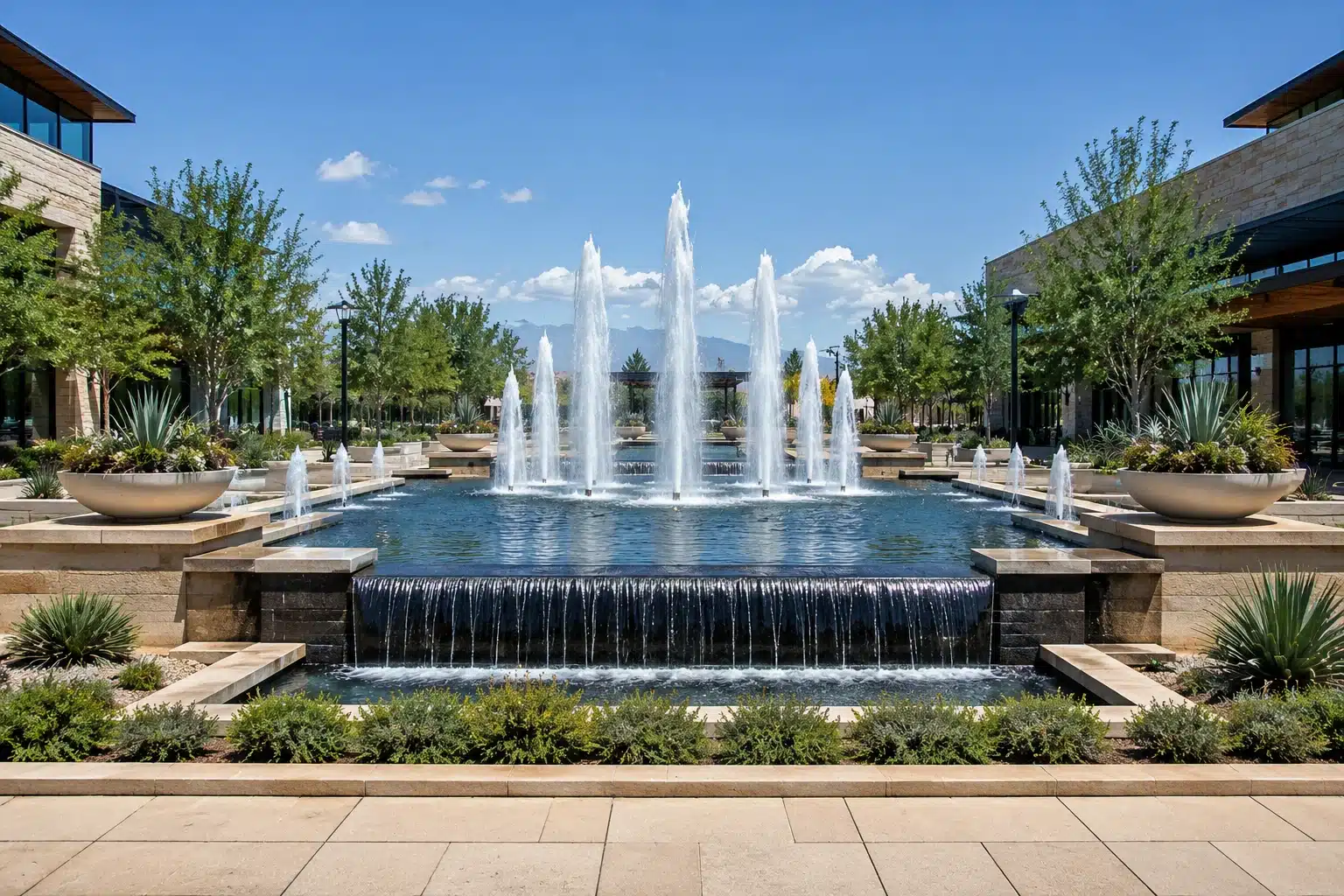
Evaporation is the main cause of water loss in outdoor commercial fountains. In hot, arid, or windy climates, these losses can be significant, raising operating costs and complicating sustainability and water-efficiency efforts.
Fortunately, evaporation loss can be managed. With careful design, smart controls, and best operational practices, owners can reduce water use without compromising the visual appeal of their fountains.
Understanding evaporation is essential for long-term success, whether you are designing new commercial fountains or upgrading existing ones.
Quick Facts
- Wind is often the largest contributor to unexpected fountain water loss.
- Low-aeration water displays can significantly reduce evaporation.
- Conductivity-based blowdown controls may reduce discharge by 30–50%.
- Water consumption should be tracked monthly.
- Combined water-efficiency strategies can reduce total water loss by 30–60%.
How Can You Reduce Evaporation Loss in a Commercial Fountain?
To reduce evaporation loss in large outdoor commercial fountains, use low-aeration water displays, minimize exposed surface area, limit wind exposure, optimize operating schedules, and implement automated conductivity-based blowdown controls.
Incorporating these strategies during design can reduce total water loss by 30% to 60% while preserving the visual and experiential benefits of commercial fountains.
Understanding What Drives Evaporation in Fountain Systems
Before implementing solutions, it is important to understand the main factors that influence evaporation.
Water Surface Area
Greater exposed water surface area leads to higher evaporation. Wide, shallow basins usually lose more water than deeper ones because of their higher surface-to-volume ratios.
Air Temperature and Humidity
Evaporation increases with higher temperatures and lower humidity. Fountains in desert or semi-arid areas lose more water than those in cooler, coastal climates.
Wind Exposure
Wind is a major contributor to unexpected water loss. It removes the humid layer above the water, accelerating evaporation and increasing drift.
Water-in-Air Exposure
Water displays that produce fine droplets, mist, or heavy turbulence greatly increase the surface area exposed to air.
Aerated jets, mist systems, and turbulent cascades typically cause more evaporation than sheet-flow water walls, reflecting pools, or laminar jets.
Estimated Impact of Evaporation Reduction Strategies
Strategy | Typical Water Savings | Implementation Difficulty |
Wind Sensors + VFD Control | 10–30% | Moderate |
Low-Aeration Water Displays | 15–40% | Moderate |
Optimized Basin Geometry | 10–25% | Low |
Conductivity-Based Blowdown Control | 30–50% Blowdown Reduction | Low |
Operational Scheduling | 5–20% | Low |
Although each project has unique conditions, these ranges offer a helpful framework for assessing water-efficiency opportunities.
Strategy 1: Basin Design for Minimal Surface Area
Optimizing basin geometry is one of the most effective long-term ways to reduce evaporation.
A deeper basin with less exposed surface area usually loses less water to evaporation than a wide, shallow basin of the same volume.
For new custom fountains located in water-sensitive regions, design teams should consider:
- Basin depths of 18 inches or greater
- Reduced surface-area-to-volume ratios
- Efficient hydraulic circulation patterns
- Strategic basin placement relative to prevailing winds
These design choices are mostly hidden below the waterline, so they rarely affect aesthetics but provide significant operational benefits.
Strategy 2: Select Water Displays with Lower Evaporation Rates
Not all fountain displays consume water at the same rate.
Some water effects naturally minimize air-water contact while others significantly increase evaporation through atomization and spray formation.
Lower-Evaporation Displays
- Sheet-flow weirs
- Overflow edges
- Reflecting pools
- Laminar jet systems
- Smooth water walls
Higher-Evaporation Displays
- Aerated jets
- Spray nozzles
- Mist systems
- Highly turbulent cascades
- Multi-directional plume jets
This does not mean high-energy displays should be avoided entirely. Instead, designers should balance visual objectives with water-efficiency goals.
Strategy 3: Wind Management
Wind is often the main cause of unexpected evaporation loss in large outdoor fountains.
Even a well-designed fountain can experience significant water loss when exposed to constant wind. To minimize direct exposure to prevailing winds.
Landscape architects can use vegetative windbreaks, architectural screens, strategic hardscape, and building-edge protection to reduce wind over the water surface.
Wind Sensor Integration
Modern fountain control systems can integrate wind sensors with variable frequency drives (VFDs).
When wind speeds exceed predefined thresholds, the pump speed automatically adjusts, reducing jet height and minimizing spray drift.
This approach protects water resources and fountain performance without manual intervention.
Common Causes of Unexpected Water Loss
Many property owners assume evaporation is the only cause of increased water use.
In reality, facility managers often find that operational issues are the main source of excessive water use.
Common causes include:
- Leaking auto-fill valves
- Malfunctioning level sensors
- Improperly adjusted blowdown controls
- Damaged piping connections
- Excessive splash caused by changing wind patterns
These issues are usually found during routine fountain maintenance inspections, not water-efficiency audits.
Therefore, evaporation-reduction efforts should always include water-consumption monitoring.
A properly functioning fountain shows predictable seasonal water use. Major deviations often signal operational problems that need investigation.
Example: Reducing Water Loss in a Commercial Plaza Fountain
A mixed-use commercial development in a hot, windy climate experienced excessive make-up water consumption during peak summer months. After evaluating the fountain system, the operations team integrated wind sensors with VFD-controlled pumps and adjusted operating schedules to reduce water-in-air exposure during high-wind periods.
This resulted in an estimated 35% reduction in seasonal water use, with no change to the fountain’s appearance or guest experience. This example shows that operational adjustments can deliver significant savings without major system changes.
Strategy 4: Operational Scheduling
Not all operating hours contribute equally to guest experience.
The hottest hours of the day usually have the highest evaporation rates but the lowest user engagement.
Effective scheduling strategies include:
- Reduced pump speeds during peak heat periods
- Full operation during mornings and evenings
- Seasonal programming adjustments
- Automated weather-responsive schedules
These strategies can greatly reduce water use without noticeably affecting visitor experience.
Strategy 5: Automated Blowdown Optimization
While blowdown is not technically evaporation, it adds to total make-up water use. Total dissolved solids (TDS) and initiate discharge only when necessary.
Automated conductivity control can reduce blowdown-related water use by 30% to 50% compared to timer-based systems.
Evaporation Reduction and Sustainability Goals
Water conservation is now a central goal in modern commercial development.
Projects pursuing LEED certification, ESG initiatives, sustainability reporting programs, or broader environmental goals increasingly evaluate fountain performance as part of their overall water strategy.
Fortunately, modern commercial fountains can support both sustainability objectives and architectural design goals.
Efficient hydraulics, optimized controls, smart water treatment, and careful display selection enable fountains to provide strong visual experiences while minimizing resource use.
Commercial Fountain Evaporation Reduction Checklist
✓ Analyze prevailing wind conditions
✓ Minimize unnecessary water-in-air exposure
✓ Utilize laminar jets where appropriate
✓ Optimize basin depth-to-surface-area ratios
✓ Incorporate wind-responsive VFD controls
✓ Implement conductivity-based blowdown management
✓ Track make-up water consumption
✓ Coordinate sustainability goals during design development
✓ Review local conservation regulations
✓ Establish long-term maintenance procedures
Projects that address these factors early often achieve lower operating costs and better long-term performance.
Measuring Evaporation Performance
Commercial properties with sustainability reporting requirements should actively monitor water consumption.
Installing a dedicated sub-meter on the make-up water line allows facility teams to track consumption, set performance baselines, detect leaks early, verify efficiency improvements, and support sustainability reporting.
Historical consumption data is often one of the most valuable diagnostic tools for operators.
Real-World Coordination Challenges
Evaporation reduction requires coordination with other project elements.
Many projects require coordination among fountain consultants, civil engineers, landscape architects, water treatment specialists, and facility teams.
In mixed-use developments, water-efficiency goals must often align with landscape irrigation systems, utility routing constraints, stormwater management strategies, municipal conservation requirements, and sustainability certification programs.
Early coordination reduces design conflicts and improves long-term operational performance.
Long-Term Value of Efficient Fountain Design
A properly designed fountain system can deliver substantial water savings over its operational life.
Efficient hydraulics, optimized basin geometry, advanced controls, and proactive fountain maintenance help reduce water consumption while preserving visual quality.
As municipalities prioritize water conservation, efficient fountain design is becoming a competitive advantage, not just a sustainability feature.
Commercial properties that invest in water-efficient systems are better positioned to meet future regulations while maintaining the value of high-quality water features.
Key Takeaway
Reducing evaporation loss requires intelligent design, operational planning, and ongoing monitoring.
For most outdoor commercial fountains, the best results come from low-aeration water displays, wind-responsive controls, efficient basin geometry, conductivity-based blowdown management, and comprehensive monitoring.
By combining these strategies, large outdoor fountains can significantly reduce water use while maintaining their visual appeal.
Work With Fountains.com
Fountains.com designs water-efficient commercial fountain systems that combine sustainability, performance, and long-term reliability.
Our team partners with architects, developers, landscape architects, and facility managers to optimize basin geometry, water display selection, wind-responsive controls, automated blowdown systems, maintenance planning, and sustainability-focused fountain engineering.
We also create specialized custom fountains and outdoor fountains tailored to the needs of commercial developments.
Contact our team to discuss your project goals and water efficiency objectives.
FAQs:
In high-evaporation climates, combining basin optimization, wind management, display selection, and intelligent controls can reduce water loss by 30–60% compared to unoptimized systems.
Yes. Deeper basins generally have less exposed surface area per unit volume of water and provide greater thermal mass, which can slightly reduce peak water temperatures.
In many cases, yes. Most PLC-based fountain control systems can integrate wind sensors that automatically reduce pump speeds during high-wind events.
For most commercial applications, sheet-flow water walls, laminar jet displays, and reflecting pools are among the most water-efficient fountain designs because they minimize aeration, splash, and wind drift while maintaining strong visual appeal.
Some jurisdictions impose restrictions on decorative fountain operation during drought emergencies. Owners should monitor local regulations and incorporate emergency operating modes into fountain control systems.
Yes. Monthly monitoring helps establish baseline consumption patterns and allows facility teams to quickly identify leaks, control failures, or unexpected operational changes.
Many jurisdictions permit reclaimed water use, provided treatment and regulatory requirements are satisfied. Always verify local code requirements before implementation.