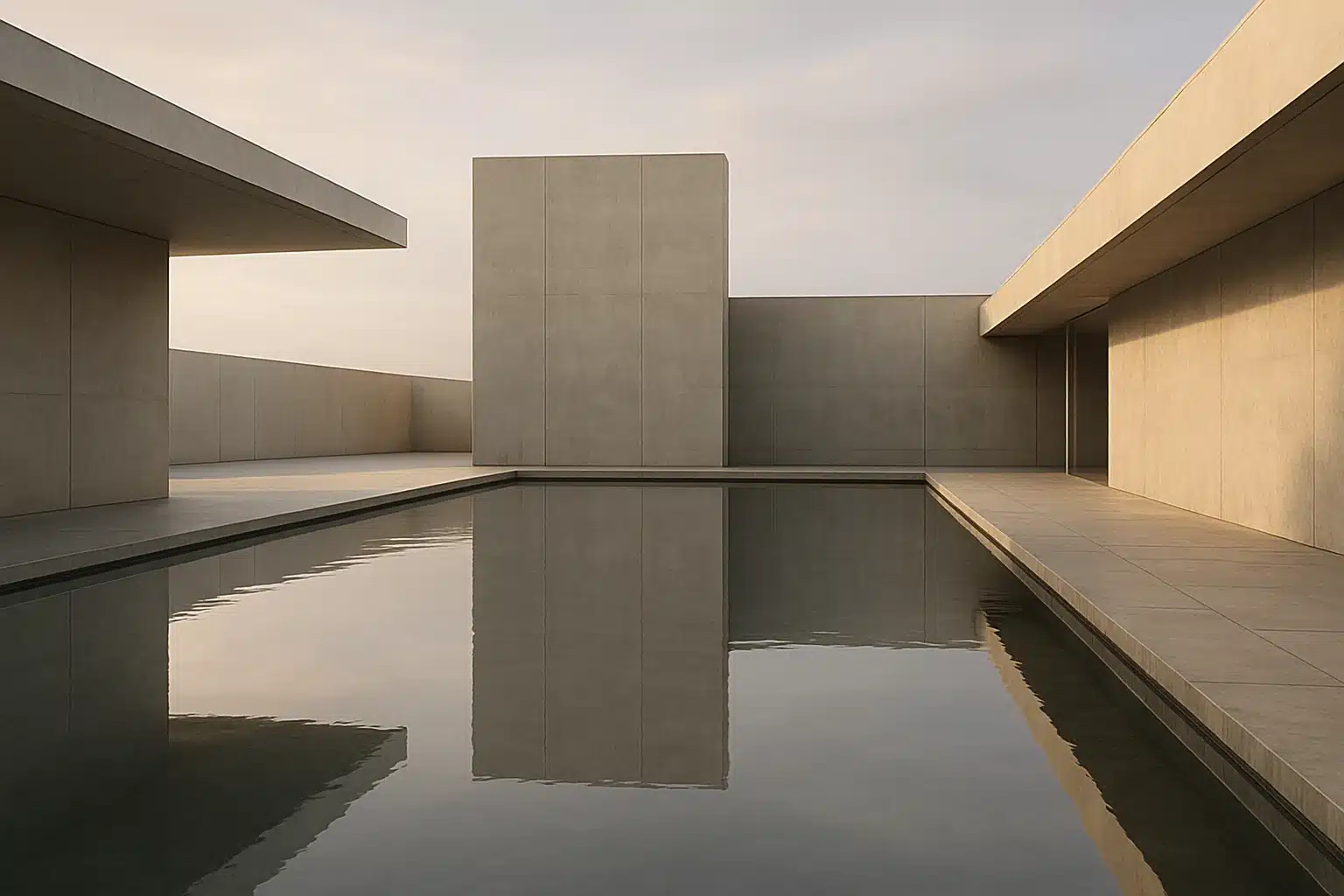
Introduction: Where Water and Architecture Become One
There is a moment, quiet, crystalline, nearly sacred, when water becomes more than a functional element within a space. It becomes a collaborator. A mirror. A sculptor of light. A silent companion that heightens everything around it. This, in essence, is water minimalism: a design philosophy that merges the restraint of minimal architecture with the meditative qualities of still water.
You can see it in the sharp reflections on a shallow courtyard pool, the shimmer of a linear rooftop channel, or the disappearing edge of an infinity basin that erases the boundary between built form and horizon. When architects embrace water as a minimalist material, they create sculpted stillness, spaces where calm is designed, not just found.
In this in-depth exploration, we’ll dive into the origins, principles, applications, and emotional impact of architectural fountains. More than a design trend, it’s a dialogue between nature and geometry, simplicity and atmosphere, solid and fluid.
The Origins of Water Minimalism in Architecture
Water has always appeared in architecture, from ancient Roman baths to Islamic courtyard fountains to Japanese temple ponds. But what distinguishes minimalist water architecture from historical uses is its intent.
1. Modern Minimalism as Foundation
The minimalist movement of the mid-20th century, popularized by architects such as Mies van der Rohe, Tadao Ando, and John Pawson, emphasized purity of form, reduction of unnecessary elements, and quiet spatial rhythm. As minimalism evolved, architects began treating water as another essential material: one that reinforces simplicity rather than embellishment.
2. Japanese Aesthetics and the Influence of Zen
Japanese architecture has long embraced the contemplative properties of water and emptiness. Concepts like ma (the space between things) and wabi-sabi (beauty in simplicity) deeply shape modern water minimalism. Shallow pools, raked gravel symbolic of waves, and carefully framed reflections all influence today’s minimalist approach.
3. Technological Advances
Modern waterproofing, precision concrete, and slim-edge pool design allow architects to craft water forms with absolute clean lines, something difficult to achieve in earlier eras. These innovations opened the door to dramatic new forms of sculpted stillness.
What Is Sculpted Stillness?
Sculpted stillness refers to the intentional use of water as a minimal architectural medium to shape atmosphere, perception, and emotion. It is architecture not just built, but composed, where the water itself becomes an active visual and sensorial element.
Think of a shallow reflecting pool where the sky becomes part of the structure, or the quiet hum of a thin water sheet sliding down a concrete wall. These are not decorative flourishes; they are fundamental design gestures that alter the understanding of space.
Key Characteristics of Sculpted Stillness
- Minimal movement: Water is often still or nearly still.
- Mirror-like surfaces: Used to reflect architecture, landscape, or sky.
- Precision geometry: Clean lines, right angles, flat planes.
- Emphasis on negative space: What is not built is just as important.
- Tactile silence: The design feels meditative and sensory.
- Light manipulation: Water becomes a projector, magnifier, or dimmer of light.
When architecture meets water minimalism, the result is often a sense of suspended time, as if the environment is holding its breath.
Why Water Works So Beautifully in Minimalist Architecture
1. Water Reflects Light in Dynamic Yet Controlled Ways
In minimalism, light is everything. Water enhances this by catching and casting illumination across surfaces. Even still water slightly trembles, creating subtle shifts that animate an otherwise restrained environment.
2. Water Softens Hard Materiality
Concrete, stone, metal, and glass dominate minimalist architecture. Water provides contrast: gentle, fluid, organic. The combination invites balance rather than tension.
3. Water Removes Visual Clutter
By emphasizing clean surfaces and spatial emptiness, water becomes a void—yet a reflective one. In its emptiness, it offers clarity.
4. Water Adds Sensory Depth Without Adding Complexity
Minimalism aims to simplify, but not sterilize. The faint sound or scent of water contributes to multisensory experience without overwhelming the visual discipline.
Design Principles of Water Minimalism
1. Reduction to Essentials
Every line, plane, depth, and movement must serve purpose. Water features are designed with restraint: no excessive ornamentation, no unnecessary jets or sculptures.
2. Controlled Edges and Boundaries
Edges matter immensely in water minimalism:
- Zero-edge basins create visual infinity.
- Raised perimeters create crisp shadow lines.
- Narrow coping intensifies the water’s visual presence.
- Precision is the difference between elegance and distraction.
3. Play Between Reflection and Absorption
Architects design surfaces around the water to either reflect or absorb:
- Reflective surfaces: polished stone, glass façades.
- Absorptive surfaces: raw concrete, matte metal.
This interplay enhances depth and contrast.
4. Shallow Depth and Transparency
Minimalist water features are often shallow for practical and aesthetic reasons. Thin layers increase stillness, transparency, and calm.
5. Integration With Landscape
The water must feel part of the larger environment:
- aligned with horizon lines
- framed by natural elements
- positioned to draw the eye outward
Landscape becomes part of the architectural composition.
Applications of Sculpted Stillness
Water minimalism shows up across architectural typologies, each transforming space in distinct ways.
1. Residential Architecture
In homes, minimalist water design creates sanctuary. Examples include:
- Reflecting pools in courtyards that draw light deep into rooms.
- Linear ponds along hallways that extend sightlines.
- Roof pools or sky terraces that visually merge with the skyline.
- Entry pools that slow the transition from exterior chaos to interior calm.
- Even tiny water elements, like a narrow 10 cm-deep channel, can transform atmosphere.
2. Cultural Institutions
Museums, galleries, and spiritual spaces often employ water to evoke solemnity or introspection.
Tadao Ando’s Church of the Light and the Modern Art Museum of Fort Worth demonstrate how water amplifies stillness, grounding visitors in quiet contemplation.
3. Luxury Hospitality
Hotels and resorts heavily embrace sculpted stillness to create memorable arrival experiences.
Long, narrow reflecting pools that frame a lobby or lounge elevate the sense of arrival, while minimal infinity edges dissolve the boundary between architecture and landscape.
4. Public Spaces and Urban Installations
Urban designers use water minimalism to inject calm into dense environments:
- silent plazas with thin water sheets
- sunken water courts
- waterfront promenades with subtle reflective elements
These create micro-moments of pause in otherwise fast-paced surroundings.
5. Corporate and Institutional Campuses
Minimalist water elements help soften the rigidity of office complexes:
courtyard reflecting pools, shallow water carpets, or mirror-like ponds encourage rest, mindfulness, and groundedness.
Architectural Techniques That Create Sculpted Stillness
1. Infinity Edges
Infinity basins blur boundaries, creating a perfect horizon line that creates a sense of visual erasure. When paired with a minimalist structure, the effect is surreal, like architecture floating on sky.
2. Shadow Pools
A shadow pool is a shallow black-bottomed basin that reflects the surrounding architecture sharply. These are staples of minimalist museums and luxury residences.
3. Water Courtyards
Central courtyards with still water echo traditional design from Japanese ryokans and Islamic riads, but reinterpreted in modern form.
4. Water Walls and Thin Sheets
Ultra-thin vertical flows provide a gentle texture without disrupting minimal serenity.
5. Sunken Water Platforms
Platforms that sit just above water’s surface create levitation illusions, especially when framed with unseen edges.
Psychological and Emotional Impact
1. Immediate Calm
Still water has measurable effects on stress reduction. Pairing it with minimal architecture amplifies the soothing effect, creating spaces conducive to meditation, reflection, or thoughtful work.
2. Enhanced Spatial Perception
Water creates illusions of expanded space through reflections. A courtyard may feel twice its size. A room may appear to glow.
3. Mindfulness and Presence
The subtle nature of still water encourages slower movement, deeper breath, and quieter thought.
4. Sensory Engagement Without Overstimulation
While maximalist water features can overwhelm, minimalist water is an invitation to listen inward.
Iconic Examples of Water Minimalism
Tadao Ando’s Water Temple (Japan)
A circular pool of still water leads to an underground sanctuary, an iconic masterpiece of sculpted stillness.
Luis Barragán’s Reflecting Pools (Mexico)
Barragán used still water as color, shadow, and emotion. His minimal pools highlight his mastery of silence and form.
The Modern Art Museum of Fort Worth
Its water court mirrors five pavilions, creating a sense of floating architecture.
Peter Zumthor’s Therme Vals (Switzerland)
Though not minimal in water volume, the restrained geometry and muted tones create profound stillness.
Designing Your Own Moments of Sculpted Stillness
Whether you’re an architect, designer, or homeowner, water minimalism can be adopted at various scales.
- Start With the Principle of Less
Remove elements until the water feels intentional, not ornamental. - Prioritize Edges
The boundary defines everything. A clean, uninterrupted edge creates purity. - Balance Solid and Fluid
Pair water with strong forms: concrete walls, stone slabs, large glass panels. - Integrate Light Thoughtfully
Design for reflection at sunrise, sunset, or night lighting. - Maintain Restraint
The power of water minimalism lies in what is not added.
The Future of Water Minimalism
As sustainability and biophilic design advance, water minimalism is evolving. Architects are exploring:
- Rain-fed reflecting pools
- Greywater-based landscape basins
- Solar-illuminated water surfaces
- Ultra-low-water designs using mist or optical illusions
The future blends tranquility with responsibility, proving stillness can be both beautiful and ecological.
Conclusion: Where Stillness Becomes Sculpture
Sculpted stillness is more than design, it’s a philosophy. It’s the idea that moments of quiet can be crafted, that architecture can breathe, and that water can shape emotion. As more designers embrace water minimalism, our built environments may increasingly reflect a world in which calm is not an accident but a fundamental architectural intention.
Through still water, architecture gains a pulse, a gentle, meditative rhythm that invites us to feel more deeply, see more clearly, and move more mindfully.
FAQs:
Water minimalism focuses on stillness, simplicity, and clean geometry, whereas traditional features often rely on ornamentation, movement, and decorative complexity.
Not necessarily. Still, shallow pools require consistent but simple upkeep mainly filtration, surface cleaning, and maintaining water levels.
Absolutely. Even a narrow channel, a small reflecting basin, or a shallow interior water tray can introduce sculpted stillness into compact environments.