CYBER MONDAY: 10% off ALL FOUNTAINS. Use CYBER10 at checkout
406.1.The-Eternal-Drop

The Eternal Drop: Designing Fountains Inspired by a Single Moment of Flow

When a Single Drop Becomes a Universe

There’s something profoundly hypnotic about a drop of water, its arc, its descent, its splash, the ripples it sends outward. A single moment of flow can feel eternal. It contains tension, release, balance, gravity, and grace. Designers, artists, and architects have long looked to water for inspiration, but few explore the poetic potential of one instant frozen, and unfrozen, into form.

“The Eternal Drop” is both a concept and an approach: a philosophy for creating fountains that embody a single suspended moment of motion. Instead of designing complex water shows or towering installations, this approach isolates the beauty of flow itself. It magnifies the elegance of a single gesture, a droplet about to fall, a stream about to separate, a surface about to ripple.

This blog post explores the art, science, technology, and symbolism behind designing fountains inspired by this single ephemeral moment. If you are an architect, landscape designer, artist, or someone who simply loves water features, this deep dive offers insight into how to turn a fleeting instant into a timeless piece of design.

Why a Single Moment? The Philosophy Behind the Concept

Water is one of nature’s most dynamic substances, constantly shifting between states, pressures, and pathways. When we watch fountains, we often admire the patterns and cycles of movement, but rarely do we pause to appreciate the microscopic events happening within the flow.

Yet inside every fountain:

  • A droplet stretches before separating from its source
  • Gravity pulls while surface tension resists
  • A stream narrows, thickens, curves, or wavers
  • Air interacts with water to sculpt texture and sound

The “Eternal Drop” philosophy says: Focus on that one smallest moment. Let it define the entire structure.

Capturing Essence Over Complexity

Designers often think in terms of spectacle, high jets, choreographed sprays, colored lights. While visually impressive, these can overwhelm the intimate poetry of water.

A single-moment-inspired fountain, by contrast, emphasizes:

  • Minimalism
  • Emotional clarity
  • Organic geometry
  • Stillness within motion

It’s a meditation rather than a performance.

Nature’s Blueprint: The Science of a Droplet

Before translating the moment into design, it helps to understand what actually happens when a droplet forms. The science, while invisible to the naked eye, provides valuable clues for shaping a fountain’s form.

Surface Tension and Curvature

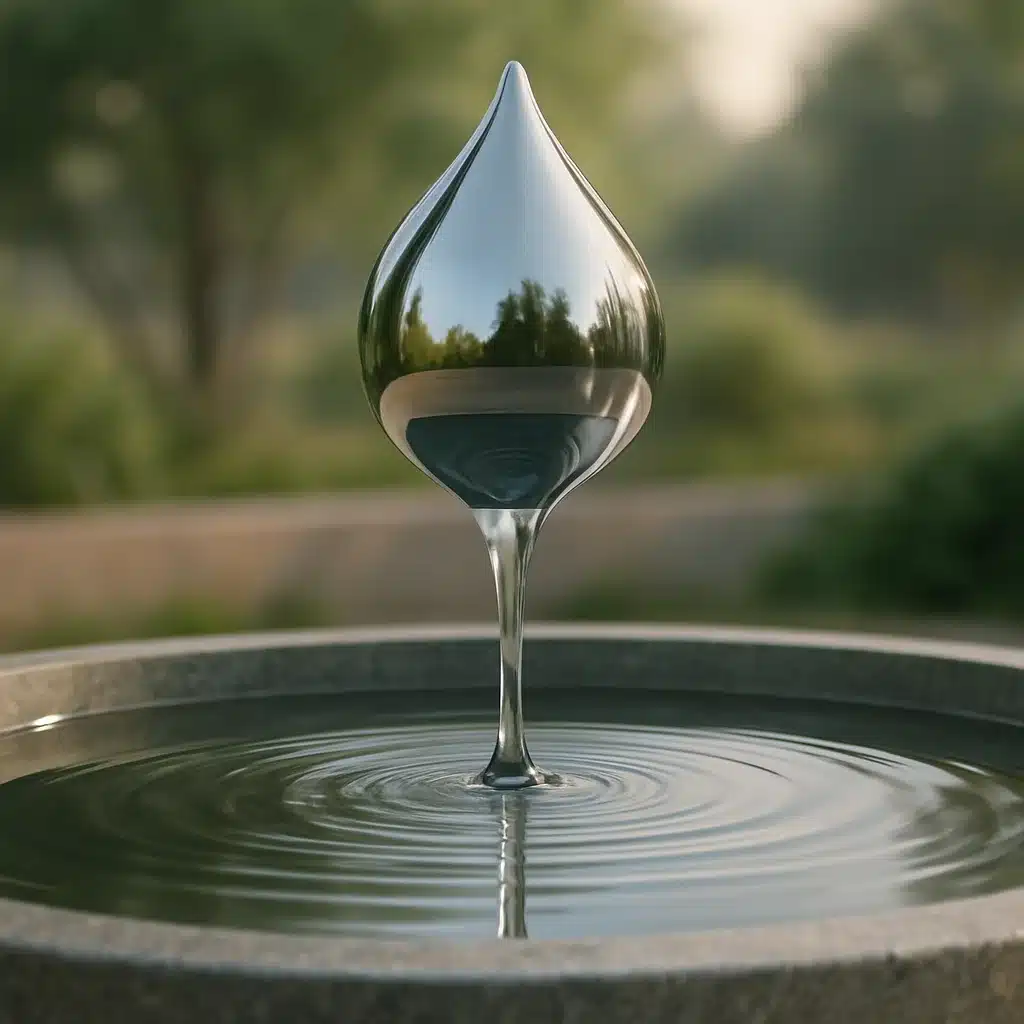
The shape of a droplet is determined by the interplay between gravity and surface tension. At the instant just before release, it elongates into a teardrop, not the rounded raindrop of popular imagery.

This teardrop geometry, with its tapered top and bulbous bottom, has inspired countless architectural forms. The subtle asymmetry adds lifelike authenticity.

Necking and Separation

Just before a droplet falls, the thin “neck” where it meets the water source stretches to its maximum. This produces:

  • A cylindrical column
  • A narrowing waist
  • A sudden separation point

A fountain could interpret this as:

  • A sculptural column
  • A narrowing basin
  • A break in patterns of flow
  • Splash and Ripples

If the inspiration moment is the impact of the drop:

  • Crown-like shapes emerge
  • Ripples expand concentrically
  • Micro-sprays break into beads

These can be expressed through:

  • Radial stonework
  • Concentric platforms
  • Patterned overflow channels
  • Science becomes sculpture.

Artistic Interpretations: Turning Fluid Dynamics into Design

Now that we’ve examined the physics, how does one convert that moment into a tangible fountain?

1. Sculptural “Frozen Motion” Forms

Some fountains emulate the literal shape of a drop:

  • Crystal-clear glass-like resin sculptures capturing a droplet mid-fall
  • Metal forms shaped to resemble stretching water
  • Stainless steel or chrome surfaces reflecting the environment like liquid mirrors
  • The shape alone becomes the centerpiece, with water flowing subtly around it.

2. Flow-Mimicking Water Paths

Rather than depicting the drop, some designers focus on the movement:

  • A single stream pouring slowly down a smooth curve
  • Water “splitting” at a carved separation point
  • Cascades that resemble ripples radiating outward
  • The water path itself becomes the art.

3. Negative Space as a Design Element

Sometimes the most powerful moment is the space between the drop and the source:

  • A suspended sculpture above a catch basin
  • Light or mist filling the gap
  • A visual tension that mirrors the moment before falling
  • The empty space communicates anticipation.

4. Minimalist Zen-Inspired Installations

A single drop, repeated at intervals, creates:

  • A meditative rhythm
  • A calming soundscape
  • A sense of timelessnessThese fountains prioritize sound as much as visuals.

5. Kinetic or Parametric Designs

With modern tools, designers can manipulate flow patterns through parametric modeling:

  • Surfaces shaped through algorithmic simulations
  • 3D-printed forms based on real fluid dynamics data
  • Dynamic nozzles controlling droplet size and intervals
  • This blends art with advanced computation.

Materials That Capture the Moment

Choosing the right material is essential for achieving the aesthetic of a frozen droplet or delicate flow pattern.

Stainless Steel

  • Reflective
  • Durable
  • Mimics liquid surfaces
  • A favorite for modern interpretations.

Glass and Resin

  • Allows for translucent forms
  • Perfect for large-scale “frozen drops”
  • Can be backlit for dramatic effects
  • Ideal for indoor or sheltered installations.

Stone and Concrete

  • Earthy, solid, grounding
  • Excellent for ripple-like carvings
  • Softens the presence of water with texture
  • Useful for outdoor Zen-inspired gardens.

Copper and Bronze

  • Ages gracefully
  • Develops patina
  • Adds warmth and timelessness
  • Beautiful in traditional or nature-themed fountains.

The Role of Light: Illuminating the Moment

Light is critical for emphasizing the subtle geometries and motions.

Backlighting Frozen Drops

Casting light from behind or beneath enhances:

  • Curvature
  • Transparency

Depth

  • Especially effective with glass and resin.
  • Highlighting Ripples

Directional lighting can bring out:

  • Surface shadows
  • Circular patterns

Texture in stone or metal

  • Warm lighting adds tranquility; cool lighting adds modernity.
  • Water-Activated Light

Some fountains use specialty LEDs that react to flow:

  • Changing color with movement
  • Pulsing with drop rhythm
  • Creating silhouettes of streams

This merges technology with organic inspiration.

Sound Design: The Whisper of Flow

Sound is often forgotten in fountain design, but for a moment-inspired installation, it’s everything.

  • A single drop can produce:
  • A soft tap
  • A winding trickle
  • A resonant plink based on the basin shape

Designing the acoustics involves:

  • Basin depth
  • Material density
  • Distance from drop to surface
  • Some designers tune basins like instruments, an engineering art form in itself.

Symbolism: What a Single Drop Represents

Across cultures, a droplet carries profound meaning:

  • Life – water is essential
  • Renewal – the cycle of falling and rising
  • Meditation – focusing on one moment
  • Continuity – the endless flow of nature
  • Fragility and strength – delicate form, unstoppable force

A fountain inspired by such a symbol carries emotional resonance beyond aesthetics.

Modern Examples of the Eternal Drop Concept

Though the philosophy is not widely named, its influence can be seen in many contemporary designs.

The “Frozen Splash” Sculptures

Several public art installations capture a bursting droplet in resin or steel, often towering several meters high.

Ripple Basins in Zen Gardens

Minimalist fountains that drop slow, timed droplets into a polished stone bowl to create expanding ripples.

Suspended Droplet Installations

Sculptures made of glass or metal hung above pools to create tension and anticipation.

Parabolic Stream Fountains

Where a constant stream appears too perfect to be real, stretched in a precise arc reminiscent of a droplet just after separation.

These examples demonstrate the universality of the moment’s beauty.

Technology Enhancing Design: From Simulation to Automation

  • Digital tools have revolutionized fountain design.
  • Fluid Dynamics Simulation

Software like RealFlow or CFD modeling allows designers to:

  • Capture the exact shape of a droplet mid-fall
  • Study ripple patterns
  • Simulate splash dynamics
  • Then translate the data into 3D models.
    3D Printing

Complex organic shapes are now easier to fabricate:

  • Intricate basins
  • Parametric ripple patterns
  • Internal water channels
  • Smart Water Controls

Automation allows:

  • Adjustable droplet size and timing
  • Flow modulation
  • Energy-efficient pump cycles
  • Creating a fountain that truly breathes with its environment.
  • Designing Your Own Eternal Drop Fountain

If you’re considering creating one yourself, whether for a home garden, an office lobby, or a public space, here’s how to approach it.

Step 1: Choose the Moment

Decide which instant inspires you most:

  • The stretch before the drop?
  • The separation?
  • The fall?
  • The splash?
  • The ripple?

Step 2: Decide on Literal or Abstract Interpretation

Do you want:

  • A sculpture that shows the moment?
  • Or water flow that suggests the moment?

Step 3: Select Materials

Balance:

  • Aesthetics
  • Durability
  • Light interaction
  • Sound qualities

Step 4: Prioritize Sound and Light

These two amplify the emotional impact more than size or complexity.

Step 5: Keep It Minimal

The beauty lies in simplicity. Overdesigning dilutes the power of the moment.

Why the Eternal Drop Resonates Today

In a chaotic world, people crave focus, calm, and moments of stillness. A fountain anchored in a single moment provides:

  • A point of meditation
  • A poetic reminder of continuity
  • A harmonious connection to nature
  • A calming sensory experience
  • Rather than overwhelm visitors, it invites them into presence.

Conclusion: Making a Moment Last Forever

Designing fountains inspired by a single moment of flow is an invitation to slow down, to appreciate the quiet elegance embedded in nature’s smallest gestures. Whether sculpted as frozen art or expressed through living water, the Eternal Drop concept turns the ephemeral into the eternal.

A drop of water, in its simplest form, becomes a metaphor for life, movement, balance, and infinity. And when we design with these ideas in mind, we don’t just create fountains, we create poetry in motion.

FAQs:

Ultra-personalized fountains are designed from scratch to reflect a specific client’s identity, lifestyle, and artistic vision. Every detail, from water choreography to materials—is tailored, resulting in a one-of-one creation.

The full process, from concept to installation, can take several months to over a year, depending on the complexity, materials, engineering requirements, and size of the project.

Despite their complexity, most high-end bespoke fountains are engineered with smart technology and automated systems that make maintenance simple and efficient, provided they receive routine care.