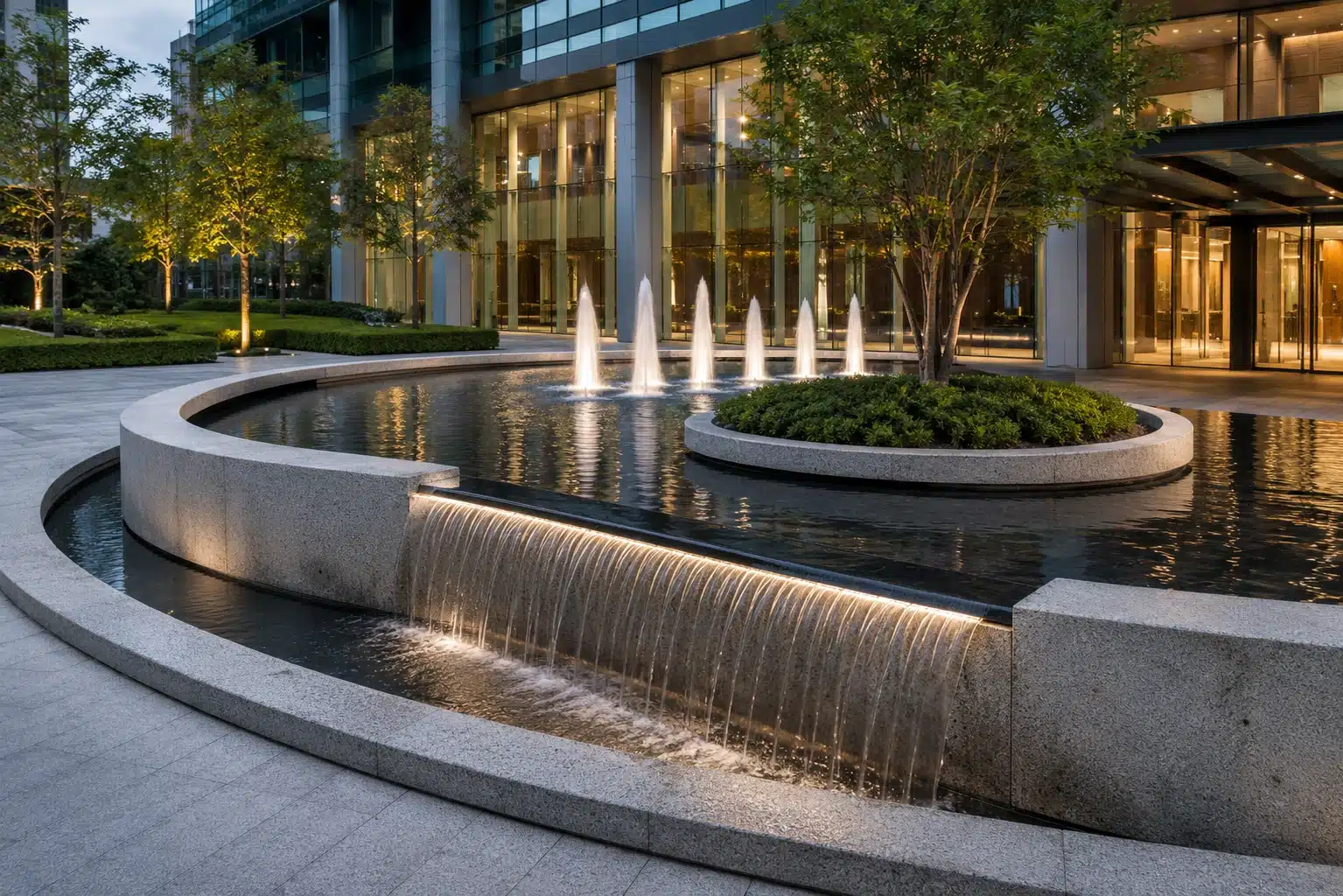
...
The Lightweight Engineering Behind Modern Commercial Water Features

The Lightweight Engineering Behind Modern Commercial Water Features

Concrete has been used in fountain construction for centuries. Its durability, mass, and formability made it the standard material for basins, pedestals, and decorative elements, from Roman public fountains to twentieth-century civic installations.

The limitation of traditional concrete in fountain applications has always been weight. A thick concrete fountain basin is heavy to fabricate, transport, and install, placing structural demands on the building or site beneath it that can be difficult and expensive to accommodate.

Glass fiber-reinforced concrete, universally known in the industry as GFRC, resolves this limitation while retaining the aesthetic versatility and durability that make concrete an excellent fountain material. It is not a substitute or a compromise. It is a superior engineering choice for a wide range of commercial fountain applications.

Why Are GFRC Fountains So Popular in Commercial Projects?

GFRC fountains have become increasingly popular because they offer the appearance and durability of traditional concrete while reducing overall weight by 60–75%. This weight reduction lowers transportation costs, simplifies installation, reduces structural requirements, and gives architects greater design flexibility.

For many commercial fountain projects, GFRC delivers the visual impact of monumental concrete construction without the engineering limitations associated with heavy cast concrete systems. This combination of performance and design flexibility has made GFRC one of the most widely specified materials for modern architectural water features.

What Is GFRC?

GFRC is a composite material made by combining Portland cement, fine aggregates, water, and polymer additives with alkali-resistant (AR) glass fibers.

The glass fibers, distributed throughout the concrete matrix or applied in layers with a cement slurry, act as a reinforcing structure, much like steel rebar in conventional concrete, but at a microscopic scale.

The result is a material with:

  • Significantly higher tensile strength than plain concrete
  • Dramatically lower thickness for equivalent structural performance
  • Weight reductions of 60–75% compared to conventional concrete of equivalent size

A GFRC panel that would weigh 100 pounds in conventional concrete can weigh only 25–30 pounds. This is not a marginal difference. It fundamentally changes structural requirements, transportation logistics, and installation methods.

Why GFRC Is Increasingly Specified for Commercial Fountains

Weight Reduction for Elevated and Structural Installations

For commercial fountain installations on elevated decks, rooftops, podium structures, or upper-floor lobbies, weight is a critical design constraint.

Traditional concrete fountain basins can impose structural loads that necessitate expensive reinforcement of the underlying structure.

GFRC allows designers to achieve the visual mass and texture of concrete with a fraction of the structural impact. A GFRC fountain that appears to be a substantial concrete installation may impose only 25–30% of the structural load its appearance suggests.

This advantage is especially valuable in hospitality, mixed-use, corporate, and residential developments where structural capacity is limited and every pound matters.

Complex Geometric Flexibility

GFRC is spray-applied or hand-packed into molds, allowing it to conform to virtually any geometry.

Compound curves, undercuts, organic shapes, and sculptural profiles that would be difficult or impossible to achieve with traditional cast concrete become practical with GFRC.

This flexibility makes GFRC an excellent material for:

  • Sculptural fountain basins
  • Artistic water feature components
  • Decorative pedestals
  • Architectural cladding
  • Custom fountain surrounds

Designers can create forms that would otherwise require expensive stone carving, metal fabrication, or specialty casting methods.

Surface Finish Versatility

GFRC accepts a wide variety of architectural finishes, making it one of the most adaptable fountain materials available.

Available finish options include:

  • Smooth polished surfaces
  • Exposed aggregate finishes
  • Textured stone-like surfaces
  • Integral pigmentation
  • Acid-washed finishes
  • Sandblasted finishes
  • Travertine-inspired textures
  • Slate-inspired textures

This versatility in finish makes GFRC suitable for both contemporary and traditional fountain aesthetics and allows it to be specified alongside natural stone, stainless steel, copper, or modern metal fountains in multi-material compositions.

Durability and Longevity

GFRC is highly durable in outdoor applications and resists many of the deterioration mechanisms that affect traditional concrete.

Key performance advantages include:

  • Excellent freeze-thaw resistance
  • Reduced water absorption
  • Improved impact resistance
  • Enhanced crack resistance
  • Long-term dimensional stability

Properly manufactured GFRC can maintain structural integrity for more than 30 years in demanding exterior environments.

The alkali-resistant glass fibers specified for modern GFRC applications resist the alkaline environment of Portland cement, preventing the degradation issues that affected early generations of fiber-reinforced concrete.

Proper maintenance practices and routine fountain maintenance help maximize the lifespan, appearance, and structural performance of GFRC fountain components. Regular inspections, cleaning, and sealing can significantly extend service life while reducing long-term maintenance costs.

485.1.Commercial-fountains

GFRC vs. Cast Concrete vs. GFRC-Faced Systems

When evaluating fountain materials, architects and developers often compare GFRC directly against traditional cast concrete. While both materials share a cement-based composition, their performance characteristics differ significantly.

GFRC vs. Traditional Concrete

Characteristic GFRC Traditional Concrete
Weight 60–75% Lighter Heavy
Structural Load Lower Higher
Design Flexibility Excellent Moderate
Installation Complexity Lower Higher
Transportation Cost Lower Higher
Sculptural Capability Excellent Limited
Freeze-Thaw Resistance Excellent Good

The most significant difference between GFRC and traditional concrete is weight.

By dramatically reducing structural load while maintaining strength and durability, GFRC expands the range of locations where large-scale fountains can be installed, including rooftop terraces, elevated podium decks, upper-level courtyards, and interior architectural spaces.

For many modern developments, this flexibility can eliminate the need for costly structural reinforcement while preserving the desired visual impact.

GFRC vs. Solid Cast Concrete

For fountain applications, GFRC panels typically range from 3/4 inch to 1-1/2 inches thick while providing performance comparable to conventional concrete sections that may be 4–6 inches thick.

The reduction in thickness and weight creates several advantages:

  • Lower transportation costs
  • Easier installation
  • Reduced crane requirements
  • Faster construction schedules
  • Lower structural loads

GFRC can be used to create:

  • Complete fountain basins
  • Decorative fountain cladding
  • Sculptural fountain elements
  • Architectural water feature components
  • Decorative wall fountain surrounds

Because of its flexibility, designers can often achieve forms and profiles that would be difficult or impractical with traditional concrete construction.

GFRC-Faced Systems

A common approach in commercial fountain construction combines structural concrete or steel with GFRC facing panels.

In these hybrid systems, the structural basin provides waterproofing and load-bearing capacity, while GFRC panels provide the finished architectural appearance.

This approach offers several benefits:

  • Structural reliability
  • Reduced visible weight
  • Improved design flexibility
  • Easier future repairs
  • Greater finish customization

Large commercial fountain installations frequently use this method because it balances engineering requirements with aesthetic goals.

Quality Specifications for Commercial GFRC Fountains

Not all GFRC products are manufactured to the same standards. Commercial fountain applications require high-quality fabrication practices and strict quality control procedures.

AR Glass Fiber Content

Alkali-resistant (AR) glass fibers provide the tensile reinforcement that gives GFRC its strength. Commercial fountain components should typically contain a minimum of 5% AR glass fiber content by weight of cementitious materials. Lower fiber content can reduce performance and long-term durability.

Polymer Content

Modern GFRC formulations typically include acrylic or PVA polymer additives. Benefits include:

  • Improved water resistance
  • Reduced permeability
  • Enhanced freeze-thaw performance
  • Increased durability

Water-Cement Ratio

Commercial fountain applications should utilize a low water-cement ratio in the recommended range of 0.35–0.40. This helps minimize permeability and improves long-term strength.

Compressive Strength

High-quality GFRC fountain components should typically achieve a minimum of 5,000 PSI compressive strength at 28 days. Many premium fabricators exceed this benchmark.

Modulus of Rupture (MOR)

For structural panel applications, minimum MOR values should generally exceed 2,000 PSI. This provides the flexural performance necessary for large fountain components.

Industry Standards

Commercial projects should specify compliance with the PCI MNL-130 Manual for Quality Control for Plants and Production of Glass Fiber Reinforced Concrete Products.

For large projects, mock-up panels should be required before production begins. Mock-ups allow the project team to verify color, texture, surface finish, aggregate exposure, and overall appearance before committing to full fabrication.


Installation Considerations for GFRC Fountain Components

GFRC components are typically fabricated off-site and transported to the project location for installation. This controlled fabrication environment often results in higher quality and greater consistency than site-built construction.

Connection Design

GFRC panels must be attached to supporting structures using properly engineered connection systems. Typical attachment methods include:

  • Embedded anchors
  • Stainless steel brackets
  • Flex anchors
  • Mechanical fastening systems

Rigid attachment systems that restrict movement can lead to cracking and premature failure.

Thermal Movement

Like all cement-based materials, GFRC expands and contracts with temperature changes. Designs must accommodate:

  • Thermal expansion and contraction
  • Structural movement
  • Differential movement between materials

Proper detailing prevents unnecessary stress concentrations.

Installation and Safety 768x512 1

Sealant Joints

Panel-to-panel joints and transitions between GFRC and adjacent materials require flexible sealants. High-performance sealants help accommodate movement, prevent water intrusion, improve durability, and maintain aesthetic appearance. Joint design should be coordinated early in the design process.

Waterproofing Considerations

When GFRC is used in a fountain basin system, waterproofing remains critical. Common approaches include:

  • Stainless steel liners
  • Waterproof membrane systems
  • Hybrid waterproofing assemblies

While GFRC provides strength and appearance, dedicated waterproofing systems are typically required for long-term watertight performance.

Long-Term Maintenance of GFRC Commercial Fountains

GFRC fountains are considered relatively low-maintenance compared to many traditional fountain materials. However, regular care remains important to preserve appearance, structural integrity, and long-term performance. A proactive maintenance program helps protect the owner’s investment while minimizing repair costs and operational disruptions.

Sealing

Penetrating sealers designed for cementitious materials can improve water resistance and reduce staining. Benefits include:

  • Reduced moisture absorption
  • Improved stain resistance
  • Enhanced freeze-thaw performance
  • Easier cleaning

Most commercial fountain installations benefit from resealing every three to five years, depending on climate, water chemistry, and exposure conditions.

Efflorescence Management

Efflorescence is the migration of calcium salts to the surface of cement-based materials. In newly installed GFRC fountains, some efflorescence is normal and typically decreases over time as the material matures.

Management strategies include:

  • Routine cleaning
  • Mild acid washing when appropriate
  • Proper drainage design
  • Maintaining balanced water chemistry

While efflorescence is usually cosmetic rather than structural, addressing it helps preserve the fountain’s appearance.

Crack Monitoring

Hairline cracks occasionally develop in cement-based materials and are often superficial. Routine inspections should evaluate crack size, crack progression, water infiltration, and structural movement.

Stable hairline cracks generally require only monitoring, while growing cracks or movement-related cracking should be evaluated by the original fabricator or an experienced fountain specialist.

Cleaning and Surface Care

Routine cleaning helps preserve the architectural finish and prevent staining. Recommended practices include:

  • Regular debris removal
  • Gentle cleaning with approved products
  • Avoiding harsh chemicals
  • Periodic inspection of sealants and joints
  • Monitoring water quality

Combined with routine fountain maintenance, these practices help maximize the lifespan of GFRC fountain components.

Key Takeaway

GFRC combines the appearance of traditional concrete with dramatically reduced weight, making it one of the most versatile materials available for commercial fountain construction.

Its strength, finish flexibility, durability, and structural efficiency make it particularly valuable for:

  • Rooftop fountains
  • Elevated podium installations
  • Hospitality developments
  • Mixed-use projects
  • Corporate plazas
  • Large architectural water features

As commercial fountain designs continue to become more ambitious, GFRC offers a practical solution that balances aesthetics, engineering performance, transportation efficiency, and installation flexibility.

For many modern fountain projects, GFRC delivers the visual impact of monumental concrete construction without the structural challenges traditionally associated with heavy cast concrete systems.

Work With Fountains.com

Fountains.com designs and fabricates custom commercial fountains using GFRC, stainless steel, stone, copper, and multi-material combinations.

Our design team works closely with architects, developers, landscape architects, contractors, and property owners to identify the optimal material system for each project’s structural, aesthetic, and operational requirements.

Whether you’re planning a rooftop water feature, hospitality fountain, civic installation, or large-scale architectural centerpiece, we can help determine whether GFRC is the right solution for your project.

We also offer expertise across a broad range of commercial fountains, helping clients balance appearance, performance, maintenance requirements, and budget considerations.

Contact our team to discuss your project or explore our portfolio of custom fountain solutions.

FAQs:

GFRC can be used in fountain basin applications but typically requires a waterproofing system.
Common approaches include:

  • Waterproof membrane systems
  • Stainless steel liners
  • Hybrid waterproofing assemblies

GFRC should generally not be relied upon as the sole waterproof barrier for long-term submerged applications.

GFRC offers significantly higher compressive strength and often provides a more natural architectural appearance than fiberglass (FRP).
Fiberglass may be lighter and advantageous for extremely large or complex components, while GFRC is often preferred when a stone-like appearance is desired.
Both materials can perform well when properly engineered.

Yes.
Minor damage and localized defects can typically be repaired using compatible cementitious repair materials.
More extensive repairs should be performed by contractors experienced in GFRC restoration to ensure proper color matching, texture matching, and structural performance.

If the fountain is being fully winterized and drained, submersible pumps should generally be removed and stored in a climate-controlled environment.

Proper storage helps protect seals, bearings, and other components during extended shutdown periods and can improve long-term equipment reliability.

High-quality GFRC manufactured with alkali-resistant glass fibers and modern polymer additives has demonstrated service lives exceeding 30 years in outdoor applications.
Proper detailing, waterproofing, drainage, sealing, and maintenance all contribute significantly to long-term durability.

Initial fabrication costs may be higher than basic cast concrete in some applications.
However, reduced transportation costs, lower installation expenses, reduced structural requirements, and increased design flexibility often create overall project savings.
For many commercial fountain projects, the total installed cost can be highly competitive when compared to traditional concrete systems.

Yes.
One of GFRC’s greatest advantages is its finish flexibility.
GFRC can replicate:

  • Natural stone
  • Travertine
  • Limestone
  • Slate
  • Smooth contemporary concrete
  • Exposed aggregate finishes

This versatility makes it suitable for both modern and classical fountain aesthetics.

SUMMER SALE: 10% OFF ALL PRODUCTS
Use Code: SUMMER10