Introduction: When Grandeur No Longer Needs Excess
For centuries, fountains have been synonymous with monumentality. They were grand, imposing, and unapologetically dominant, symbols of power, wealth, and civic pride. From Roman aqueduct-fed plazas to Baroque water spectacles, monumental fountains were designed to overwhelm the senses and assert authority over space.
But something has changed.
In contemporary design, especially in the world of architecture, landscape design, and experiential branding, scale no longer equals significance. Today, we are witnessing the rise of the monumental fountain without monumentality, water features that command attention and emotional impact without being physically massive or visually overpowering.
This shift is not a rejection of grandeur; it is a redefinition of it.
Modern fountains, whether outdoor water fountains in urban courtyards, indoor fountains in hospitality spaces, or minimalist rain curtain water features, are now designed to feel monumental rather than look monumental. They rely on proportion, rhythm, sound, materiality, and human interaction rather than sheer size.
In this article, we explore how fountains are evolving, how designers are creating presence without excess, and how this new approach applies across outdoor fountains, indoor water fountains, wall fountains, floor fountains, tabletop fountains, garden fountains, and rain curtain fountains.
The Historical Obsession With Monumentality
To understand the shift, we must first understand the tradition.
Historically, monumental fountains were expressions of dominance over nature. Water was scarce, difficult to transport, and expensive to control. A massive fountain signaled technological prowess and political authority. The louder, taller, and more complex the water display, the greater the statement.
Classic monumental fountains shared several traits:
- Enormous scale
- Central placement
- Heavy ornamentation
- Figurative sculpture
- Loud, dramatic water movement
They were meant to be seen from afar, often from multiple vantage points, reinforcing hierarchy and control.
But modern life no longer demands this kind of visual hierarchy.
Why Monumentality Feels Outdated Today
Contemporary audiences experience space differently. Cities are denser, attention spans shorter, and environmental awareness stronger. A fountain that dominates space can now feel intrusive rather than inspiring.
Several cultural shifts have driven the move away from traditional monumentality:
1. Human-Centered Design
Modern architecture prioritizes human experience over symbolic dominance. A water fountain should invite interaction, not intimidate.
2. Sustainability and Resource Awareness
Large-scale fountains consume more water, energy, and maintenance. Smaller, smarter water features communicate responsibility and restraint.
3. Minimalism and Material Honesty
Design today favors clean lines, authentic materials, and subtle expression. Ornamentation is replaced with precision.
4. Emotional Impact Over Visual Noise
People remember how a space feels, not how loud it is. Sound, reflection, and movement now matter more than spectacle.
The result? Fountains that are monumental in presence, not in mass.
Defining the Monumental Fountain Without Monumentality
A monumental fountain without monumentality is not defined by size or decoration. It is defined by experience.
These fountains often share the following qualities:
- Carefully controlled water movement
- Strong geometric or architectural alignment
- Integration with surrounding space
- Emphasis on sound, reflection, and rhythm
- Simplicity that invites contemplation
Whether it’s a rain curtain fountain in a hotel lobby or a minimalist outdoor water fountain in a corporate plaza, the goal is the same: to create meaning without excess.
Outdoor Fountains: Presence Through Placement
Outdoor Water Fountains as Spatial Anchors
Modern outdoor fountains no longer sit at the center of a plaza demanding attention. Instead, they are often integrated along pathways, edges, or architectural axes.
An outdoor water fountain today may:
- Guide movement through space
- Create acoustic separation from traffic
- Reflect architecture rather than compete with it
By aligning water features with human circulation, designers create subtle monumentality, spaces that feel important without shouting.
Garden Fountains: Intimacy Over Dominance
Garden fountains exemplify this shift beautifully. Rather than towering centerpieces, contemporary garden fountains are often:
- Low-profile
- Material-driven (stone, corten steel, concrete)
- Designed for close interaction
A small garden fountain with gentle water flow can feel more monumental than a massive sculptural piece if it resonates emotionally with the viewer.
Indoor Fountains: Quiet Authority
Indoor Water Fountains and Emotional Scale
Indoor fountains operate under different rules. Confined spaces demand restraint, yet the desire for impact remains.
Modern indoor water fountains rely on:
- Verticality rather than volume
- Sound attenuation rather than projection
- Light interaction rather than ornament
An indoor fountain doesn’t need to be large to be powerful. A carefully designed wall fountain or rain curtain can define an entire interior environment.
Wall Fountains as Architectural Elements
Wall fountains are perhaps the clearest example of monumentality without mass. Integrated directly into architectural surfaces, they blur the line between structure and water feature.
Benefits of wall fountains include:
- Minimal footprint
- Strong visual presence
- Calm, continuous sound
In offices, hotels, and wellness spaces, wall fountains create moments of pause without overwhelming the interior.
Rain Curtain Fountains: Monumentality in Motion
The Rise of the Rain Curtain Water Feature
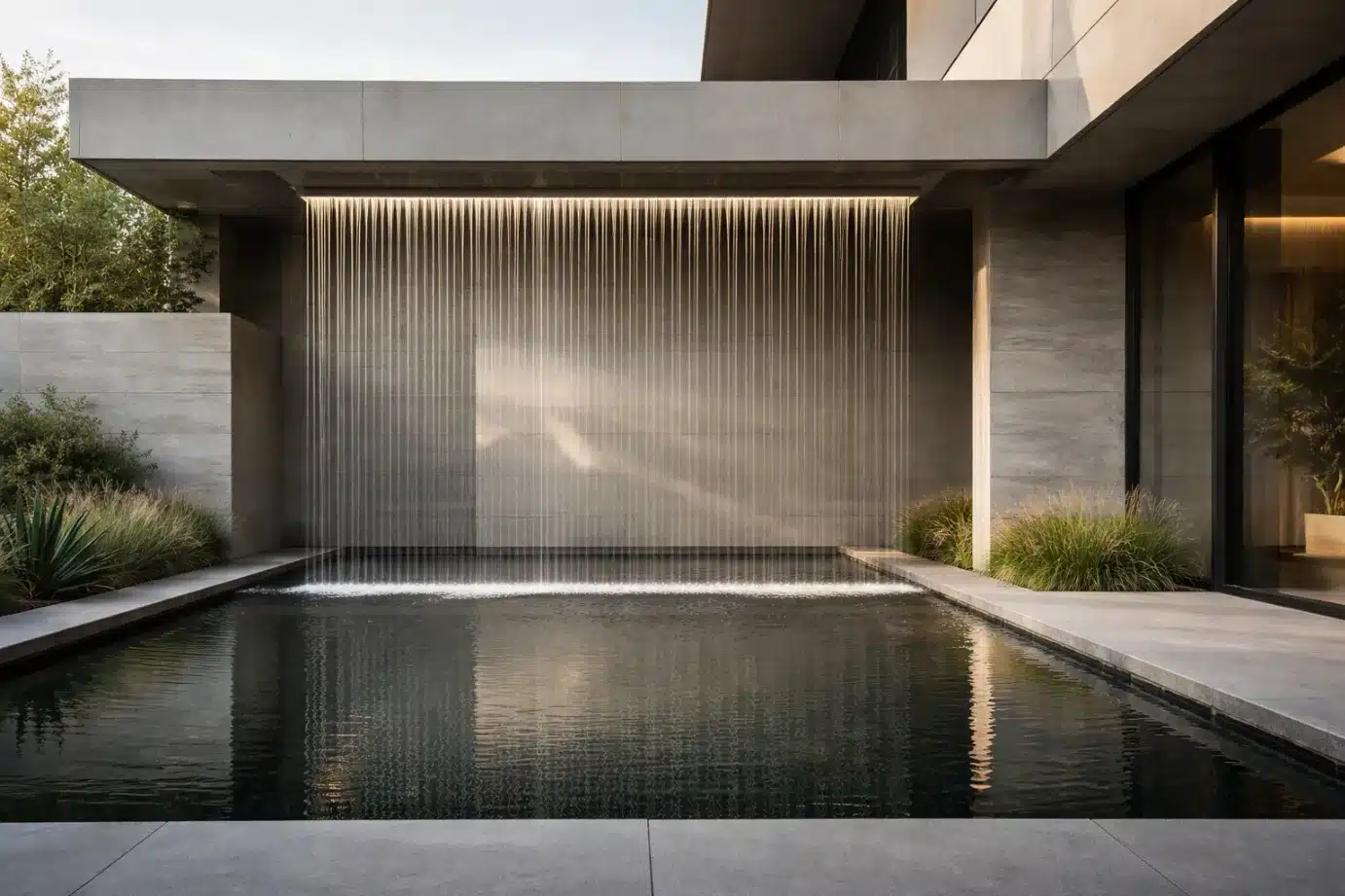
Few water features embody modern monumentality better than the rain curtain fountain. Composed of evenly spaced water streams falling in a controlled plane, rain curtain water features feel both technological and poetic.
They achieve impact through:
- Precision rather than volume
- Repetition rather than chaos
- Transparency rather than mass
A rain curtain fountain can span several meters yet feel light, almost immaterial.
Indoor and Outdoor Applications
Rain curtain fountains work equally well indoors and outdoors:
- Indoors, they define zones without walls
- Outdoors, they frame views and soften architecture
Whether used as a lobby centerpiece or a transitional outdoor element, rain curtain water features communicate sophistication and restraint.
Floor Fountains: The Ground as Stage
Floor fountains reject the idea of elevation altogether. Instead of rising above the viewer, they emerge from the ground plane.
This inversion creates a powerful psychological effect:
- The viewer becomes part of the fountain
- Space feels activated rather than dominated
- Water becomes experiential rather than observational
Floor fountains in public spaces encourage interaction, movement, and play, an entirely different kind of monumentality rooted in participation.
Tabletop Fountains: Small Scale, Deep Impact
Rethinking Monumentality at the Micro Level
Tabletop fountains may seem like the opposite of monumental, yet they demonstrate how presence is not tied to size.
In homes, offices, and hospitality spaces, tabletop fountains:
- Introduce water features at a personal scale
- Create calm through sound and repetition
- Serve as intimate focal points
These small water fountains prove that monumentality is not about physical dominance—it’s about emotional resonance.
Indoor Fountains and Brand Identity
In commercial spaces, fountains increasingly function as brand statements rather than decorative objects.
Modern indoor fountains communicate:
- Precision
- Calm confidence
- Technological refinement
A minimalist indoor water fountain aligns well with brands that value clarity, innovation, and human-centered design. The absence of excess becomes the message.
Water Features as Environmental Storytelling
The monumental fountain without monumentality tells a story, not of power, but of balance.
Through water features, designers now express:
- Sustainability
- Respect for resources
- Harmony between architecture and nature
By controlling water flow, reducing splash, and optimizing recirculation, modern fountains demonstrate responsibility without sacrificing beauty.
The Sensory Power of Restraint
True monumentality today is sensory, not visual.
Sound
The gentle white noise of water fountains reduces stress and masks unwanted sound without overwhelming the ear.
Movement
Slow, consistent motion draws attention longer than chaotic displays.
Reflection
Still or lightly rippled surfaces double space visually, creating depth without adding volume.
When these elements are carefully balanced, even the simplest fountain can feel profound.
Designing for the Future of Fountains
As cities evolve and private spaces become more intentional, the future of fountains lies in:
- Modular systems
- Customizable water features
- Adaptive indoor and outdoor applications
From rain curtain fountains to garden fountains and wall fountains, the emphasis will remain on quality of experience over quantity of material.
The monumental fountain without monumentality is not a trend—it is a reflection of how we now define value, beauty, and meaning.
Conclusion: Monumentality Reimagined
We no longer need fountains to tower over us to feel their importance.
Today’s most powerful water fountains whisper rather than shout. They integrate rather than dominate. They invite reflection rather than demand attention.
Whether it’s an outdoor fountain in a public plaza, an indoor wall fountain in a hotel, a rain curtain water feature defining space, or a quiet tabletop fountain in a private room, modern water features achieve monumentality through intention, restraint, and emotional intelligence.
In redefining monumentality, we are not making fountains smaller, we are making them smarter.