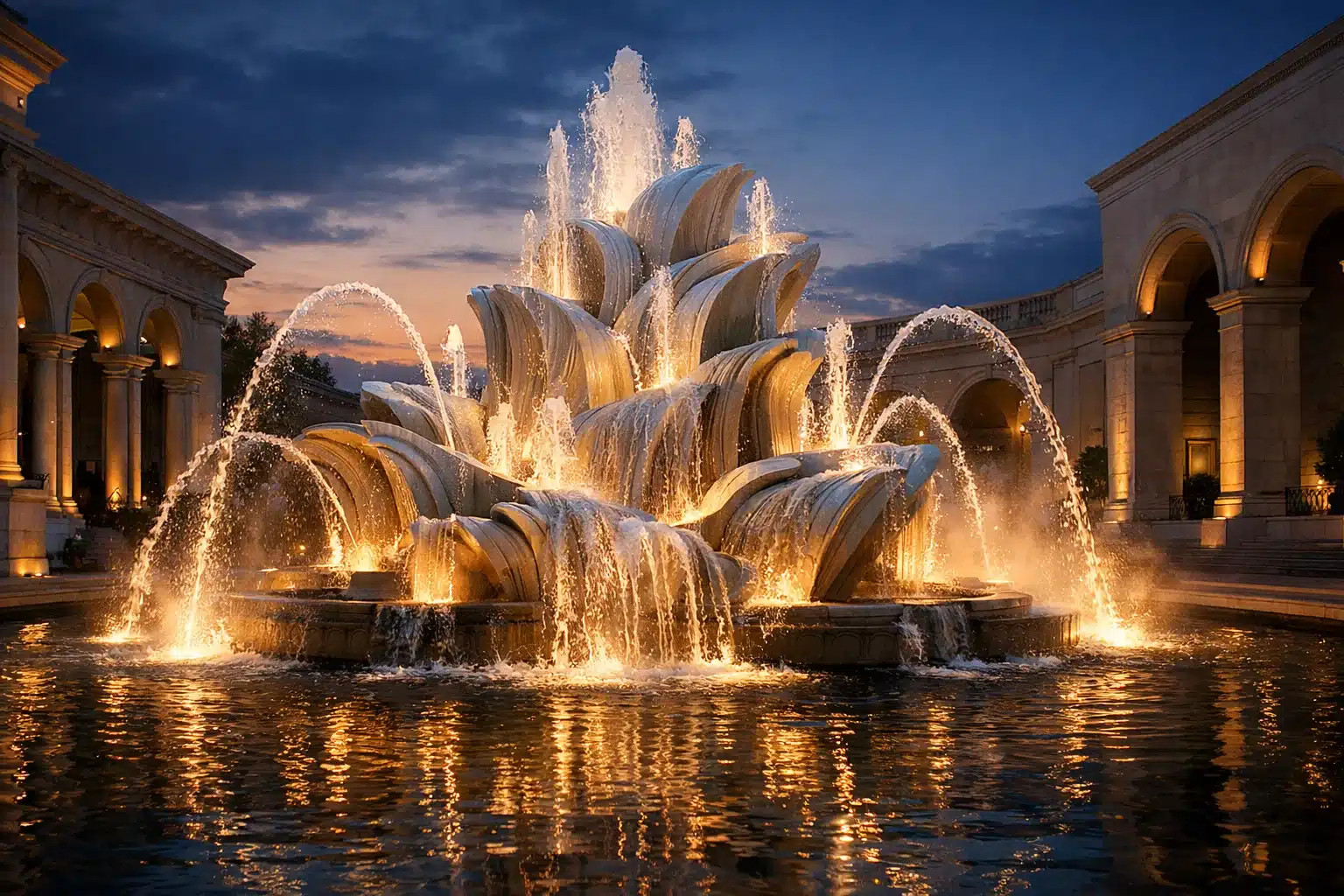
Introduction: When Excess Returns With Intention
Design history rarely moves in a straight line. Instead, it spirals, revisiting past movements, reinterpreting them through new technologies, values, and cultural priorities. One of the most striking examples of this cyclical evolution is the Neo-Baroque revival, a contemporary design movement that reclaims the drama, sensuality, and excess of the Baroque era while recontextualizing it for modern sensibilities.
At the heart of this revival lies water art, fountains, cascades, reflective pools, mist installations, and kinetic fluid sculptures that transform space into spectacle. Once a symbol of absolute power and divine authority in 17th-century Europe, water is now being used to communicate emotion, luxury, sustainability, and immersive experience.
From ultra-luxury hotels and private estates to museums, public plazas, and even retail environments, opulent water features are once again commanding attention. But this is not a simple return to gilded cherubs and symmetrical basins. Neo-Baroque water art merges historical exuberance with digital fabrication, sustainable engineering, and contemporary minimalism, creating a bold paradox that feels both ancient and futuristic.
This article explores the roots of Baroque water design, the forces behind its modern resurgence, and how today’s designers are using water as a medium for storytelling, power, and sensory immersion.
Understanding Baroque Water Art: Power Made Fluid
Water as Political and Spiritual Theater
In the original Baroque period (roughly 1600–1750), water was never merely decorative. It was ideological.
Grand fountains at Versailles, Rome, and Vienna were designed to:
- Demonstrate dominion over nature
- Reinforce monarchic and religious authority
- Create theatrical experiences that evoked awe and submission
Water was animated, forced upward against gravity, choreographed into elaborate displays, and framed by sculpture, architecture, and sound. The complexity of hydraulic systems themselves became a symbol of intellectual and technological superiority.
Sensory Excess as a Design Philosophy
Baroque design rejected restraint. It embraced:
- Movement over stillness
- Curves over straight lines
- Contrast over harmony
- Emotion over rationality
Water amplified these qualities. Its reflective surfaces multiplied light and ornamentation, while its sound softened stone and architecture with rhythm and life. The result was a multisensory environment where visitors were not just observers, but participants.
Why Neo-Baroque Now? Cultural and Design Catalysts
The End of Strict Minimalism
After decades dominated by minimalist aesthetics, clean lines, neutral palettes, and visual restraint, design culture is shifting. Many designers and clients are seeking emotional richness and visual impact rather than austerity.
Neo-Baroque water art answers this desire by offering:
- Drama without chaos
- Complexity without clutter
- Ornament with intention
Water provides a dynamic counterbalance to modern architectural rigidity, softening steel, glass, and concrete with movement and reflection.
The Experience Economy
In a world saturated with images and content, experience has become currency. Hospitality, retail, and cultural spaces now compete not just on function, but on memorability.
Opulent water installations:
- Encourage social sharing and photography
- Create immersive environments
- Establish iconic brand identities
A dramatic fountain or mist-filled atrium is no longer an indulgence, it’s a strategic design investment.
Technological Advancements in Water Design
Modern water art is powered by tools the Baroque masters could only dream of:
- Computer-controlled pumps and lighting
- Precision-engineered nozzles
- Sustainable water recycling systems
- Interactive sensors and AI-driven choreography
These technologies allow designers to achieve unprecedented complexity while maintaining efficiency and environmental responsibility.
Defining Neo-Baroque Water Art in Contemporary Design
Neo-Baroque water art is not about copying historical motifs. Instead, it draws on Baroque principles and translates them into modern forms.
Key characteristics include:
1. Theatrical Movement
Water is choreographed, not static. Jets rise and fall, cascades pulse, and mist drifts through space in carefully designed sequences.
2. Sculptural Fluidity
Rather than symmetrical basins, contemporary water art often takes sculptural forms, spirals, folds, and organic geometries that echo Baroque dynamism without literal ornament.
3. Light as Ornament
LED lighting replaces gold leaf. Color, shadow, and reflection become the new decoration, transforming water into a luminous material.
4. Emotional Narrative
Each installation tells a story, of abundance, serenity, power, or transcendence, aligning with the Baroque goal of emotional engagement.
Neo-Baroque Water Art Across Design Disciplines

Architecture: Buildings That Perform
In contemporary architecture, water is increasingly integrated into the building itself rather than appended as landscaping.
Examples include:
- Atriums with vertical water curtains
- Facades incorporating flowing water panels
- Interior courtyards animated by reflective pools
These features blur the boundary between structure and spectacle, turning architecture into a living, breathing entity.
Landscape Design: Gardens Reimagined
Modern landscape designers are revisiting Baroque garden principles, axial planning, controlled vistas, and dramatic focal points, while softening them with organic planting and sustainable practices.
Neo-Baroque landscapes often feature:
- Long, linear reflecting pools
- Overflowing edges that suggest abundance
- Hidden water sources that create surprise
The result is a space that feels both ordered and alive.
Interior Design: Water as Luxury Material
Water is no longer confined outdoors. In high-end interiors, it appears as:
- Indoor fountains and rills
- Water walls in lobbies and spas
- Reflective pools beneath staircases or skylights
These installations elevate interiors from static spaces to immersive environments, aligning with the Neo-Baroque emphasis on sensory richness.
Sustainability and the New Ethics of Opulence
One of the most significant differences between historical Baroque water art and its contemporary counterpart is ethics.
Today’s opulence must justify itself.
- Closed-Loop Water Systems
- Modern installations use recirculated water, dramatically reducing consumption while maintaining visual abundance.
- Energy-Efficient Technologies
- High-efficiency pumps, gravity-fed systems, and smart controls minimize energy use without sacrificing performance.
- Symbolic Abundance, Not Waste
Neo-Baroque water art often suggests excess rather than literally consuming it. Thin sheets of water, mist, and reflection create the illusion of abundance with minimal resources.
This shift allows designers to embrace grandeur while respecting environmental realities.
Cultural Symbolism: Why Water Still Means Power
Despite changing values, water remains one of the most potent symbols in design.
It represents:
- Life and renewal
- Wealth and control
- Time and impermanence
- Calm and chaos simultaneously
In a global context marked by climate anxiety and resource scarcity, opulent water art carries layered meaning. It can be aspirational, provocative, or even critical, inviting viewers to reflect on humanity’s relationship with nature.
Digital Baroque: Technology as Ornament
One of the most exciting aspects of the Neo-Baroque revival is its relationship with digital technology.
Algorithmic Choreography
Water displays can now respond to:
- Music
- Foot traffic
- Weather conditions
- Time of day
This responsiveness echoes the Baroque fascination with movement and transformation, translated into a digital language.
Augmented Reality and Projection
Projection mapping turns water into a canvas for light, pattern, and narrative, adding a new layer of ornamentation that is ephemeral rather than permanent.
Data-Driven Design
Designers use computational tools to model fluid dynamics, creating forms that feel both natural and otherworldly, an evolution of the Baroque obsession with complexity.
Criticism and Controversy: Is Neo-Baroque Too Much?
Not everyone embraces the return of opulence.
Critics argue that:
- It risks superficial spectacle
- It may prioritize aesthetics over social function
- It can feel exclusionary or elitist
However, proponents counter that Neo-Baroque water art is not about excess for its own sake. Instead, it reclaims emotion, craftsmanship, and sensory engagement in an era often dominated by efficiency and abstraction.
When executed thoughtfully, it can enrich public space, elevate cultural dialogue, and reconnect people with the elemental power of water.
The Future of Neo-Baroque Water Art
Looking ahead, several trends are shaping the next phase of this revival:
- Biophilic Integration: Water features designed to support ecosystems, not just aesthetics
- Public Accessibility: Grand water art moving beyond private luxury into civic spaces
- Hybrid Aesthetics: Combining Baroque drama with minimalist framing
- Adaptive Systems: Installations that evolve over time rather than remaining static
As designers continue to explore the balance between abundance and responsibility, Neo-Baroque water art is likely to become more nuanced, layered, and culturally resonant.
Conclusion: A Return to Wonder
The Neo-Baroque revival is not nostalgia, it is a reassertion of wonder in contemporary design. By embracing opulent water art, designers are pushing back against visual fatigue and emotional detachment, reintroducing movement, sensuality, and drama into the built environment.
Water, in its endless adaptability, becomes the perfect medium for this expression. It reflects our technologies, values, and contradictions, simultaneously controlled and uncontrollable, luxurious and essential.
In an age defined by speed and simplicity, Neo-Baroque water art invites us to pause, to feel, and to be overwhelmed, in the best possible way.