...
Variable Frequency Drives for Commercial Fountain Pumps: Engineering Guide for Efficient Fountain Systems

Variable Frequency Drives for Commercial Fountain Pumps: Engineering Guide for Efficient Fountain Systems

In commercial fountain engineering, pump performance directly influences nearly every part of long-term system success, from water behavior and acoustic control to energy consumption, maintenance requirements, and equipment lifespan.

While the visual design of a fountain often receives the most attention, the hydraulic system behind the installation determines whether the feature performs reliably year after year.

For decades, many fountain systems relied on fixed-speed pumps. The equipment was either fully on or completely off, with flow controlled mechanically through throttling valves. While functional, that approach introduced avoidable energy waste, increased startup stress, limited hydraulic flexibility, and more operational noise.

Variable Frequency Drives changed that.

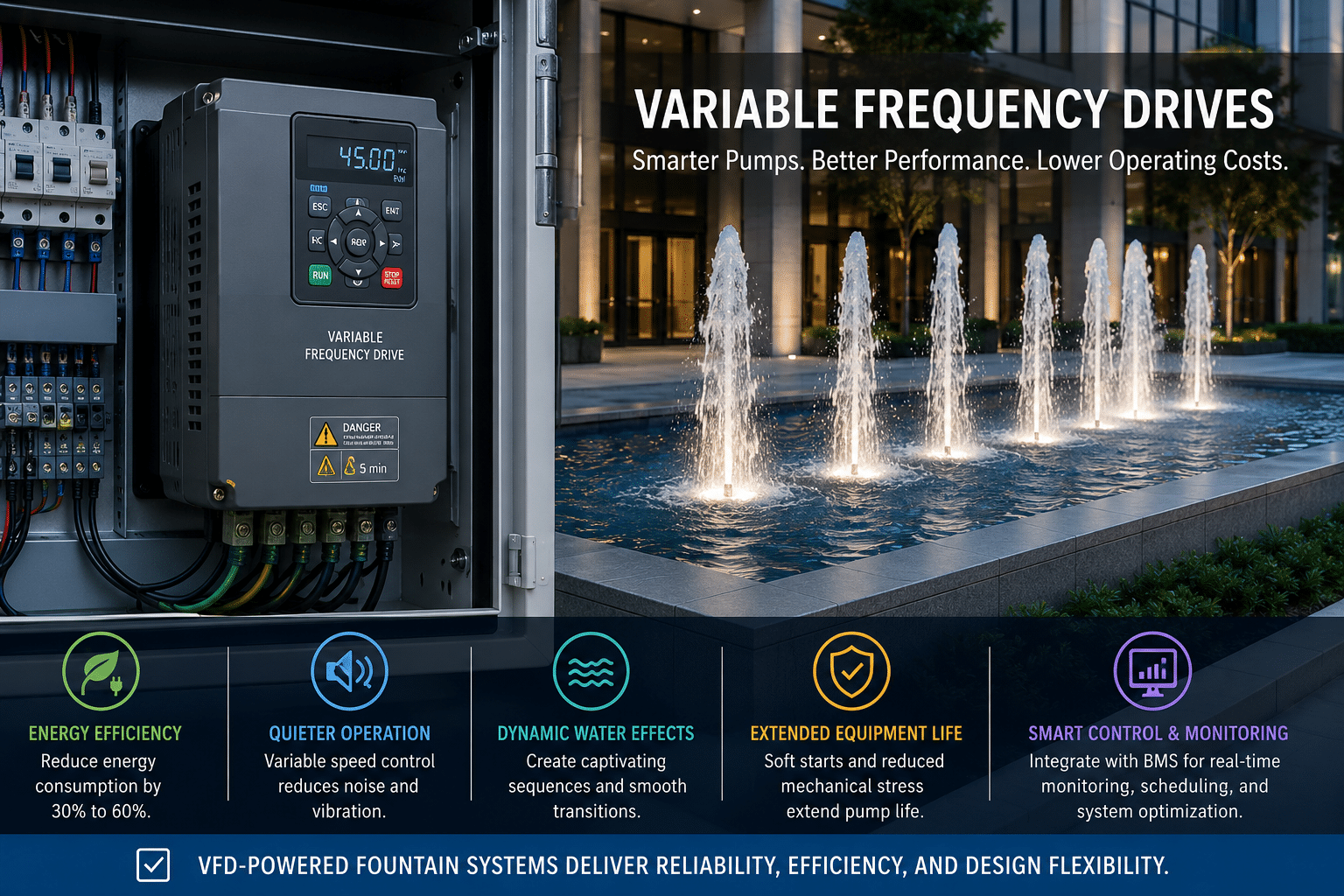
Today, VFD-controlled pump systems are considered a best practice for many commercial fountains because they improve hydraulic precision, lower operating costs, support dynamic sequencing, reduce equipment wear, and give facilities teams significantly more control over long-term operation.

For architects, developers, MEP engineers, fountain consultants, and owners involved in custom commercial fountains or large-scale architectural water features, understanding VFD integration is an important part of specifying efficient, reliable fountain systems.

 Fountains Blog


VFD System Design Checklist for Commercial Fountains

Before finalizing fountain engineering documents, project teams should coordinate the following VFD-related requirements.

CategoryKey Coordination Items
Electrical CoordinationVoltage requirements, motor FLA, disconnects, breaker sizing
Pump IntegrationPump curves, TDH calculations, variable-flow ranges
Controls IntegrationPLC coordination, Modbus/BACnet communication, BMS integration
Enclosure ProtectionNEMA 12 or NEMA 4X ratings
Acoustic PerformanceNoise reduction targets and operating ranges
Energy EfficiencyVariable flow scheduling and nighttime setback modes
Dynamic Water EffectsSequencing logic and synchronized speed modulation
Cooling & VentilationMechanical room ventilation and ambient temperature limits
Maintenance AccessService clearances and fault log accessibility
CommissioningRamp settings, acceleration curves, and fault testing

What Is a Variable Frequency Drive?

A Variable Frequency Drive, commonly called a VFD, is an electronic motor controller that adjusts pump speed by changing the electrical frequency supplied to the motor.

In commercial fountain engineering, this allows pump output to respond precisely to hydraulic demand instead of operating at one fixed speed.

That flexibility gives fountain engineers direct control over water flow rates, head pressure, energy consumption, acoustic performance, startup behavior, and sequencing through one programmable platform.

Instead of restricting flow with partially closed valves, the drive adjusts the motor itself to deliver only the hydraulic output required.

For modern commercial fountains and premium outdoor installations, that precision creates measurable advantages in efficiency, reliability, and overall water presentation.

Why Fixed-Speed Fountain Pumps Create Limitations

Understanding VFD value starts with understanding the operational limitations of fixed-speed systems.

Inefficient Flow Control

Traditional fixed-speed pumps often regulate flow by partially closing valves downstream.

Because the pump continues operating at full speed, excess energy turns into turbulence and heat, hydraulic efficiency drops, and operating costs rise unnecessarily.

Variable-speed control solves this by adjusting pump output directly.

Harsh Electrical Startup

Fixed-speed pumps create high inrush current during startup, often drawing several times their normal running amperage.

Repeated hard starts place additional stress on motor windings, bearings, couplings, breakers, electrical panels, and supply wiring.

Over time, that mechanical wear becomes costly.

Limited Water Effect Flexibility

Fixed-speed operation limits fountains to basic on-and-off behavior.

That restricts programming flexibility and makes it difficult to create transitions or layered hydraulic scenes.

For premium commercial installations, that becomes a major design limitation.

Higher Acoustic Levels

Pumps running continuously at maximum speed generate more vibration and mechanical noise.

This becomes especially important in hotel lobbies, mixed-use developments, healthcare environments, corporate plazas, and hospitality spaces where sound quality matters.

How Variable Frequency Drives Improve Fountain Performance

Energy Efficiency

Energy savings are one of the most important reasons VFDs are specified in commercial fountain systems.

Pump power follows the Affinity Laws, where energy demand changes approximately with the cube of pump speed.

That means:

80% speed uses roughly 51% power

60% speed uses roughly 22% power

In many commercial fountain applications, VFD systems reduce pump energy usage by 30% to 60% compared with valve-throttled fixed-speed operation.

For fountains running daily, long-term savings can become substantial.

Soft Starting and Reduced Mechanical Stress

VFDs ramp motors gradually from zero to operating speed over a programmable period.

That reduces electrical inrush, bearing wear, coupling stress, startup shock loading, and cavitation risk.

For fountains cycling multiple times per day, this creates measurable reliability benefits.

Dynamic Water Effects and Programmable Sequences

Variable-speed pump control makes water effects possible that fixed-speed systems cannot deliver.

VFD-controlled fountains can create gradual reveals, pulsing displays, layered transitions, synchronized sequences, and lower-flow nighttime operation while maintaining consistent hydraulic performance.

For custom commercial fountains, that flexibility transforms the water feature into an active architectural element capable of evolving visually throughout the day.

Acoustic Control

Variable-speed control also improves sound management.

Engineers can fine-tune flow for quieter evening operation, hospitality-focused acoustic balance, event scheduling, and lower lobby noise.

This has become increasingly important in premium hospitality and mixed-use projects.

Controls Integration and BMS Coordination

Modern fountain engineering increasingly connects VFDs to centralized automation.

Integrated communication protocols allow fountain sequence controls, lighting systems, remote monitoring platforms, and building automation systems to operate through one coordinated strategy.

Facilities teams gain direct visibility into runtime conditions, energy use, alarms, water levels, and variable-speed schedules from one centralized platform.

For larger fountain systems, this improves operational oversight while supporting long-term fountain maintenance planning.

Long-Term ROI of VFD-Controlled Fountain Systems

Over the lifespan of a commercial fountain installation, VFDs often provide significant operational value.

Lower energy consumption, reduced equipment wear, longer motor life, quieter operation, improved hydraulic stability, and greater control flexibility all contribute to measurable lifecycle savings.

For larger hospitality and civic installations, properly engineered architectural water features paired with VFD-driven pump systems can deliver substantial operational value over the life of the project.

Need Help Engineering Commercial Fountain Pump Systems?

Early VFD coordination often improves hydraulic performance, reduces energy consumption, minimizes equipment wear, and creates greater long-term operational flexibility.

Fountains.com supports architects, MEP engineers, developers, and commercial project teams with fountain engineering, hydraulic calculations, pump schedules, VFD integration, BMS coordination, equipment vault layouts, shop drawings, commissioning support, and construction-phase coordination.

Whether your project involves hospitality developments, public plazas, civic installations, or large-scale commercial fountains, our team helps coordinate efficient, reliable water features from design through construction.

Contact Fountains.com to discuss VFD integration or request a custom fountain consultation.