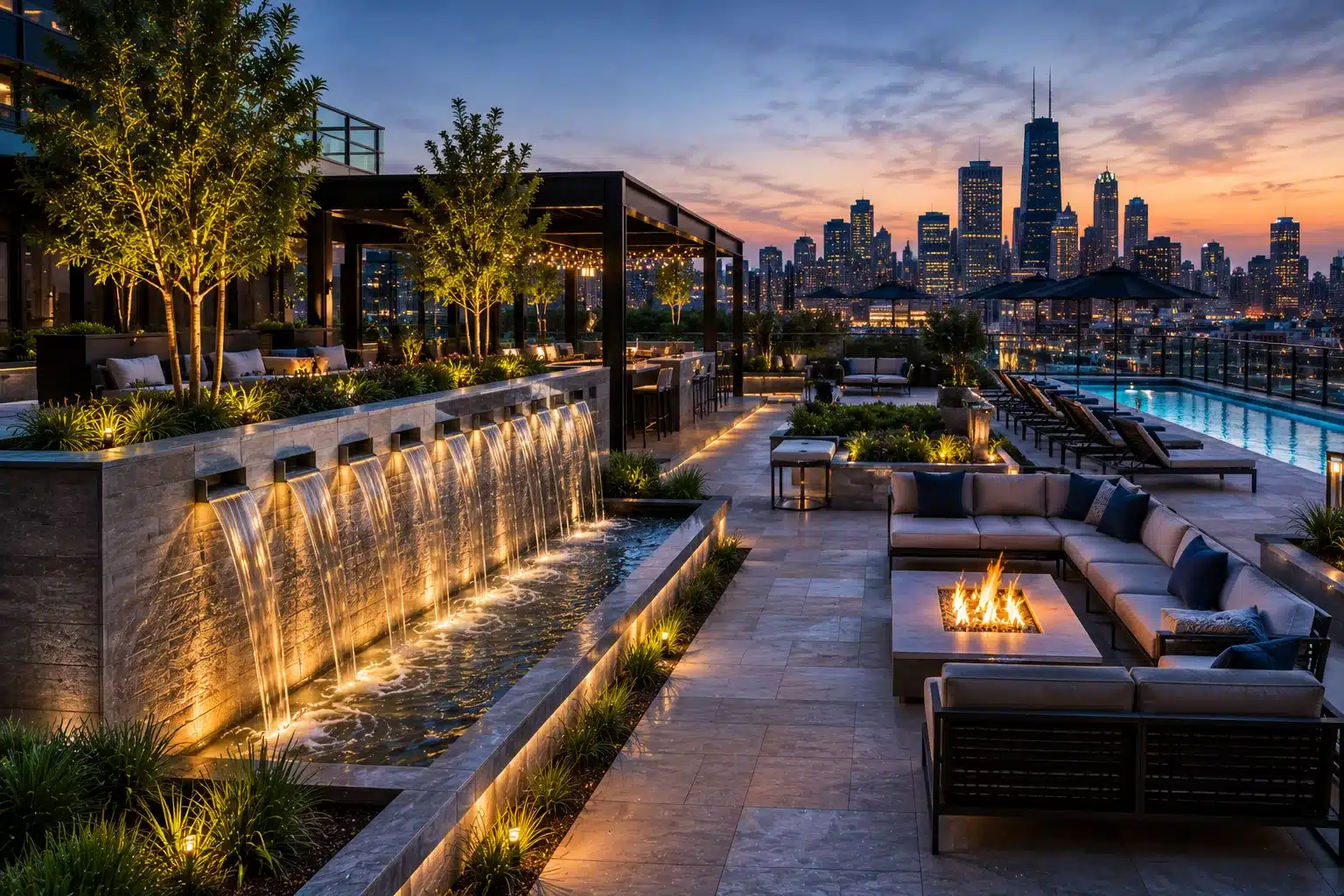
...
Water Features in Multifamily Amenity Decks What Developers Need to Know

Water Features in Multifamily Amenity Decks: What Developers Need to Know

The amenity deck has become one of the most contested differentiators in multifamily residential development. In competitive urban markets, the quality of amenity programming — rooftop pools, outdoor lounges, co-working spaces, fitness environments — directly influences leasing velocity, rent premium, and long-term tenant retention.

Water features are among the highest-impact investments available to multifamily developers working on amenity decks. They are visually distinctive, acoustically functional, and create photogenic environments that drive organic marketing through resident social media. When designed and specified correctly, they deliver measurable leasing value well beyond their installation cost.

When designed poorly, they become maintenance liabilities. The difference is almost entirely in the specification and operational planning decisions made during design.

Water Features in Multifamily Amenity Decks What Developers Need to Know 2

What Residents Actually Want From Amenity Water Features

Understanding the resident perspective is the starting point for amenity deck water feature design. Residents are not looking for spectacle — they are looking for environment. A water feature that creates a genuinely better outdoor experience is valued; one that exists primarily as a marketing image but is loud, poorly maintained, or operationally problematic becomes a source of complaints.

The qualities residents respond to most positively in amenity water features:

  • Acoustic comfort — the sound of water that masks urban noise and creates a sense of separation from the city
  • Visual quality — clear water, consistent operation, well-maintained finishes
  • Ambient enhancement — water that makes the overall environment more pleasant to occupy, not a feature that demands attention
  • Evening presence — well-lit water features dramatically improve the quality of outdoor amenity spaces after dark, extending their usability

Scale and drama are less important than consistency and quality. A modest, impeccably maintained water feature outperforms a large, neglected one in resident satisfaction every time.

Structural Considerations for Amenity Deck Installations

Amenity decks — whether at ground level, podium level, or on a building roof — present specific structural constraints that directly affect water feature design and specification.

Dead Load

Water is heavy at 8.34 pounds per gallon. A modest fountain basin holding 500 gallons of water imposes more than 4,000 pounds of dead load on the structure beneath it. This load, combined with the weight of the basin itself, landscaping, paving, and furniture, must be confirmed as within the structural capacity of the deck before any fountain sizing decisions are made. Engage the structural engineer early.

Waterproofing Integrity

Any penetration through the amenity deck for fountain drainage, supply piping, or electrical conduit must be carefully detailed and waterproofed. Failures at penetration points are a leading cause of leak damage to occupied spaces below. All fountain-related penetrations should be designed in coordination with the waterproofing consultant.

Equipment Placement

Pump rooms, filtration equipment, and control panels for amenity deck fountains require dedicated space — ideally below the deck level in a conditioned or semi-conditioned mechanical room. Rooftop equipment locations must be assessed for waterproofing, drainage, and access.

Water Features in Multifamily Amenity Decks What Developers Need to Know

Design Approaches That Work Well on Amenity Decks

Rill and Channel Features

Linear water channels integrated into the hardscape design of an amenity deck create movement and sound without the structural impact of a large basin. They work particularly well as dividers between activity zones — separating the pool area from the lounge seating, or the dining zone from the fitness area.

Wall-Mounted Water Features

Vertical water features on perimeter or partition walls add visual interest without consuming precious floor area on a constrained amenity deck. Rain curtain installations on glass or stainless panels create dramatic backdrops for lounge seating areas and photography.

Plunge Pool Spillways and Spa Overflows

Where a pool is part of the amenity deck design, architectural overflow systems — spa spillways, scupper channels, infinity edges — add water movement and sound at relatively low additional cost, integrated into the pool structure.

Freestanding Feature Fountains

Custom sculptural or architectural freestanding fountains create a focal point for the amenity deck design. These are most effective when positioned as terminators of a view axis — visible from the entry point of the deck and drawing the eye through the space.

Maintenance Planning for Amenity Deck Water Features

Amenity deck water features serve residents who live in the building and who have a higher tolerance for operational problems than hotel guests or retail visitors. A fountain that has cloudy water for a week, or that is shut down for maintenance during a hot weekend, generates resident complaints and social media posts that damage the property’s reputation.

Operational planning should address:

  • Water treatment automation — automated chemical dosing and UV treatment systems reduce the frequency of manual intervention and maintain consistent water quality
  • Access for routine maintenance — cleaning, filter servicing, and chemical replenishment must be achievable without disrupting amenity deck use
  • Emergency shutdown and drain capability — the system should be drainable quickly if a mechanical failure occurs
  • 24/7 monitoring — remote monitoring with alarm notification allows problems to be identified and addressed before they become visible failures

Water Features in Multifamily Amenity Decks What Developers Need to Know

ROI of Water Features on Multifamily Amenity Decks

Developers consistently cite amenity quality as a primary driver of rent premium in competitive markets. Water features contribute to this premium in several measurable ways:

  • They elevate the photography and visual marketing of the property
  • They appear prominently in prospective tenant tours
  • They are mentioned frequently in positive resident reviews
  • They create environments that retain residents — reducing turnover costs

A well-executed amenity deck water feature with a total installed cost of $75,000–$150,000 is realistically recoverable through a $50–$100 per month rent premium across a fraction of a building’s units within the first lease cycle. For larger or more prominent installations, the premium is proportionally greater.

The operational commitment — water treatment, maintenance, and eventual component replacement — must be budgeted as an ongoing cost of the amenity. Well-managed water features on multifamily properties remain operational assets for 15–25 years with appropriate lifecycle investment.

Work With Fountains.com

Fountains.com designs and builds custom water features for multifamily residential amenity decks, rooftop installations, and podium-level outdoor environments. We work with residential developers and architects to navigate the structural, waterproofing, and operational requirements of elevated amenity installations.

Contact our team to discuss your development project, or explore our commercial fountain capabilities and custom fountain options.

FAQs:

This depends on the basin size, water volume, and basin material. Engage the structural engineer with specific water feature dimensions and water volume before finalizing any design. Do not assume existing structural capacity is adequate.

Yes, but it requires a structural assessment of the existing deck, a waterproofing review at all proposed penetration points, and confirmation that equipment can be accommodated. Retrofit installations are more complex and costly than those designed from the start.

Through design — choosing water behaviors and feature geometries that produce controlled sound levels — and through mechanical specification, including VFD-controlled pumps that allow sound levels to be adjusted at commissioning.

Yes. Water treatment chemicals, filter media, UV lamps, and routine maintenance labor should be included in the annual common area maintenance budget. A dedicated line item prevents deferred maintenance.

SUMMER SALE: 10% OFF ALL PRODUCTS
Use Code: SUMMER10