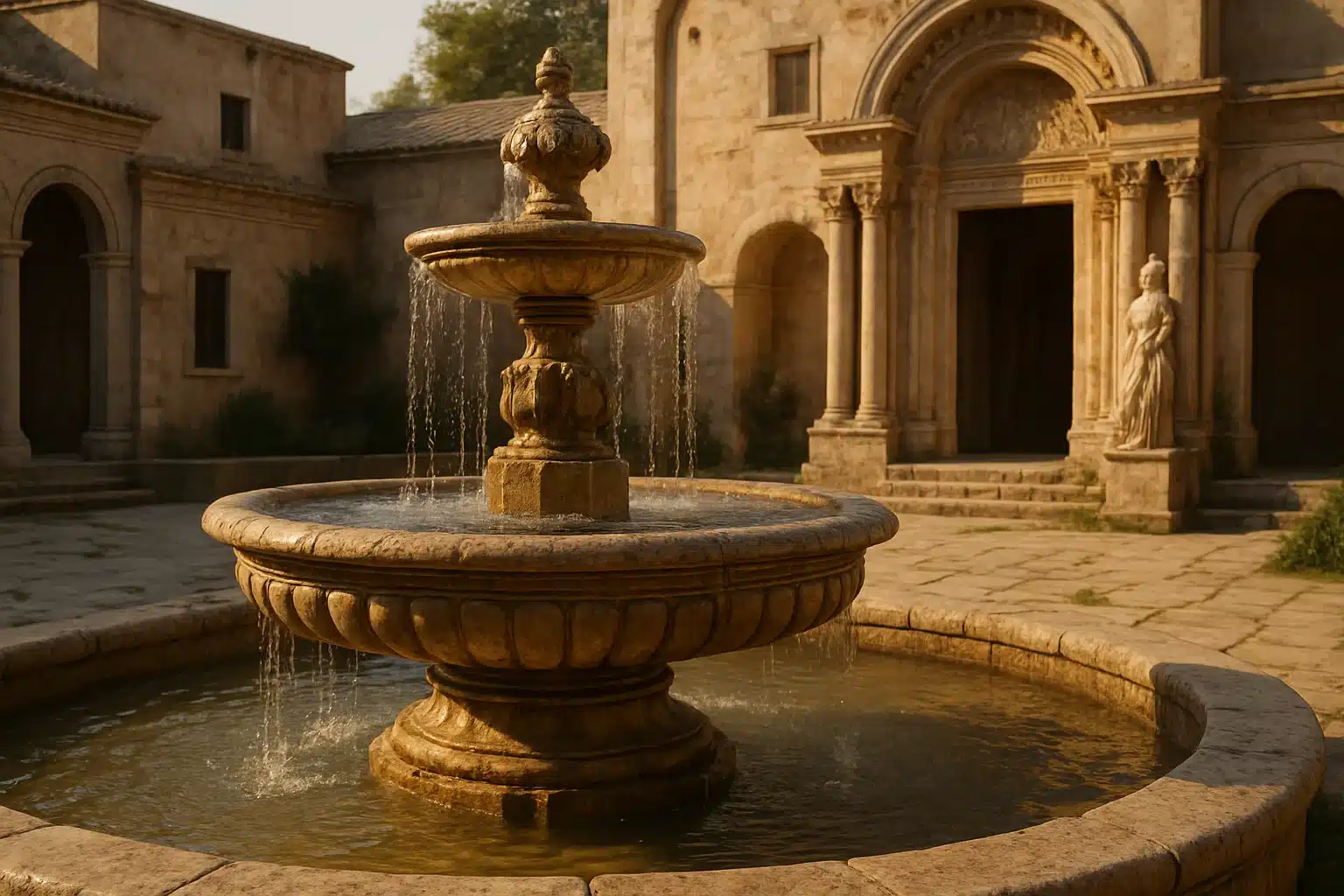
396.1.Ancient-fountains

Why Every Civilization Built Fountains: A Historical Deep Dive

Introduction: More Than Just Flowing Water

From the tranquil trickle of a Zen garden basin to the grandeur of Rome’s Trevi Fountain, fountains have fascinated humanity for millennia. They have been carved into palaces, gardens, temples, and city squares, serving not only as sources of water but as symbols of life, art, and divine power.

But why did every civilization, from the Mayans to the Persians, Egyptians, Greeks, and beyond, build fountains? What was their purpose beyond utility?

This deep dive explores how fountains evolved across time and continents, tracing their journey from simple water sources to architectural masterpieces that expressed faith, authority, and cultural identity.

1. The Lifeblood of Civilization: Fountains as Water Sources

Before fountains became artistic marvels, they were practical necessities. Ancient civilizations often arose near water, rivers like the Nile, Tigris, Euphrates, and Indus, because water was life. However, as societies grew, direct access to clean water became a challenge.

1.1 Ancient Mesopotamia and Early Engineering

In Mesopotamia (modern-day Iraq), some of the world’s earliest known fountains were built as part of irrigation systems. Engineers diverted river water through canals, channels, and gravity-fed conduits to serve temples and royal gardens.

These early “fountains” were often symbolic, representing the gift of life from the gods, especially from Enki, the Sumerian god of water and wisdom. Though primitive compared to later examples, they marked the beginning of human attempts to control and display flowing water.

1.2 Egypt: Sacred Water and Eternal Life

In ancient Egypt, fountains were tied to spiritual belief. Water was a divine element associated with the Nile’s eternal cycle of death and rebirth. Temple courtyards often included small pools or basins fed by underground springs.

The Egyptians saw these water features as purifying and regenerative, used for ritual cleansing before approaching the gods. While they weren’t “fountains” in the decorative sense, these installations influenced later cultures that blended spiritual and aesthetic functions.

2. The Greeks: Harmony, Beauty, and Civic Life

The ancient Greeks brought an artistic and philosophical dimension to water features. For them, a fountain was not merely a utility but a symbol of order (kosmos)—the harmonious relationship between nature, humanity, and the divine.

2.1 Fountains in the Agora

Greek city-states often built fountains in the agora, the central public square. These were vital sources of fresh water but also social hubs where citizens gathered to converse, debate, and relax.

The “Enneakrounos” (Nine Spouts) fountain in Athens, built around the 6th century BCE, is one of the earliest examples of monumental public fountains. It was designed with marble spouts and stone basins, blending practicality with aesthetic appeal.

2.2 Myth and Symbolism

Water held mythological importance in Greek culture. Nymphs, naiads, and gods like Poseidon and Aphrodite were associated with springs and flowing water. Thus, many fountains featured sculptural depictions of these deities, reinforcing the belief that water was a divine blessing.

3. The Roman Revolution: Power, Engineering, and Luxury

No civilization mastered the art and engineering of fountains like the Romans. Their aqueducts, some stretching over 50 miles, transported water across mountains and valleys to feed cities, baths, and, most famously, public fountains.

3.1 Aqueducts and Civic Pride

By the 1st century CE, Rome had eleven aqueducts supplying over a million cubic meters of water daily. This infrastructure powered a network of fountains that provided drinking water to citizens and showcased imperial might.

Public fountains, or nymphaea, often took the form of grand architectural backdrops with multiple tiers, columns, and marble sculptures. They were as much about civic function as political propaganda, symbols of the emperor’s benevolence.

3.2 Fountains as Art and Propaganda

The Trevi Fountain’s ancient predecessors already embodied spectacle. Water cascaded from sculpted figures representing gods, rivers, or conquered territories. For example, the Fountain of the Aqua Virgo, built under Augustus, featured statues symbolizing Rome’s dominion over nature.

Romans also enjoyed private fountains in villa courtyards, a luxury made possible by sophisticated plumbing and lead piping. In essence, fountains became both public works and personal indulgences, a reflection of wealth, status, and cultural refinement.

4. The Islamic Golden Age: Geometry, Reflection, and Paradise

When the Islamic world rose to prominence between the 7th and 13th centuries, fountains took on a profound spiritual and aesthetic meaning rooted in Qur’anic imagery.

4.1 Gardens of Paradise

The Qur’an describes paradise as a garden “beneath which rivers flow.” Inspired by this vision, Islamic architects designed chahar bagh (fourfold gardens) divided by channels of water converging at a central fountain or pool.

These symmetrical layouts, seen in places like the Alhambra in Spain and the Taj Mahal in India, represented divine order and spiritual tranquility. The gentle sound of trickling water symbolized eternal peace.

4.2 The Science of Water and Reflection

Islamic engineers advanced hydraulic technology, developing pumps and siphons to create fountains in arid climates. They also explored water’s reflective properties, using still pools and narrow channels to amplify light and shadow, turning courtyards into serene mirrors of the heavens.

Fountains in Islamic architecture thus merged art, science, and faith, embodying the unity of the divine and natural worlds.

5. Medieval Europe: Sacred Springs and Monastic Life

After the fall of Rome, Europe’s urban infrastructure declined, and fountains lost their civic grandeur. Yet they survived within monasteries and religious complexes, where water remained central to spiritual life.

5.1 Monastic Cloisters and Purity

Monks used fountains in cloisters for ritual cleansing, gardening, and daily sustenance. The lavabo, a stone basin for washing hands, became a symbol of moral and physical purity. These small, often unadorned fountains reflected medieval Europe’s ascetic values.

5.2 Pilgrimage and Sacred Wells

Throughout medieval Europe, natural springs were believed to possess healing powers. Churches and shrines were built around them, turning these “holy wells” into pilgrimage sites. Some evolved into decorative fountains, merging Christian symbolism with older pagan traditions of water worship.

6. The Renaissance: Humanism and the Return of Splendor

The Renaissance revived classical ideals, and with them came a resurgence of grand fountains. This era reimagined water not as a necessity but as a medium for artistic expression and intellectual symbolism.

6.1 Rome Reborn

Popes and princes sponsored monumental fountains to display wealth, taste, and divine favor. The papacy restored ancient aqueducts like the Aqua Virgo, feeding new fountains across Rome.

One notable example is the Fountain of the Four Rivers (Fontana dei Quattro Fiumi) by Gian Lorenzo Bernini (1651), which personified four major rivers, the Nile, Ganges, Danube, and Rio de la Plata, representing the global reach of the Catholic Church.

6.2 Gardens of Power and Perspective

Across Europe, aristocrats built elaborate gardens centered around fountains. The Villa d’Este in Tivoli (16th century) boasted over 500 water features, including cascades, jets, and grottoes.

These gardens reflected Renaissance ideals of harmony between humanity and nature, as well as mastery over the elements, an echo of divine creation.

7. The Baroque Era: Drama, Emotion, and Movement

Why Every Civilization Built Fountains A Historical Deep Dive

If the Renaissance celebrated balance, the Baroque era reveled in emotion and spectacle. Fountains became stages for theatrical displays of light, sound, and motion.

7.1 Versailles: Water as Political Theater

Nowhere was this clearer than at the Palace of Versailles under Louis XIV, the “Sun King.” The palace gardens contained over 1,400 fountains, powered by ingenious hydraulics known as the Machine de Marly.

These fountains were designed to awe visitors and reinforce Louis’s image as a ruler whose power mirrored that of the cosmos itself. The central Fountain of Apollo, depicting the sun god rising from the sea, became a direct allegory for the king’s divine right.

7.2 The Urban Spectacle

Throughout Baroque Europe, cities installed elaborate public fountains as civic attractions. The Trevi Fountain, completed in 1762, epitomized this trend, its dynamic sculptures and roaring water transforming Rome’s cityscape into a living theater of myth and movement.

8. The Enlightenment and Industrial Revolution: Function Meets Progress

By the 18th and 19th centuries, technological advances redefined fountains once again. With improved pumps, valves, and pressurized systems, fountains could reach new heights, literally and figuratively.

8.1 Public Health and Civic Identity

In industrializing cities, fountains regained their practical importance as sources of clean drinking water. Municipal fountains like London’s Shaftesbury Memorial Fountain (1893) symbolized progress, philanthropy, and social reform.

Fountains became central features in public parks and squares, reflecting Enlightenment ideals of accessibility and civic virtue.

8.2 Artistic Experimentation

Meanwhile, fountains also became canvases for modern art. The 19th century saw an explosion of stylistic diversity, from neoclassical statues to Art Nouveau and Beaux-Arts extravagance. The mechanization of water allowed for playful experimentation, leading to musical fountains, kinetic displays, and even illuminated jets by the early 20th century.

9. Modern and Contemporary Fountains: Expression and Innovation

Today’s fountains blend art, technology, and sustainability. They have evolved from ancient symbols of divine power to reflections of modern creativity and community engagement.

9.1 Interactive and Digital Fountains

Modern fountains often invite participation rather than passive admiration. The Crown Fountain in Chicago’s Millennium Park, for example, features LED faces that “spit” water—a playful, democratic reimagining of classical motifs.

Similarly, Dubai’s Fountain (opened 2009) uses computer-controlled jets choreographed to music, merging spectacle with precision engineering.

9.2 Eco-Fountains and Sustainability

In an age of climate awareness, fountains are being reimagined to recycle water, use solar power, and integrate with green infrastructure. Urban planners now design water features not only for beauty but for cooling microclimates and improving air quality.

9.3 Fountains as Global Symbols

From the Bellagio in Las Vegas to the Okavango Delta-inspired fountains in Africa, these structures continue to symbolize prosperity, unity, and cultural pride. Though their materials and mechanics have changed, the emotional pull remains timeless—humans are still drawn to the sound and sight of living water.

10. The Deeper Meaning: Why Fountains Endure

Across millennia, fountains have embodied four enduring themes:

  • Life and Renewal: Every fountain represents the life-giving power of water, essential, cyclical, and eternal.
  • Art and Order: From Greek balance to Islamic geometry, fountains have mirrored humanity’s quest for beauty and harmony.
  • Power and Prestige: Whether a Roman emperor or a modern metropolis, those who control water demonstrate mastery and influence.
  • Community and Connection: Fountains are gathering places, where people meet, reflect, and find peace amid the flow of life.

Ultimately, the universal story of fountains is the story of civilization itself: our attempt to shape nature, celebrate its gifts, and find meaning in motion.

Conclusion: Water, Memory, and the Human Spirit

Every civilization built fountains because every civilization needed water, and longed to celebrate it. What began as a simple means of survival became an art form that captures humanity’s highest aspirations: beauty, spirituality, and permanence.

As you watch water dance in a modern city plaza or ripple in an ancient courtyard, you are witnessing a living tradition, a continuous stream connecting the past to the present, and the practical to the poetic.

FAQs:

The earliest fountains date back to ancient Mesopotamia, where water was channeled through gravity-fed systems to temples and gardens. These were functional yet symbolic, representing divine favor and fertility.
Romans used fountains to distribute fresh water from aqueducts throughout their cities. They also saw them as symbols of power, culture, and luxury, integral to both civic pride and imperial propaganda.
Modern fountains often symbolize renewal, community, and creative expression. They blend technology, art, and environmental design to remind us of our enduring connection to water and life.