Introduction: From Chaos to Composition
Water has always fascinated humanity. It reflects light, reshapes landscapes, calms the mind, and introduces motion where there would otherwise be stillness. For centuries, fountains and water features were designed to showcase abundance or power—grand vertical jets, cascading tiers, or playful sprays driven largely by gravity and pressure. While visually impressive, much of traditional water movement leaned toward the appearance of randomness, shaped by physics rather than intention.
Today, that paradigm is shifting.
Modern fountains are no longer just mechanical systems pushing water through nozzles. They are composed experiences, guided by algorithms, sensors, programmable pumps, and precise hydraulic engineering. Every ripple, curtain, arc, and drop can be choreographed. Water movement has become designed behavior, not accidental motion.
This is the essence of algorithmic elegance, when water behaves like music written in code, architecture expressed through motion, and art rendered in flow.
In this article, we explore how algorithmic thinking is redefining fountains, from intimate indoor water fountains and tabletop fountains to monumental outdoor fountains and immersive rain curtain water features. We’ll examine how composition, precision, and digital intelligence are transforming water from a natural element into a controlled, expressive medium.
Understanding Algorithmic Design in Water Features
What Does “Algorithmic” Mean in This Context?
An algorithm is a set of rules or instructions designed to produce a specific outcome. In fountain design, algorithms control:
- Flow rates
- Timing sequences
- Pressure modulation
- Light synchronization
Sensor-driven responses
Environmental adaptation (wind, temperature, humidity)
Instead of water simply reacting to gravity, it responds to logic.
This doesn’t remove beauty, it enhances it. Algorithmic fountains introduce predictable rhythm, repeatable patterns, and intentional variation. Much like a composer arranges notes, designers now arrange water movement.
From Random Splash to Choreographed Flow
Traditional Water Movement
Historically, fountains relied on:
- Fixed nozzles
- Constant pressure
- Gravity-fed cascades
The result was motion that felt alive but uncontrolled. Even in ornate garden fountains, variation came from natural disturbance, wind, evaporation, or pump inconsistency.
Algorithmic Water Movement
Modern water fountains are different. They are:
- Digitally controlled
- Sensor-aware
- Programmable down to milliseconds
Water can pause, accelerate, pulse, or cascade in sequences that feel deliberate and expressive.
This shift is why contemporary water features often feel meditative, architectural, and intentional rather than decorative noise.
Outdoor Fountains as Living Systems
The Evolution of Outdoor Water Fountains
Outdoor fountains once served as landmarks or focal points, ornamental centerpieces in plazas or estates. Today, outdoor water fountains function more like dynamic environments.
Algorithmic control allows them to:
- Adapt to wind conditions to reduce overspray
- Change flow patterns throughout the day
- Sync movement with lighting and sound
Respond to human presence
Large outdoor fountains now operate as responsive systems, not static installations.
Garden Fountains: Precision in Tranquility
Garden fountains have embraced algorithmic elegance in subtle ways. Rather than dramatic jets, modern garden fountains focus on controlled serenity:
Low-flow laminar streams
- Timed cascades that mimic breathing rhythms
- Gentle pulses that enhance mindfulness
These water features often use algorithms to maintain consistent sound frequencies, preventing harsh splashes and creating soft, continuous acoustics that promote relaxation.
Indoor Water Fountains: Designed Calm
Why Algorithms Matter Indoors
Indoor fountains exist in controlled environments where precision matters more than spectacle. Algorithmic design ensures:
- Quiet pump operation
- Even flow distribution
- Minimal splash or mist
- Consistent visual rhythm
Indoor water fountains often serve wellness, hospitality, and corporate environments. Their success depends on predictability and refinement, not randomness.
Wall Fountains as Vertical Composition

Wall fountains are perhaps the clearest expression of composed water movement.
Instead of water tumbling unpredictably, algorithms regulate:
- Sheet thickness
- Edge definition
- Flow velocity
- Break frequency
The result is water that behaves like fabric, smooth, continuous, and intentional. These indoor fountains transform walls into living canvases where motion replaces ornament.
Tabletop Fountains: Small Scale, High Precision
Tabletop fountains might be compact, but their design challenges are significant. Limited volume means every drop matters.
Algorithmic tuning allows:
- Perfect circulation without stagnation
- Balanced sound levels
- Continuous flow without overflow
Even at this scale, water movement is composed, not accidental, demonstrating that algorithmic elegance isn’t limited by size.
Rain Curtain Fountain: Where Code Meets Gravity
The Rise of Rain Curtain Water Features
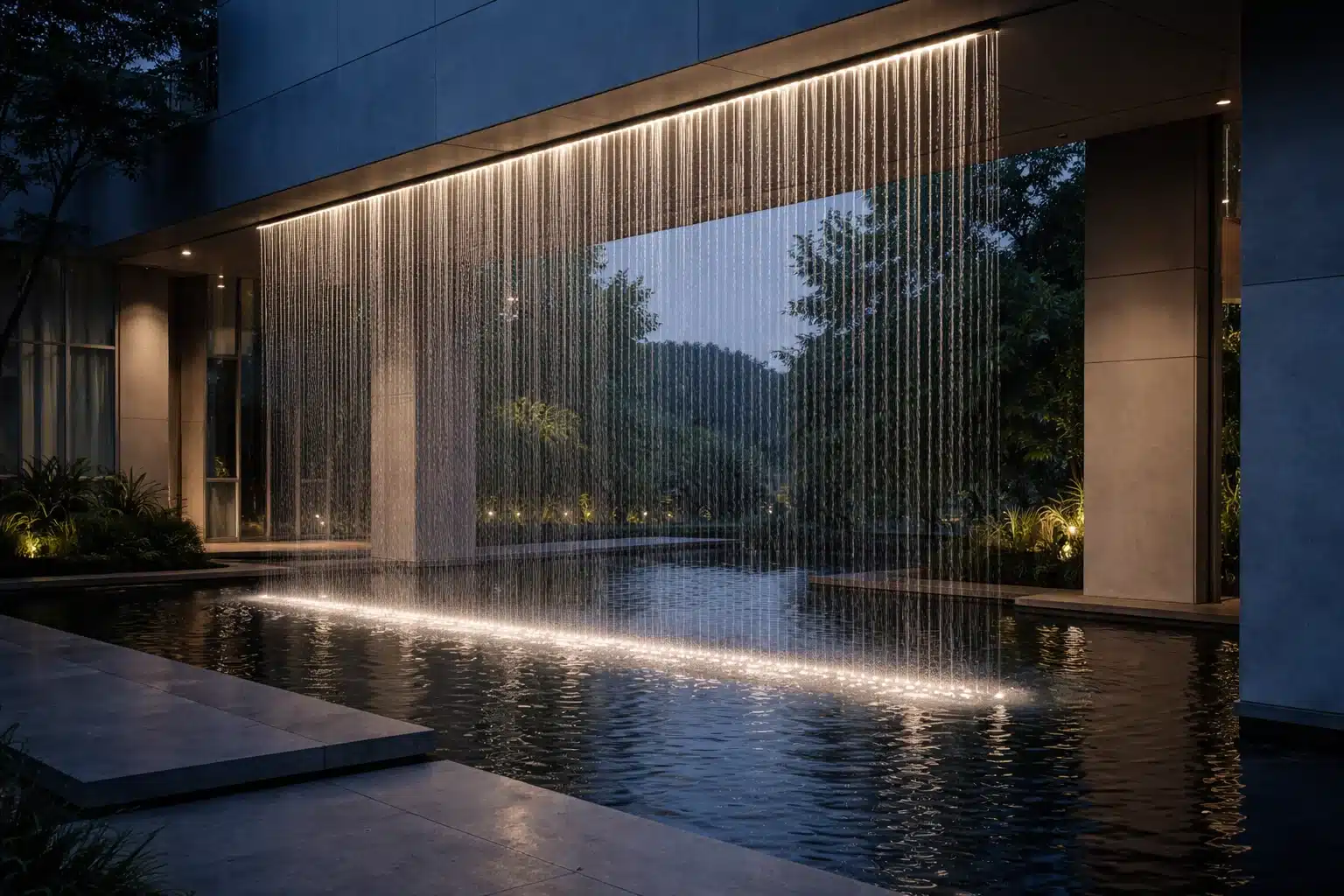
A rain curtain fountain is one of the most striking examples of algorithmic water design. Unlike traditional cascades, rain curtains create controlled vertical streams that appear suspended in space.
Using solenoid valves and digital timing, these fountains can:
- Form text or symbols in falling water
- Create patterns that shift in real time
- Pause and resume flow instantly
What looks like rain is actually mathematics in motion.
Emotional Impact of Composed Rain
Humans are deeply responsive to rain. A rain curtain water feature leverages this emotional connection while removing unpredictability.
The result is:
- No splashing chaos
- No inconsistent drips
- No irregular sound
Instead, you experience a designed rainfall, calming and immersive.
Floor Fountains: Water as Architecture
Floor fountains integrate water directly into walkable space. Here, randomness is not just undesirable, it’s dangerous.
Algorithmic systems control:
- Jet height
- Timing intervals
- Pressure consistency
Drain synchronization
These outdoor fountains often respond to occupancy, activating sequences only when people approach. Water becomes an interactive architectural layer, choreographed for safety and delight.
Indoor vs Outdoor Fountains: Different Algorithms, Same Elegance
Environmental Variables
Outdoor water fountains must adapt to:
- Wind
- Temperature
- Sun exposure
- Debris
Indoor fountains operate in stable conditions but require:
- Noise control
- Evaporation management
- Precise acoustics
Algorithms are tailored to each environment, but the goal remains the same: intentional flow.
Energy Efficiency Through Design
Algorithmic control also reduces waste:
- Pumps operate only when needed
- Flow adjusts dynamically
- Evaporation is minimized
This makes modern water features more sustainable while enhancing visual quality.
Water Features as Experiential Design
Beyond Decoration
Today’s fountains are no longer accessories. They are:
- Mood-setting elements
- Wayfinding tools
- Wellness installations
- Brand expressions
Algorithmic water movement allows designers to align water behavior with human emotion, calm in hospitals, energy in public plazas, luxury in hospitality spaces.
Sound as a Designed Output
Water sound is often overlooked, but algorithms allow precise acoustic tuning:
- Droplet size affects pitch
- Flow rate affects rhythm
- Impact surface changes resonance
This transforms fountains into acoustic instruments, not just visual ones.
The Philosophy of Composed Water
Why Randomness Is No Longer Enough
Random water movement can feel lively, but it lacks narrative. Algorithmic elegance introduces:
- Repetition with variation
- Predictability without monotony
- Motion with meaning
Just as architecture evolved from ornament to intention, water features are evolving from splash to structure.
Water as a Medium, Not a Material
When water movement is composed, water becomes a medium of expression, similar to light, sound, or space. Designers don’t just install fountains, they author experiences.
The Future of Algorithmic Fountains
Looking ahead, we can expect:
- AI-driven adaptive fountains
- Personalized water experiences
- Integration with smart buildings
Real-time environmental feedback
Indoor fountains may respond to biometric data. Outdoor water fountains may adjust patterns based on crowd movement. Garden fountains may sync with circadian rhythms.
The future of fountains is not louder or bigger, it’s smarter and more intentional.
Conclusion: Elegance Is Intentional
Algorithmic elegance marks a turning point in how we experience water. No longer bound by chance, modern fountains and water features are designed with the same care as architecture, music, or digital art.
From tabletop fountains to rain curtain water features, from indoor fountains to expansive outdoor water fountains, the shift is clear: water movement is no longer random.It is composed.And in that composition, we find calm, beauty, and meaning.
FAQs:
Algorithmic fountains use digital controls and programmed logic to precisely manage water flow, timing, and patterns, resulting in intentional, repeatable movement rather than random splashing.
No. Algorithmic design is used in everything from tabletop fountains and indoor fountains to wall fountains, garden fountains, and rain curtain water features.
Actually, they are often more energy-efficient because pumps and systems operate dynamically, adjusting flow only when needed and reducing waste.