Introduction
For commercial properties in climates that experience freezing temperatures, outdoor fountain operation presents a fundamental engineering challenge: water freezes, and the expansion forces generated by freezing water are powerful enough to crack stone, rupture pipes, split welds, and destroy pump components. Property owners and developers who want year-round operation of commercial fountains, or who need their fountains to survive winter months in a protected dormant state, must address freeze protection during the design phase. Retrofitting freeze protection after installation is expensive and often architecturally compromising. This guide covers the primary freeze protection strategies for outdoor commercial fountain installations, including active heating systems, drain-down design, and the operational protocols that support them.
What Is the Best Freeze Protection Method for a Commercial Fountain?
For most outdoor commercial fountains located in freeze-prone climates, complete drain-down winterization remains the most reliable and cost-effective freeze protection strategy. By removing water from basins, piping, pumps, and associated equipment before freezing temperatures occur, owners can significantly reduce the risk of costly structural and mechanical damage. For fountains that must remain operational throughout winter, a coordinated freeze protection system is typically required. These systems often combine basin heating, pipe heat tracing, insulation, automated controls, and temperature monitoring to maintain safe operating conditions and prevent freeze-related failures.The Freeze Damage Risk in Commercial Fountains
Water expands approximately 9% when it freezes. That expansion exerts enormous force on any container, including granite or concrete fountain basins, copper or stainless steel piping, and the pumps and mechanical equipment that form the fountain’s circulation system. Without proper freeze protection, outdoor commercial fountains commonly experience:- Cracked basins and coping, particularly in porous stone materials
- Burst piping in supply lines and recirculation systems
- Pump damage caused by frozen water trapped inside housings
- Nozzle failures resulting from ice expansion inside jet assemblies
- Electrical and control system damage caused by moisture freezing inside conduit and junction boxes
Strategy 1: Complete Drain-Down Design
The most dependable freeze protection strategy is designing the fountain so all water can be completely removed from the system before freezing temperatures arrive.How It Works
When freezing conditions are forecast, the fountain is shut down and water is drained from:- The main basin
- Supply and recirculation piping
- Pump housings and strainers
- Nozzle bodies and jet assemblies
- Heat exchangers
- UV sterilization equipment
Design Requirements for Effective Drain-Down
An effective drain-down system requires careful engineering during design and construction.- Sloped piping that naturally drains toward designated low points
- Drain valves installed at every low point
- Drainable pump housings
- Drainable nozzle assemblies
- Adequately sized basin drains
- Accessible air purge connection points
Limitations of Drain-Down
Drain-down systems are ideal for fountains that can be seasonally shut down. However, they do not support year-round operation because water must be removed whenever freezing conditions are expected. Facilities that require continuous fountain operation during winter months typically need active freeze protection systems rather than seasonal drain-down alone.
Strategy 2: Basin and Pipe Heating
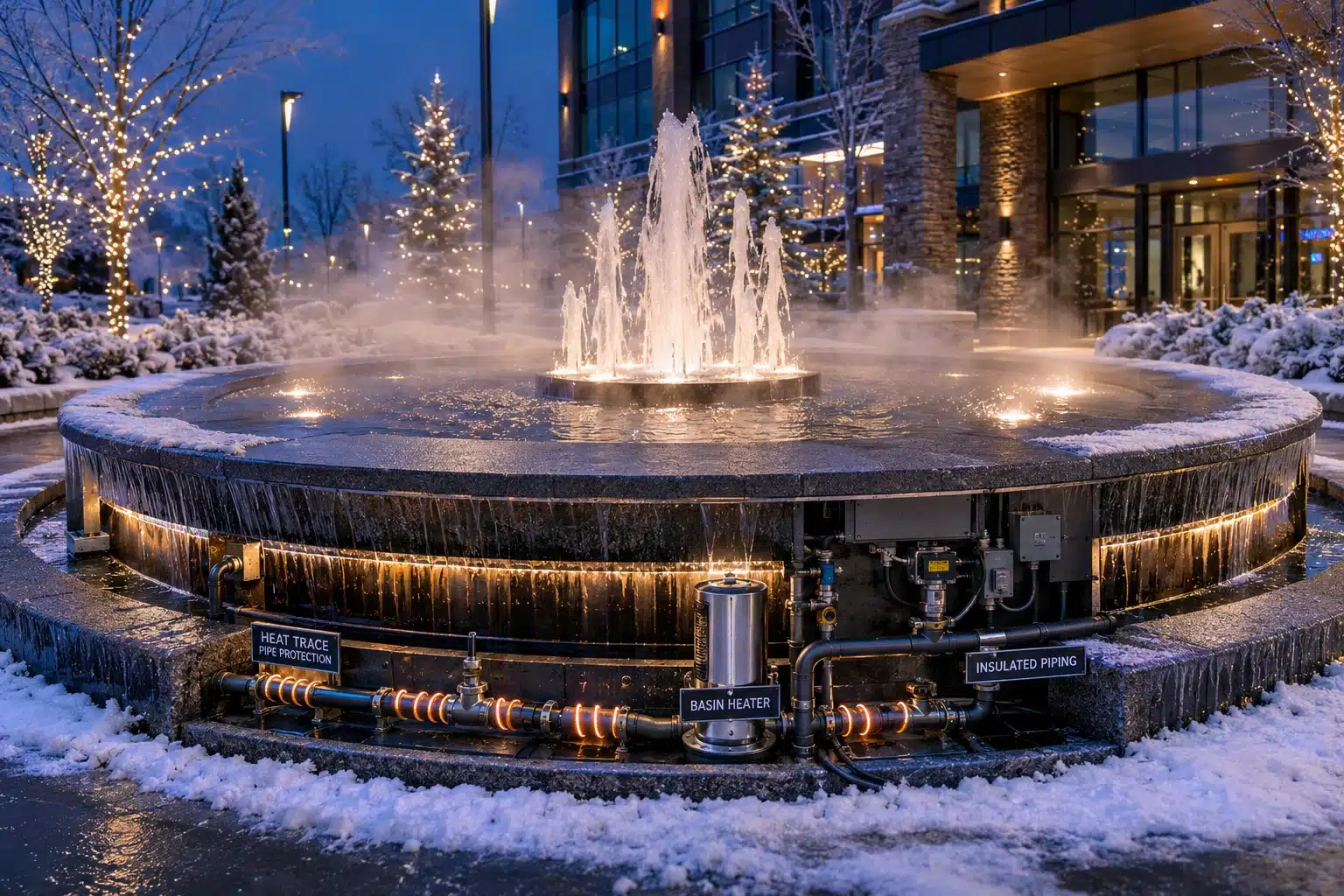
For fountains designed to operate year-round, active heating systems are required to keep water temperatures above freezing.Submersible Basin Heaters
Electric submersible heaters or hydronic heat exchange systems can maintain basin temperatures above freezing during cold weather. These systems are typically sized according to:- Basin volume
- Expected winter temperatures
- Heat loss calculations
- Fountain operating conditions
Heat Tape for Piping
Electric trace heating, commonly called heat tape, is used to protect supply and recirculation piping from freezing. Modern self-regulating heat tape automatically adjusts heat output based on pipe temperature, improving efficiency while maintaining freeze protection. Proper specification includes:- Correct temperature rating
- Appropriate watt density
- Weatherproof protection
- Compatibility with pipe materials
Insulation
Insulation works together with active heating systems to reduce heat loss and improve energy efficiency. Common insulation materials include:- Closed-cell foam insulation
- Mineral wool insulation
- Weatherproof insulation jackets
Strategy 3: Automated Freeze Protection Systems
Modern commercial fountain control systems can integrate freeze protection automation that reduces the risk of manual intervention failures and helps protect critical infrastructure during sudden weather changes. For facilities that operate year-round or manage multiple properties, automation provides an additional layer of protection that improves reliability and reduces operational risk.Temperature-Based Automatic Drain
A temperature sensor, or multiple sensors located throughout the fountain system, can automatically trigger a drain-down sequence when temperatures approach freezing conditions. The control system typically:- Closes make-up water valves
- Shuts down pumps
- Opens drain valves
- Initiates compressed air purging
- Verifies system shutdown status
Automatic Heater Activation
Rather than relying on facility personnel to manually activate freeze protection equipment, modern systems can automatically energize basin heaters and pipe heat tracing when temperatures approach predetermined thresholds. Benefits include:- Faster response times
- Reduced operator error
- Improved energy efficiency
- Enhanced equipment protection
Remote Monitoring and Alarm Systems
Remote monitoring platforms provide real-time visibility into system conditions and can notify maintenance teams when temperatures approach dangerous levels. Many commercial fountain systems now include:- Temperature monitoring
- Alarm notifications
- Heater status monitoring
- Drain sequence verification
- Remote system access

Seasonal Winterization vs. Year-Round Operation
One of the most important decisions during fountain planning is whether the fountain will operate throughout winter or be seasonally shut down. The answer affects equipment selection, operational costs, maintenance requirements, and overall project budget.Seasonal Winterization
For commercial properties where fountain operation is not required during winter months, seasonal winterization remains the most practical and cost-effective approach. A complete winterization program should become part of a facility’s ongoing fountain maintenance strategy and typically includes:- Shutting down electrical systems
- Draining basin water
- Purging piping with compressed air
- Removing sensitive components
- Securing equipment
- Covering exposed basin areas
- Documenting shutdown procedures
Year-Round Operation
Year-round operation requires substantially greater investment in both equipment and operational planning. Typical requirements include:- Basin heaters
- Pipe heat tracing
- Insulated piping
- Insulated equipment vaults
- Automated controls
- Remote monitoring systems
- Backup freeze protection procedures
Freeze Protection Strategy Comparison
| Strategy | Initial Cost | Operating Cost | Reliability | Year-Round Operation |
|---|---|---|---|---|
| Drain-Down Winterization | Low | Low | Excellent | No |
| Basin Heating Only | Moderate | Moderate | Moderate | Limited |
| Heat Trace + Insulation | Moderate | Moderate | Good | Partial |
| Fully Automated Freeze Protection | High | Moderate | Excellent | Yes |
Freeze-Resistant Material Selection
Material selection plays a significant role in determining how well a fountain performs during freeze-thaw cycles. Different materials respond differently to water absorption, thermal expansion, and repeated freezing conditions.Stainless Steel
Stainless steel, commonly used in premium metal fountains, offers excellent freeze resistance and can tolerate thermal expansion and contraction without cracking. Its durability and low water absorption make it one of the most reliable materials for cold-climate fountain applications.Copper
Copper provides moderate freeze resistance because of its ductility. While it can tolerate some expansion, prolonged freezing conditions can still damage piping and fountain components if water is trapped inside.Granite and Dense Stone
Granite and other dense stone materials generally perform well in freeze-thaw environments because they absorb very little water. When properly sealed and maintained, these materials offer excellent long-term durability.Porous Stone Materials
Materials such as limestone and sandstone are more vulnerable to freeze damage because water can penetrate the stone matrix. When trapped water freezes and expands, surface spalling and cracking can occur.Concrete
Concrete basins can perform well in cold climates when properly designed, reinforced, and constructed with low water-to-cement ratios. However, poor-quality concrete or improperly detailed basins may develop cracking when exposed to repeated freeze-thaw cycles.Recommended Materials for Freeze Climates
For outdoor commercial fountains in regions that experience regular freezing temperatures, the most reliable material combinations typically include:- Stainless steel components
- Sealed granite surfaces
- Freeze-resistant concrete construction
- Proper waterproofing systems
- Durable piping materials designed for cold-weather applications
Key Takeaway
Successful freeze protection begins long before winter arrives. Whether a fountain will remain operational throughout the year or be seasonally winterized, the freeze protection strategy should be incorporated into the fountain’s engineering, controls, and maintenance planning from the earliest stages of design. For many commercial properties, complete drain-down winterization remains the most dependable and cost-effective solution. By removing water from basins, piping, pumps, and associated equipment before freezing temperatures occur, owners can significantly reduce the risk of expensive repairs and premature equipment replacement. Projects that require year-round operation typically benefit from a coordinated approach that combines basin heating, pipe heat tracing, insulation, automation controls, and remote monitoring. Planning for freeze protection early helps reduce long-term maintenance costs, extend equipment lifespan, and protect the overall performance of the fountain system.Need Help Designing Freeze Protection Systems for Commercial Fountains?
Fountains.com works with architects, developers, MEP engineers, contractors, and facility teams to design freeze-resistant commercial fountains for cold-weather climates. Our team provides:- Drain-down system design
- Basin heating coordination
- Pipe heat tracing layouts
- Freeze protection automation
- Seasonal winterization planning
- Long-term operational guidance
- Equipment vault coordination
- Cold-weather fountain engineering
Frequently Asked Questions
At What Temperature Should Freeze Protection Procedures Begin?
Freeze protection procedures should typically begin when sustained ambient temperatures approach 35–38°F (2–3°C). Waiting until temperatures reach 32°F (0°C) may leave insufficient time to drain systems or activate protective measures before freeze damage occurs. For facilities utilizing automated controls, freeze protection systems are often configured to activate before freezing conditions develop.Can a Commercial Fountain Operate During Winter?
Yes. Many commercial fountains successfully operate year-round in cold climates. However, year-round operation requires properly engineered freeze protection systems that may include basin heating, pipe heat tracing, insulation, automated controls, and continuous monitoring. Without these systems, winter operation can significantly increase the risk of freeze-related failures.Is a Basin Heater Alone Enough to Prevent Freeze Damage?
Not usually. While basin heaters can protect standing water inside the basin, they do not necessarily protect exposed piping, valves, nozzles, or equipment located outside the heated zone. Most year-round systems require a coordinated freeze protection strategy that addresses the entire fountain infrastructure.Do Submersible Pumps Need to Be Removed for Winter?
If the fountain is being fully winterized and drained, submersible pumps should generally be removed and stored in a climate-controlled environment. Proper storage helps protect seals, bearings, and other components during extended shutdown periods and can improve long-term equipment reliability.Are Outdoor Fountains Under Roof Canopies Protected From Freezing?
Not necessarily. Many covered structures still experience ambient temperatures below freezing. Even when direct snow and precipitation are eliminated, exposed piping and fountain components may still be vulnerable to freeze damage. Each project should be evaluated based on actual winter design temperatures rather than the presence of a roof structure alone.FAQs:
Freeze protection procedures should typically begin when sustained ambient temperatures approach 35–38°F (2–3°C). Waiting until temperatures reach 32°F (0°C) may leave insufficient time to drain systems or activate protective measures before freeze damage occurs.
For facilities utilizing automated controls, freeze protection systems are often configured to activate before freezing conditions develop.
Yes. Many commercial fountains successfully operate year-round in cold climates.
However, year-round operation requires properly engineered freeze protection systems that may include basin heating, pipe heat tracing, insulation, automated controls, and continuous monitoring. Without these systems, winter operation can significantly increase the risk of freeze-related failures.
Not usually.
While basin heaters can protect standing water inside the basin, they do not necessarily protect exposed piping, valves, nozzles, or equipment located outside the heated zone. Most year-round systems require a coordinated freeze protection strategy that addresses the entire fountain infrastructure.
If the fountain is being fully winterized and drained, submersible pumps should generally be removed and stored in a climate-controlled environment.
Proper storage helps protect seals, bearings, and other components during extended shutdown periods and can improve long-term equipment reliability.
Not necessarily.
Many covered structures still experience ambient temperatures below freezing. Even when direct snow and precipitation are eliminated, exposed piping and fountain components may still be vulnerable to freeze damage.
Each project should be evaluated based on actual winter design temperatures rather than the presence of a roof structure alone.
For most properties, complete drain-down winterization remains the most reliable and economical solution.
For installations that require year-round operation, a combination of basin heating, pipe heat tracing, insulation, automation, and monitoring generally provides the highest level of protection.