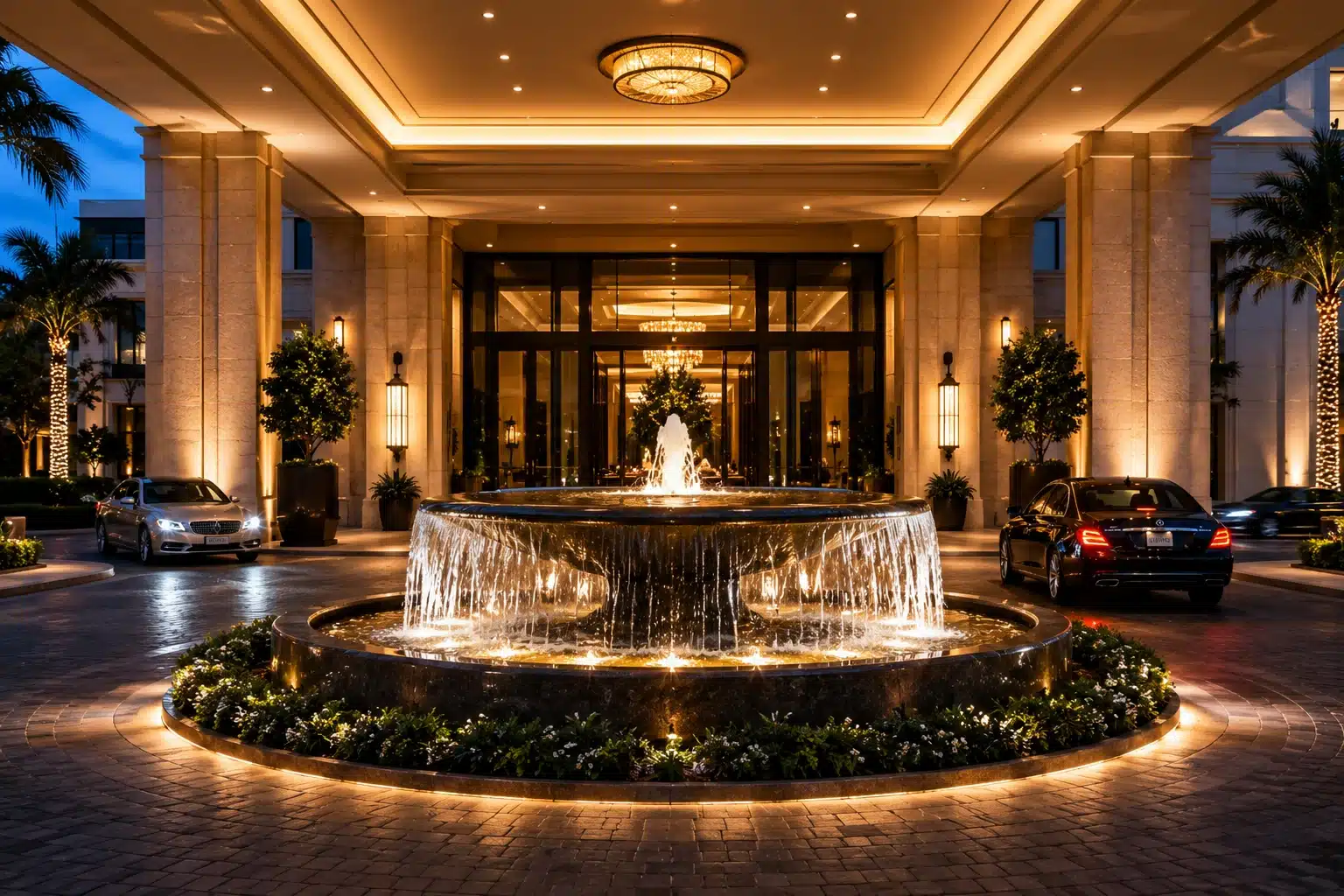
The porte-cochère is one of the most choreographed moments in luxury hotel design. Guests arrive by car, emerge into a sheltered arrival court, and encounter the property for the first time in a composed, controlled environment. Every element of that space communicates something about what lies beyond: the level of service, the attention to detail, and the quality of the experience.
A well-designed porte-cochère fountain amplifies that communication considerably. It fills the arrival court with the sound and movement of water, creates a visual focal point that gives the space genuine architectural presence, and signals a level of investment and care that guests carry with them throughout their stay.
Why Luxury Hotels Invest in Porte-Cochère Fountains
Luxury hotels compete on guest experience as much as they compete on amenities. The arrival sequence often determines a guest’s first emotional impression of the property, making the porte-cochère one of the most valuable branding opportunities in hospitality design.
A thoughtfully designed fountain immediately communicates quality, sophistication, and attention to detail. For many luxury properties, a custom fountain becomes a signature feature that guests remember long after their stay.
This is why many hospitality developers incorporate commercial fountains into arrival courts, resort entrances, and luxury hospitality environments. A well-executed arrival fountain helps create a memorable first impression while reinforcing the property’s brand identity.
Why the Arrival Fountain Matters
Hospitality research consistently shows that guests form lasting impressions of a hotel within the first few minutes of arrival. The sequence from the entry drive to the front desk shapes expectations that influence the entire stay.
A porte-cochère fountain contributes to this impression in several distinct ways.
Sound Before Sight
The sound of moving water reaches arriving guests before they even step out of the vehicle. The acoustic quality of the fountain, including volume, texture, and rhythm, begins shaping perception before the visual experience begins.
Well-engineered fountains produce sounds that are immediately calming and help create a transition from the outside world into the hospitality environment.
Scale and Presence
A fountain positioned at the center of the arrival court provides architectural structure and visual hierarchy.
Covered arrival areas can often feel spatially unresolved without a strong focal point. A central fountain introduces verticality, visual weight, and compositional balance while helping define the space.
Light and Reflection
In evening operation, an illuminated fountain transforms the arrival experience.
Submerged LED lighting and carefully coordinated architectural lighting create reflections and visual movement that elevate the atmosphere far beyond what traditional building lighting alone can achieve.
Brand Signal
A custom fountain designed specifically for the property sends a powerful message about investment, quality, and attention to detail.
Guests may not consciously analyze the fountain, but they intuitively recognize the care and resources required to create and maintain it.
Design Principles for Luxury Hotel Arrival Fountains
Common Porte-Cochère Fountain Styles
| Fountain Style | Atmosphere | Best For |
|---|---|---|
| Reflecting Pool | Quiet and Elegant | Ultra-Luxury Hotels |
| Gentle Cascade | Relaxing and Welcoming | Resorts and Destination Hotels |
| Rain Curtain | Contemporary and Dramatic | Modern Luxury Properties |
| Sculptural Fountain | Iconic and Memorable | Flagship Hotels |
| Sheet Water Feature | Clean and Architectural | Boutique and Lifestyle Brands |
Choosing the right fountain style should align with the property’s brand identity, guest expectations, and overall architectural character.
Scale Calibration
The most common mistake in porte-cochère fountain design is under-scaling.
A fountain that appears generously proportioned in a rendering can feel surprisingly small once surrounded by vehicles, columns, porte-cochère roofs, and large-scale architecture.
Arrival fountains should be designed to maintain visual presence when viewed from a vehicle approaching the hotel, not just from pedestrian distances.
Successful projects rely on accurate 3D modeling, circulation studies, and in some cases physical mock-ups to verify proportions before fabrication begins.
Water Character Selection
Different water behaviors create different emotional responses and guest perceptions.
Still Reflecting Pool
Quiet, elegant, and formal.
Reflecting pools are particularly effective in ultra-luxury environments where restraint and sophistication are central to the brand experience.
Gentle Cascade
Soft, continuous sound combined with visible water movement.
This style creates a welcoming atmosphere and works exceptionally well for resorts, destination properties, and luxury hospitality environments focused on relaxation.
Rain Curtain Fountains
Contemporary, dramatic, and distinctly architectural.
Rain curtain systems create a visual backdrop of falling water that remains highly visible from long distances and often becomes a defining feature of modern luxury hospitality projects.
Blade or Sheet Water Features
Clean, modern, and precise.
Sheet-flow systems communicate craftsmanship and attention to detail while supporting contemporary architectural styles.
The selected water behavior should align closely with the hotel’s positioning, whether it is an urban luxury hotel, a destination resort, a lifestyle property, or a boutique hospitality concept.
Material Selection for Covered Environments
Porte-cochères present unique environmental conditions. While protected from direct rainfall, they remain exposed to humidity, temperature variation, vehicle exhaust, and continuous guest activity.
Material selection plays a major role in long-term appearance and performance.
Stainless Steel (316 Grade)
316 stainless steel offers exceptional corrosion resistance in humid covered environments.
It is particularly well suited to contemporary hospitality projects and can be specified in:
- Brushed finishes
- Mirror-polished finishes
- Textured architectural finishes
- Custom fabricated forms
Stainless steel remains one of the most popular materials used in premium metal fountains because of its durability, clean appearance, and compatibility with luxury hospitality environments.
Stone Materials
Granite, travertine, and limestone remain popular choices for luxury hotel fountains.
Stone communicates permanence, prestige, and craftsmanship while complementing both traditional and contemporary architecture.
Proper waterproofing, sealing, and maintenance planning remain critical to long-term performance.
Copper
Copper offers a distinctive warmth and handcrafted character that is strongly associated with traditional luxury hospitality design.
Over time, copper develops a natural patina that adds depth and visual richness to the fountain.
Benefits include:
- Unique visual character
- Premium appearance
- Long service life
- Strong association with bespoke luxury environments
Because copper changes appearance over time, hotels should establish a maintenance philosophy early in the design process. Some properties embrace the evolving patina, while others maintain a more polished appearance through periodic care.
Lighting Design
Lighting is not secondary to the fountain design. In many luxury hotels, evening arrival is when the fountain creates its strongest impression.
A fountain that appears attractive during the day but lacks thoughtful lighting design can lose much of its impact after sunset.
Effective porte-cochère fountain lighting typically includes multiple layers.
Submerged LED Lighting
Submerged fixtures illuminate water from below, creating depth, movement, and visual drama.
Benefits include:
- Enhanced water visibility
- Greater nighttime presence
- Improved visual texture
- Dynamic reflections
The best installations use high-quality commercial-grade fixtures designed specifically for continuous fountain operation.
Perimeter Lighting
Lighting positioned around the basin perimeter creates a subtle glow that visually anchors the fountain within the arrival court.
This lighting strategy often creates:
- Halo effects
- Soft reflections
- Improved nighttime wayfinding
- Enhanced architectural presence
Architectural Integration
The most successful hotel arrival fountains are designed in close coordination with the property’s architectural lighting designer.
Rather than treating the fountain as a separate element, the lighting strategy integrates:
- Building façade lighting
- Landscape lighting
- Pathway illumination
- Fountain lighting systems
This approach creates a cohesive guest experience and prevents the fountain from appearing disconnected from the surrounding architecture.
Programmable Controls
Modern LED systems allow hotels to adjust lighting programs for:
- Seasonal events
- Holiday displays
- Brand activations
- Corporate functions
- Special occasions
Programmable controls add flexibility while allowing the fountain to support broader hospitality and marketing initiatives.
Operational Considerations
A luxury hotel fountain must do more than look impressive. It must perform reliably every day, often for decades.
Operational planning is therefore just as important as aesthetics.
“`html id=”r5n8vk”
24/7 Operation
Luxury hospitality properties rarely have the option of shutting down arrival fountains during normal operating hours.
Guests arrive:
- Early morning
- Afternoon
- Evening
- Overnight
A fountain that is inactive when guests arrive diminishes the experience it was intended to create.
For this reason, hotel arrival fountains should be engineered for continuous commercial-duty operation.
Recommended specifications include:
- Commercial-grade pumps
- Redundant equipment where appropriate
- Commercial filtration systems
- Advanced control systems
- Long-life LED lighting
Reliability should be prioritized from the earliest stages of design.
Maintenance Access
Maintenance access is frequently overlooked during design and becomes a major operational challenge after construction.
Because porte-cochères experience constant guest traffic, maintenance must be efficient, discreet, and minimally disruptive.
Design teams should plan for:
- Accessible equipment vaults
- Service clearances around pumps
- Filter access
- Lighting maintenance access
- Safe technician pathways
Maintenance should be possible without blocking guest arrival routes or disrupting valet operations.
Sound Level Management
The acoustic environment within a porte-cochère is surprisingly complex.
Vehicle engines, luggage handling, guest conversations, and staff communication all compete with the fountain.
A successful fountain contributes positively to the environment without overwhelming it.
The goal is not maximum sound volume.
The goal is the correct sound character.
Variable Frequency Drives (VFDs)
Modern fountain systems often incorporate variable frequency drives that allow operators to fine-tune water flow rates.
This provides several advantages:
- Sound adjustment during commissioning
- Energy savings
- Reduced equipment wear
- Greater operational flexibility
Fine-tuning water flow helps achieve the ideal acoustic balance for each property’s unique geometry.
Common Mistakes in Hotel Arrival Fountain Design
Designing the Fountain Independently of the Architecture
The most successful porte-cochère fountains feel inseparable from the surrounding architecture.
Fountains that appear to have been added late in the design process often lack the visual impact necessary to justify the investment.
Arrival fountains should be integrated into:
- Architectural planning
- Landscape design
- Vehicle circulation studies
- Lighting design
- Guest experience planning
from the earliest stages of project development.
Under-Specifying Maintenance Infrastructure
A poorly maintained luxury hotel fountain damages the guest experience far more than the absence of a fountain.
Design teams should invest in:
- Easy-access equipment spaces
- Proper filtration
- Automated controls
- Water treatment systems
- Ongoing service programs
The objective is to make maintenance easy enough that it actually occurs consistently.
Ignoring Vehicle Circulation
Arrival courts must accommodate:
- Guest vehicles
- Valet operations
- Shuttle buses
- Service vehicles
- Emergency access
A fountain that interferes with circulation creates operational challenges that can ultimately undermine its value.
Traffic engineers, architects, and fountain designers should coordinate closely before finalizing fountain placement.
Key Takeaway
A porte-cochère fountain is far more than a decorative water feature.
It shapes first impressions, reinforces brand identity, enhances the guest experience, and establishes a sense of arrival that influences perceptions throughout a guest’s stay.
When properly integrated with architecture, lighting, circulation, and operations, an arrival fountain becomes one of the most memorable and valuable design investments a luxury hotel can make.
Long-Term Value
A well-designed and properly maintained hotel arrival fountain is one of the highest-impact design investments available to luxury hospitality developers.
Unlike many architectural features that guests may overlook, an arrival fountain influences nearly every guest who visits the property. It contributes to the emotional experience of arrival, reinforces brand identity, and helps create the memorable first impression that often shapes perceptions of the entire stay.
The value extends beyond aesthetics.
A successful porte-cochère fountain can contribute to:
- Stronger guest recall
- Increased perceived property value
- Enhanced luxury positioning
- Improved guest satisfaction
- More memorable arrival experiences
- Greater differentiation from competing properties
Because the fountain serves every arriving guest, its influence compounds over time and supports the property’s reputation long after construction is complete.
For luxury hotels, resorts, and destination properties, a signature arrival fountain often becomes one of the most photographed and recognizable elements of the entire development.
Work With Fountains.com
Fountains.com designs and builds custom commercial fountains for luxury hotel arrival courts, lobby environments, resort properties, and destination hospitality developments.
We work with hospitality developers, architects, landscape architects, lighting designers, and interior designers from concept through commissioning to create fountains that strengthen brand identity and elevate the guest experience.
Whether you’re developing a boutique hotel, luxury resort, urban hospitality project, or flagship destination property, our team can help design a fountain that complements the architecture, supports operations, and creates a memorable sense of arrival.
Explore our commercial fountains portfolio or learn more about our custom fountains capabilities to see how we help hospitality properties create exceptional water features.
Contact our team to discuss your project and explore design options tailored to your brand and guest experience goals.
FAQs:
The fountain should be large enough to maintain visual presence from approximately 50 to 100 feet away while remaining proportional to the architecture and vehicle circulation areas.
Scale studies, 3D modeling, and circulation analysis are highly recommended during design development to ensure the fountain feels appropriately sized within the arrival court.
No.
Arrival fountains provide the greatest value during periods of peak guest activity.
Luxury hotel fountains should be designed for continuous operation and specified with commercial-grade equipment capable of supporting long operating hours.
Most hospitality properties schedule fountain maintenance during low-traffic periods, typically early morning hours.
Successful designs incorporate:
- Easy-access equipment vaults
- Service pathways
- Rapid drain capability
- Quick restart procedures
These features help minimize operational disruptions while maintaining fountain performance.
Yes.
Custom arrival fountains frequently incorporate:
- Hotel logos
- Architectural crests
- Signature sculptural elements
- Custom nozzle arrangements
- Branded design motifs
These elements can reinforce the property’s identity while creating a distinctive visual experience for guests.
Yes.
Custom arrival fountains frequently incorporate:
- Hotel logos
- Architectural crests
- Signature sculptural elements
- Custom nozzle arrangements
- Branded design motifs
These elements can reinforce the property’s identity while creating a distinctive visual experience for guests.
Rain curtain fountains are often used in contemporary hospitality environments because they create dramatic visual movement while maintaining a refined architectural appearance.
Their strong visibility from long distances makes them particularly effective within larger arrival courts.
The most common materials include:
- Stainless steel
- Natural stone
- Copper
- Architectural concrete
- Glass
- Composite material systems
Many luxury properties combine multiple materials to achieve a distinctive aesthetic while balancing durability and maintenance requirements.