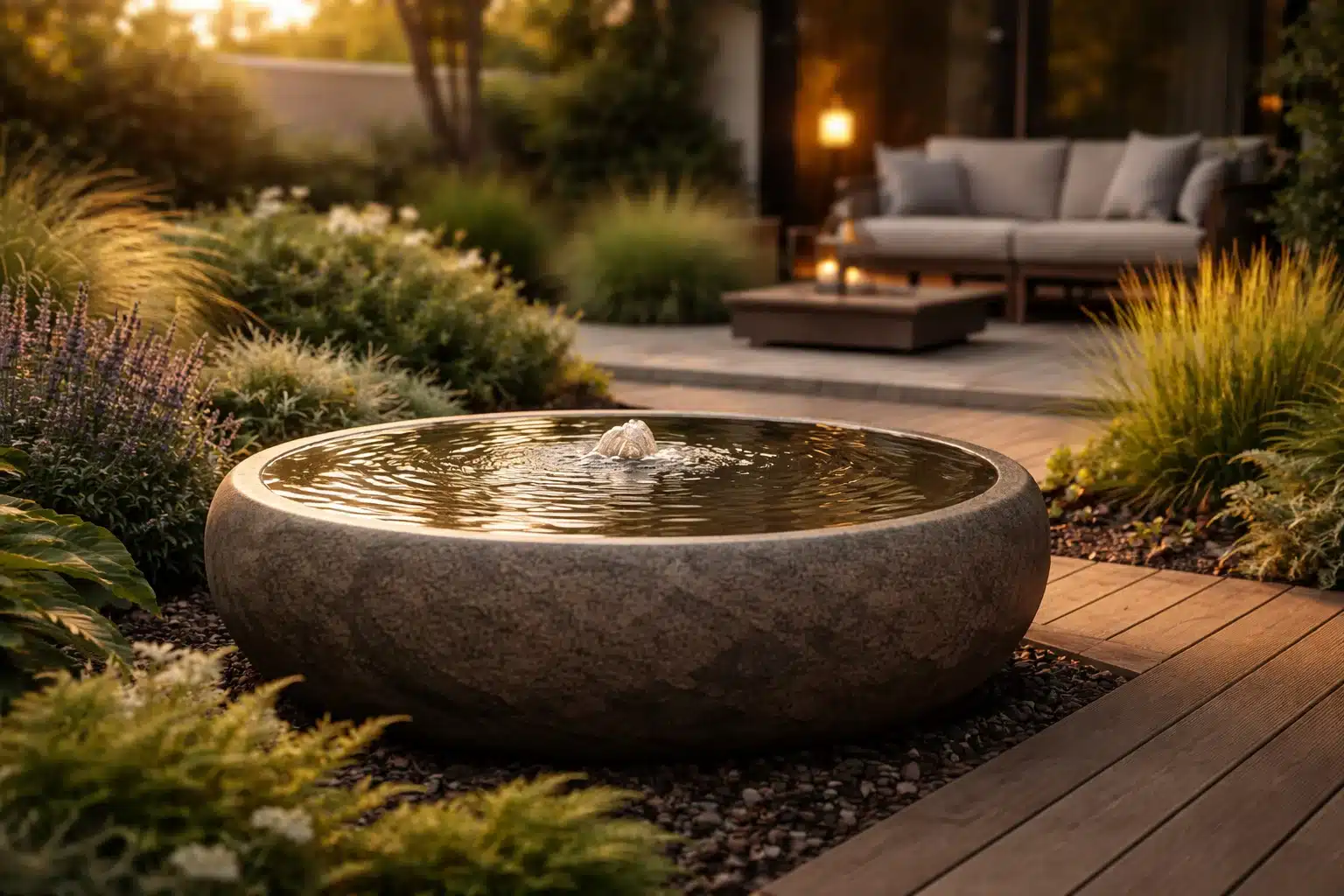
If you asked someone ten years ago what the “future” of fountains would look like, the answer probably sounded like a sci-fi movie.
More screens. More LEDs. More sensors. More “smart home” everything.
But here’s the twist: the future of fountains is heading in the opposite direction.
Not because technology is going away, but because our relationship with it is changing. People are tired. Overstimulated. Always connected. Always notified. Always in a hurry.
And that’s exactly why fountains, yes, fountains, are quietly becoming one of the most human design trends of the next decade.
Because a fountain doesn’t ask you to scroll.
It doesn’t ping you.
It doesn’t demand anything.
It just flows.
And in 2026 and beyond, that kind of presence is starting to feel like a luxury.
In this post, we’ll explore why the next era of fountains and water features is less about “high-tech” flash and more about what humans actually crave: comfort, grounding, sensory calm, and connection.
The New “Luxury” Isn’t More Stuff, It’s More Peace
Let’s start with a hard truth: modern life is loud.
Not just in sound, but in attention.
Even when we’re sitting still, our brains are juggling:
- emails
- texts
- app notifications
- news
- meetings
- to-do lists
- the endless hum of urgency
So when someone invests in outdoor fountains or indoor water fountains today, it’s often not about showing off.
It’s about creating a pocket of stillness.
A moment that feels like:
- a quiet courtyard
- a mountain lodge
- a spa lobby
- a peaceful garden path
- a hotel you never want to leave
And fountains deliver that better than almost anything else, because they work on a level deeper than “design.”
They work on the nervous system.
Fountains Are a “Sensory Technology” We Forgot We Needed
Here’s the fun part: fountains are already a kind of technology.
They always have been.
Hydraulics, pumps, filtration, basin engineering, sound shaping, flow control, these are not simple things. Even tabletop fountains involve clever mechanics.
But fountains don’t feel like technology because they don’t behave like modern tech.
They don’t demand attention.
They offer it back.
That’s why fountains feel more human than most “smart” products.
A water feature is basically an ancient invention that still works because it taps into something deeply wired into us: the soothing pull of moving water.
The Fountain Trend Isn’t About Modernity, It’s About Nature
The biggest shift in fountains isn’t that they’re becoming futuristic.
It’s that they’re becoming natural again.
In other words: instead of fountains trying to look like machines, they’re trying to look like landscapes.
This is why we’re seeing huge growth in:
- garden fountains that blend into planting beds
- outdoor water fountains that mimic springs or stone cascades
- wall fountains with textured surfaces and natural finishes
- floor fountains that feel architectural but calm
- minimalist indoor fountains that resemble natural water movement
Even in modern spaces, the fountain is less “look at me” and more “feel this.”
Why High-Tech Fountains Often Miss the Point
To be clear: technology isn’t the enemy.
Modern pumps are quieter, more efficient, and more reliable than ever. Filtration is better. Water circulation systems are smarter. Materials are more durable.
But there’s a difference between:
- using tech to improve the experience, and
- making the fountain itself feel like a gadget
When fountains get overloaded with features, overly complex lighting, app controls, multi-color modes, synchronized sound systems, they can accidentally become another thing to manage.
And the entire emotional point of fountains is the opposite.
The best fountains feel like:
- you don’t need to learn them
- you don’t need to optimize them
- you don’t need to troubleshoot them
- you can just exist near them
That’s why the future of fountains feels more human.
It’s design that respects your attention.
Outdoor Fountains: The Backyard Becomes the New Retreat
One of the biggest reasons outdoor fountains are rising in popularity is simple: people are investing in home like never before.
Not just in resale value.
In emotional value.
Outdoor water fountains have become a symbol of:
- “this is my space”
- “I’m building a life I actually enjoy”
- “I want my backyard to feel like a destination”
And this goes far beyond luxury mansions.
Even small patios are now being designed around water features:
- compact wall fountains
- low-profile floor fountains
- courtyard-style garden fountains
- small basins with gentle spillways
In many homes, a fountain is replacing what used to be:
- a second TV
- another gadget
- an oversized grill
- outdoor speakers blasting playlists
Because the fountain becomes the vibe.
Garden Fountains: A Shift Toward Living Design
Garden fountains are where the “human future” really shows up.
Why?
Because gardens are personal.
They’re slow.
They’re hands-on.
They’re about time and seasons and care.
And when you add a fountain to a garden, you’re not just adding decor, you’re adding a heartbeat.
A garden fountain becomes a focal point that changes how the entire space feels:
- birds come closer
- wind and water blend
- plants look more alive
- sitting outside feels more intentional
And importantly: garden fountains don’t have to be huge.
A simple stone bowl with a gentle overflow can be more emotionally powerful than a giant “show fountain.”
Indoor Water Fountains: The Rise of Calm Interiors
Outdoor fountains get the spotlight, but indoor water fountains are quietly becoming a major trend, especially in modern homes, offices, and wellness spaces.
Why?
Because indoor life is where stress lives.
And people are starting to design interiors the way they design mental health:
- softer lighting
- fewer harsh angles
- less clutter
- more natural textures
- more sound control
Indoor fountains fit perfectly into this shift.
A well-placed indoor fountain can:
- mask harsh background noise
- soften the feel of a room
- create a “slow” atmosphere
- make a space feel more grounded and luxurious
And it doesn’t have to be dramatic.
Even tabletop fountains can change the energy of a home office, a bedroom, or a reading corner.
Tabletop Fountains: Small Scale, Big Emotional Impact
Let’s talk about the underdog: tabletop fountains.
They’re often dismissed as “tiny decor,” but they’re actually one of the most human-centered water features available.
Why?
Because tabletop fountains are:
- accessible
- personal
- low commitment
- easy to move
- easy to enjoy
They’re the fountain equivalent of lighting a candle.
Not a major renovation.
Not a complicated project.
Just a small sensory ritual that makes life feel better.
And in the future, where people crave small daily comforts, tabletop fountains are going to keep growing.
Wall Fountains: Vertical Calm for Modern Spaces
Wall fountains are one of the best examples of “the future feels human.”
They’re architectural, sleek, and space-saving.
But the best wall fountains don’t feel like tech.
They feel like a living surface.
The trick is in the material choices and the flow style:
- natural stone textures
- soft, even sheet flow
- warm lighting (not harsh LEDs)
- gentle sound levels
- minimal visible hardware
In a modern home, wall fountains can replace what a fireplace used to represent:
- a visual anchor
- a comforting presence
- a sense of “home”
Floor Fountains: A Return to Sculptural Simplicity
Floor fountains are having a moment because they sit right at the intersection of:
- art
- architecture
- nature
- sensory comfort
Unlike flashy commercial fountains, residential floor fountains tend to lean into:
- clean forms
- grounded materials
- slow movement
- quiet sound
And that’s exactly what people want.
The future isn’t about fountains being more complex.
It’s about fountains being more meaningful.
The Rain Curtain Fountain: A Perfect Example of Human Tech
Now let’s talk about one of the coolest modern fountain styles: the rain curtain fountain.
On paper, it sounds futuristic.
A sheet of falling water that looks like rain inside a controlled frame.
But emotionally?
A rain curtain fountain is incredibly human.
Because it’s not about digital wow-factor.
It’s about:
- rhythm
- texture
- visual softness
- the hypnotic feeling of falling water
- the calm repetition that our brains love
A rain curtain water feature is basically the modern version of standing under a tree while it rains, except it’s designed, safe, and controlled.
And that’s a perfect example of the new fountain future: technology in service of feeling.
Water Features Are Becoming “Emotional Architecture”
Here’s a phrase worth keeping:
Water features are becoming emotional architecture.
In the past, fountains were often installed for:
- status
- tradition
- decoration
- property value
- grand entrances
Now, they’re being installed for:
- mood
- mental health
- ambiance
- sound design
- comfort
- restoration
In other words, fountains are moving from “ornament” to “experience.”
And experience is the most human thing we design for.
Why We Trust Water More Than Screens
This might sound strange, but think about it:
When you see a screen, your brain expects:
- information
- demands
- stimulation
- decisions
When you see moving water, your brain expects:
- safety
- nature
- continuity
- calm
Water is one of the oldest signals of life.
So even a modern indoor water fountain is tapping into something ancient.
That’s why the future of fountains doesn’t need to be louder, brighter, or smarter.
It just needs to be more emotionally intelligent.
The Best Modern Fountains Are Designed for “Soft Attention”
There’s a concept in psychology called soft fascination, things that hold your attention gently without exhausting you.
Examples:
- fire
- clouds
- leaves moving in wind
- waves
- rain
Fountains are basically engineered soft fascination.
That’s why they work so well in:
- meditation rooms
- spas
- hotel lobbies
- gardens
- patios
- courtyards
- modern living rooms
And as our world gets more intense, soft attention becomes more valuable.
Sustainability Is Part of the Human Future
The future of fountains is also more human because it’s becoming more responsible.
Modern fountains increasingly focus on:
- recirculating systems (less water waste)
- efficient pumps
- solar options for outdoor fountains
- smarter filtration
- materials that last longer and require fewer replacements
People don’t want a fountain that feels wasteful.
They want one that feels aligned with a more thoughtful lifestyle.
And that shift, toward conscious beauty, is one of the most human design trends of all.
The Future of Fountains Is Custom, Not Mass-Produced
Another huge change: people are moving away from cookie-cutter designs.
The next wave of fountains and water features is more:
- custom
- handcrafted
- locally sourced
- artisan-built
- tailored to the space
Because humans crave uniqueness again.
A fountain isn’t just a product.
It’s a personal environment.
That’s why you’ll see more demand for:
- bespoke garden fountains
- custom wall fountains
- unique rain curtain water feature installations
- indoor fountains designed to match interior finishes
- sculptural floor fountains
Fountains Will Become Part of Wellness Design (Not Just Landscaping)
If you want to understand the future, look at where fountains are showing up:
- yoga studios
- therapy offices
- medical waiting rooms
- coworking spaces
- boutique hotels
- luxury apartments
- wellness retreats
- modern workplaces
This isn’t random.
It’s because fountains are being recognized as a wellness tool.
Not in a cheesy way.
In a real way: they change how spaces feel.
And in the next decade, design will increasingly revolve around:
- nervous system comfort
- stress reduction
- sensory balance
- restorative environments
Fountains fit this perfectly.
What the Future Fountain Buyer Actually Wants
Let’s get practical.
The modern fountain buyer is rarely asking:
- “What has the most features?”
- “What’s the most high-tech?”
They’re asking:
- “Will it sound relaxing?”
- “Will it be easy to maintain?”
- “Will it look natural?”
- “Will it fit my space?”
- “Will it feel calming every day?”
That’s a very human shopping mindset.
It’s less about specs.
More about life.
The Quiet Truth: Fountains Help Us Feel Like Ourselves Again
This is the heart of it.
The future of fountains isn’t about water doing tricks.
It’s about water doing what it has always done:
- bring us back to the present
- soften our environments
- remind us that not everything needs to be optimized
- make a space feel alive
Whether it’s:
- outdoor fountains in a backyard retreat
- garden fountains surrounded by plants
- indoor water fountains in a calm living room
- tabletop fountains on a desk
- wall fountains in a modern entryway
- a rain curtain fountain in a commercial space
- floor fountains as sculptural centerpieces
…the trend is the same.
Fountains are becoming less like machines.
And more like companions.
Not something you use.
Something you live with.
And that’s why the future of fountains feels more human, not more high-tech.
FAQs:
Tabletop fountains and wall fountains are great for small rooms. They offer calming sound and movement without taking up much floor space.