...
Electrical Load Planning for Large-Scale Fountain

Electrical Load Planning for Large-Scale Fountain Installations

A commercial fountain depends on far more than hydraulic engineering to operate successfully. Behind every dramatic water display is an electrical system that powers pumps, lighting, water treatment equipment, automation controls, and safety devices. When electrical infrastructure is overlooked during design, even the most beautifully engineered fountain can experience operational failures, costly delays, and expensive redesigns.

Electrical load planning is one of the most important, yet frequently underestimated, aspects of commercial fountain engineering. Proper planning ensures that every component receives adequate power, complies with electrical codes, and operates efficiently throughout the life of the fountain.

For architects, electrical engineers, developers, contractors, and fountain designers, understanding electrical requirements early in the project enables coordination of electrical service, conduit routing, control systems, and equipment selection before construction begins.

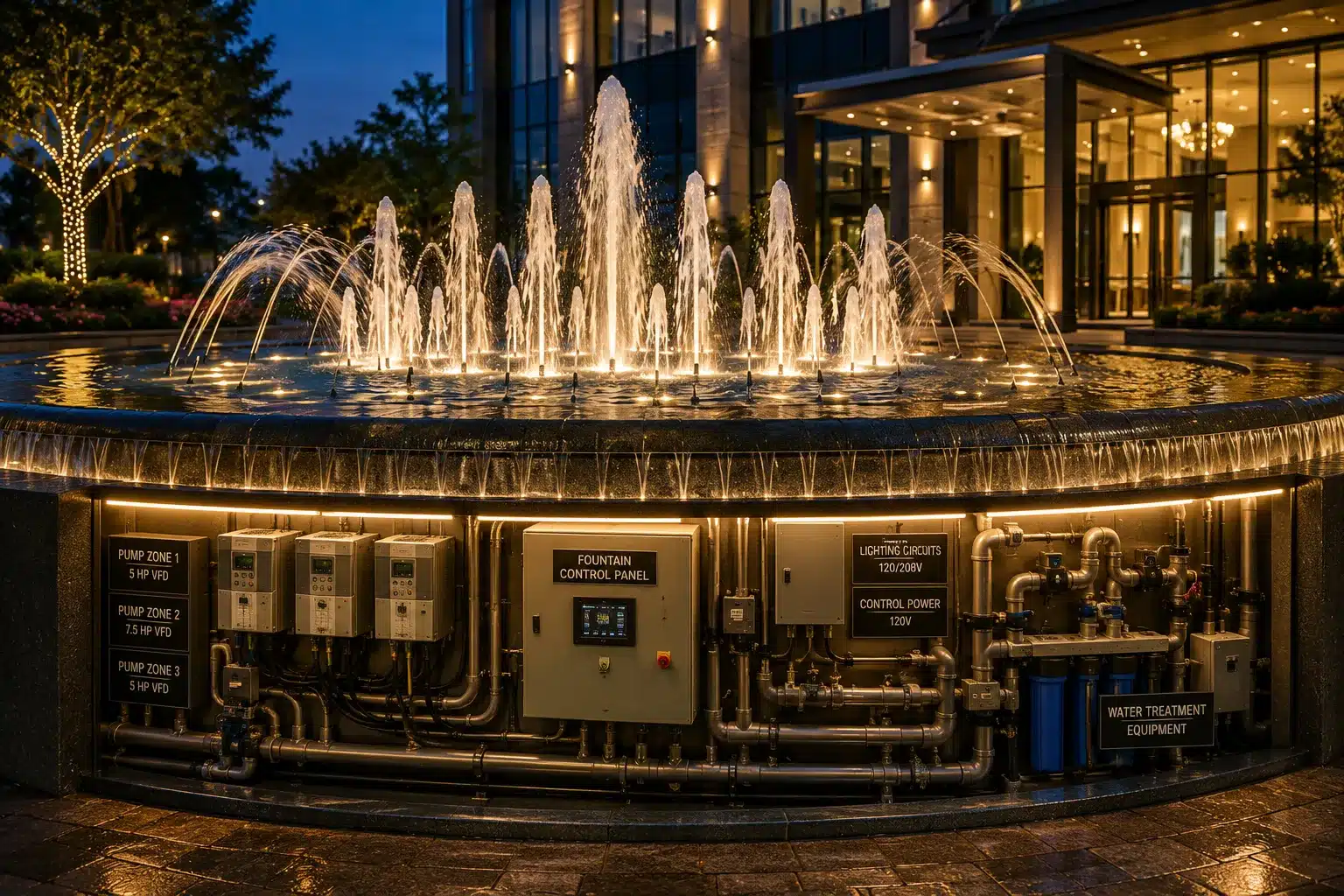
Today’s commercial fountains often include multiple pumps, programmable LED lighting, variable frequency drives (VFDs), automated water treatment systems, PLC controls, and remote monitoring equipment. All of these systems must work together within a carefully designed electrical distribution network that prioritizes safety, reliability, and long-term maintainability.

Quick Answer

Electrical load planning determines how power is distributed throughout a commercial fountain system. It includes calculating pump motor loads, lighting requirements, control panel power, water treatment equipment, voltage selection, conductor sizing, grounding, and NEC Article 680 compliance. Proper planning helps prevent overloads, improves system reliability, and supports safe long-term operation.

Electrical Loads at a Glance

Electrical Component

Typical Purpose

Relative Electrical Demand

Pump Motors

Water circulation and fountain displays

Very High

Variable Frequency Drives (VFDs)

Pump speed control

High

LED Lighting Systems

Fountain illumination

Moderate

Control Panels (PLC/HMI)

Automation and monitoring

Low

Water Treatment Equipment

UV, chemical dosing, monitoring

Moderate

While pump motors account for the largest portion of a fountain’s electrical demand, every component contributes to the overall electrical load and must be considered during system design.

Does Your Fountain Require Advanced Electrical Planning?

The larger and more complex a fountain becomes, the greater the importance of coordinated electrical engineering.

Dedicated electrical load planning is strongly recommended when a project includes:

Fountain Feature

Electrical Planning Consideration

Multiple pump zones

Individual motor load calculations

Programmable water shows

PLC and communication equipment

LED lighting systems

Separate lighting circuits

Variable frequency drives

Harmonic mitigation and conductor sizing

Automated water treatment

Dedicated control power

Interactive fountains

Additional safety and control requirements

Projects incorporating several of these features benefit from early collaboration between the fountain designer and the project’s electrical engineer.

Why Electrical Load Planning Matters

Every electrical component within a commercial fountain depends on adequate power distribution.

Undersized electrical infrastructure can result in:

  • Pump performance issues
  • Frequent breaker trips
  • Voltage drops
  • Reduced motor life
  • Lighting failures
  • Equipment overheating
  • Increased maintenance costs
  • Delays during commissioning

Electrical planning also affects future maintenance and expansion.

Providing adequate spare capacity in panels and conduit systems enables future upgrades without major electrical reconstruction.

Thoughtful planning protects both the initial investment and the fountain’s long-term reliability.

Understanding Electrical Demand

Commercial fountain systems generate several categories of electrical load that must be evaluated together rather than individually.

Major electrical consumers include:

  • Pump motors
  • Variable frequency drives
  • LED lighting
  • PLC automation systems
  • Human Machine Interface (HMI) displays
  • Chemical dosing systems
  • UV sterilization equipment
  • Communication devices
  • Monitoring sensors

Each component has different startup characteristics, operating cycles, and voltage requirements.

Understanding how these loads interact helps electrical engineers appropriately size conductors, overcurrent protection, transformers, and service equipment.

Pump Motors: The Largest Electrical Load

Pump motors typically represent the single largest electrical demand within a commercial fountain installation.

Motor current depends on:

  • Horsepower
  • Supply voltage
  • Phase configuration
  • Motor efficiency
  • Operating load

Large architectural fountains often use multiple pumps serving different hydraulic zones, including display jets, filtration, waterfalls, and water treatment systems.

Rather than sizing electrical infrastructure for individual pumps, engineers calculate the total connected motor load while considering diversity, operating schedules, and future expansion.

Many custom fountains incorporate multiple independently controlled pump systems that require separate electrical circuits and coordinated motor protection.

Variable Frequency Drives (VFDs)

Variable Frequency Drives (VFDs) have become standard equipment in many modern commercial fountain systems.

Rather than operating pumps at a constant speed, VFDs adjust motor speed based on operational requirements.

Benefits include:

  • Lower energy consumption
  • Improved hydraulic control
  • Reduced mechanical wear
  • Quieter operation
  • Programmable water displays
  • Better flow management

Although highly efficient, VFDs also introduce harmonic distortion into the electrical system.

For larger installations, engineers may specify:

  • Line reactors
  • Harmonic filters
  • Proper conductor sizing
  • Dedicated electrical panels

These measures help maintain electrical system reliability while complying with industry standards.

Planning Before Construction

Electrical planning should begin long before conduit is installed or equipment is ordered.

Early coordination allows architects, fountain designers, mechanical engineers, and electrical engineers to confirm:

  • Available utility service
  • Required voltage
  • Equipment locations
  • Conduit routing
  • Panel locations
  • Future expansion capacity

Beginning this process during design development helps prevent costly field modifications and keeps the project on schedule.

Voltage Selection and Power Distribution

Selecting the correct supply voltage is one of the earliest and most important electrical decisions in a commercial fountain project.

The chosen voltage influences conductor sizing, transformer requirements, electrical efficiency, installation costs, and long-term operating performance.

Most large commercial fountain systems utilize two primary voltage levels:

System

Typical Voltage

Pump Motors

480V Three-Phase

Lighting, Controls & Water Treatment

120/208V

For installations with multiple high-horsepower pumps, 480V three-phase power is generally preferred because it:

  • Reduces conductor size
  • Lowers the voltage drop
  • Improves electrical efficiency
  • Reduces distribution losses
  • Supports larger motor loads

Before finalizing pump specifications, designers should confirm available electrical service with both the utility provider and the project’s electrical engineer.

Designing around unavailable service voltages often results in costly redesigns during permitting or construction.

_Sfera_Sphere_Stone_Outdoor_Water_Fountain

Electrical Distribution Strategy

Large commercial fountains typically operate from a dedicated electrical sub-panel serving all fountain equipment.

A centralized distribution panel improves:

  • Circuit organization
  • Maintenance access
  • Future expansion
  • Troubleshooting
  • Equipment isolation

Typical circuits include:

  • Pump motors
  • Variable Frequency Drives (VFDs)
  • LED lighting
  • PLC control panels
  • Chemical dosing equipment
  • UV sterilizers
  • Basin heaters (where applicable)
  • Monitoring equipment

Providing dedicated circuits for each major component improves reliability while simplifying future maintenance.

Grounding and Bonding Requirements

Electrical safety is one of the highest priorities in fountain design.

Unlike standard building electrical systems, fountains are governed by NEC Article 680, which contains specific requirements for grounding and equipotential bonding around water features.

Equipotential bonding connects all metallic components into a common electrical network, eliminating dangerous voltage differences that could present a shock hazard.

Typical bonded components include:

  • Pump housings
  • Metal basin liners
  • Fountain nozzles
  • Stainless steel railings
  • Underwater lighting fixtures
  • Metal piping
  • Structural reinforcing steel where required

Proper bonding protects maintenance personnel, visitors, and electrical equipment while ensuring compliance with the National Electrical Code.

GFCI Protection

Ground-Fault Circuit Interrupter (GFCI) protection is required for circuits serving equipment in or around commercial fountains.

GFCIs continuously monitor electrical current and disconnect power almost instantly if a ground fault is detected.

This protection significantly reduces the risk of electric shock in wet environments.

Routine testing of GFCI devices should be included in every fountain maintenance program.

Conduit Routing and Raceway Design

Electrical raceways serving commercial fountains operate in challenging environments where moisture, vibration, and ground movement must all be considered.

Proper conduit design helps protect wiring throughout the installation’s life.

Best practices include:

  • Wet-location rated conduit
  • Schedule 40 or Schedule 80 PVC, where appropriate
  • Liquid-tight flexible conduit for equipment connections
  • Waterproof basin penetrations
  • Accessible pull boxes
  • Proper expansion fittings were required

Because fountain basins remain continuously exposed to water, poorly detailed conduit penetrations frequently become sources of leaks.

Designing these details correctly during construction helps prevent costly repairs later.

Separating Power and Control Circuits

Large commercial fountains often include sophisticated automation systems controlling pumps, lighting, sensors, and programmable water displays.

To minimize electrical interference, designers should separate:

  • Motor power conductors
  • Low-voltage communication cables
  • Lighting control wiring
  • Sensor wiring
  • PLC communication networks

Proper separation reduces electromagnetic interference that can affect sensitive electronic equipment.

Coordinating with the Electrical Engineer

Successful fountain projects require close coordination between the fountain designer and the project’s electrical engineer.

Rather than treating the fountain as a late design addition, electrical coordination should begin during schematic design.

The fountain designer should provide:

  • Complete motor schedule
  • Equipment voltage requirements
  • Horsepower ratings
  • Starting current information
  • Lighting loads
  • Water treatment loads
  • Control system requirements
  • Panel schedules

The electrical engineer then incorporates these loads into the building’s overall electrical design while confirming:

  • Available service capacity
  • Conductor sizing
  • Overcurrent protection
  • NEC Article 680 compliance
  • Voltage availability
  • Harmonic mitigation requirements

Early collaboration reduces change orders and helps keep construction on schedule.

Example: Mixed-Use Development Fountain

A mixed-use development is planned with a signature plaza fountain featuring:

  • Eight display pumps
  • Two filtration pumps
  • Forty-eight LED fixtures
  • PLC automation
  • UV sterilization
  • Chemical dosing equipment

Initial electrical planning assumed sufficient capacity from a nearby building service.

During design coordination, engineers discovered that the available service voltage differed from the specifications for the fountain equipment.

Because the issue was identified early, pump selections and transformer sizing were revised before construction documents were completed.

Resolving the conflict during design prevented costly field modifications and construction delays.

This example demonstrates why electrical coordination is just as important as hydraulic design for large commercial fountains.

Common Electrical Planning Mistakes

Many electrical issues originate during design rather than construction.

Common mistakes include:

  • Underestimating the total connected load
  • Selecting pump equipment before confirming the available voltage
  • Undersizing conductors for VFD applications
  • Failing to provide dedicated lighting circuits
  • Incomplete equipotential bonding
  • Poor conduit routing
  • Inadequate waterproof basin penetrations
  • Ignoring future expansion requirements
  • Delaying coordination with the electrical engineer

Avoiding these issues during design improves long-term reliability while reducing project costs.

Sustainability and Long-Term Benefits

Proper electrical planning benefits more than code compliance.

Well-designed electrical systems help:

  • Reduce energy consumption
  • Improve pump efficiency
  • Extend motor life
  • Reduce electrical maintenance
  • Improve reliability
  • Lower operating costs
  • Simplify future upgrades

Combining efficient pumps, VFD technology, programmable controls, and properly sized electrical infrastructure creates a fountain system that operates more efficiently throughout its service life.

Planning for Future Expansion

Many commercial fountain projects evolve after construction.

Owners may later request:

  • Additional lighting
  • More water features
  • Interactive controls
  • Music synchronization
  • Remote monitoring
  • Expanded automation

Providing spare panel capacity, conduit space, and electrical infrastructure during the initial installation makes future upgrades significantly less expensive.

Planning for expansion today often prevents major electrical reconstruction tomorrow.

Work With Fountains.com

Electrical engineering is just as important as hydraulic engineering in a successful commercial fountain installation.

Every project presents unique electrical requirements based on equipment selection, operating schedules, automation systems, and local utility service.

At Fountains.com, we work closely with architects, electrical engineers, developers, contractors, and project teams to provide detailed electrical load schedules that support safe, code-compliant, and efficient fountain installations.

Our documentation includes equipment schedules, motor loads, control requirements, and electrical coordination information that help simplify design while supporting long-term system performance.

Explore our:

Contact our team to discuss the electrical requirements for your next commercial fountain project.

Frequently Asked Questions

The licensed electrical engineer of record designs the electrical distribution system. Fountain designers provide detailed equipment schedules and electrical load information that support the engineer’s design.

NEC Article 680 establishes electrical safety requirements for fountains, including grounding, equipotential bonding, GFCI protection, and equipment installation. Compliance helps protect both people and equipment while ensuring successful inspections.

Some smaller commercial fountains can operate on single-phase power. However, installations with multiple high-horsepower pumps generally benefit from three-phase electrical service, as it offers greater efficiency and supports larger motor loads.

Yes. VFDs improve energy efficiency and hydraulic control but also introduce harmonic distortion into the electrical system. Larger installations may require harmonic mitigation devices such as line reactors or harmonic filters.

In most commercial applications, yes. A dedicated fountain sub-panel improves organization, simplifies maintenance, provides appropriate overcurrent protection, and allows future expansion.

Electrical service capacity, voltage availability, conduit routing, panel sizing, and equipment coordination all influence fountain design. Beginning electrical planning during schematic design helps prevent delays, redesigns, and unexpected construction costs.

Key Takeaway

Electrical load planning is one of the most critical aspects of designing a reliable commercial fountain. From pump motors and LED lighting to VFDs, automation systems, and compliance with NEC Article 680, every electrical component must work together to ensure safe and efficient operation.

By coordinating electrical design early, confirming the availability of utility service, properly sizing equipment, and planning for future expansion, project teams can create commercial fountain systems that deliver exceptional performance, reliable operation, and lower lifecycle costs for decades.


Related Resources

Continue exploring luxury water feature inspiration and design resources:

SUMMER SALE: 10% OFF ALL PRODUCTS
Use Code: SUMMER10