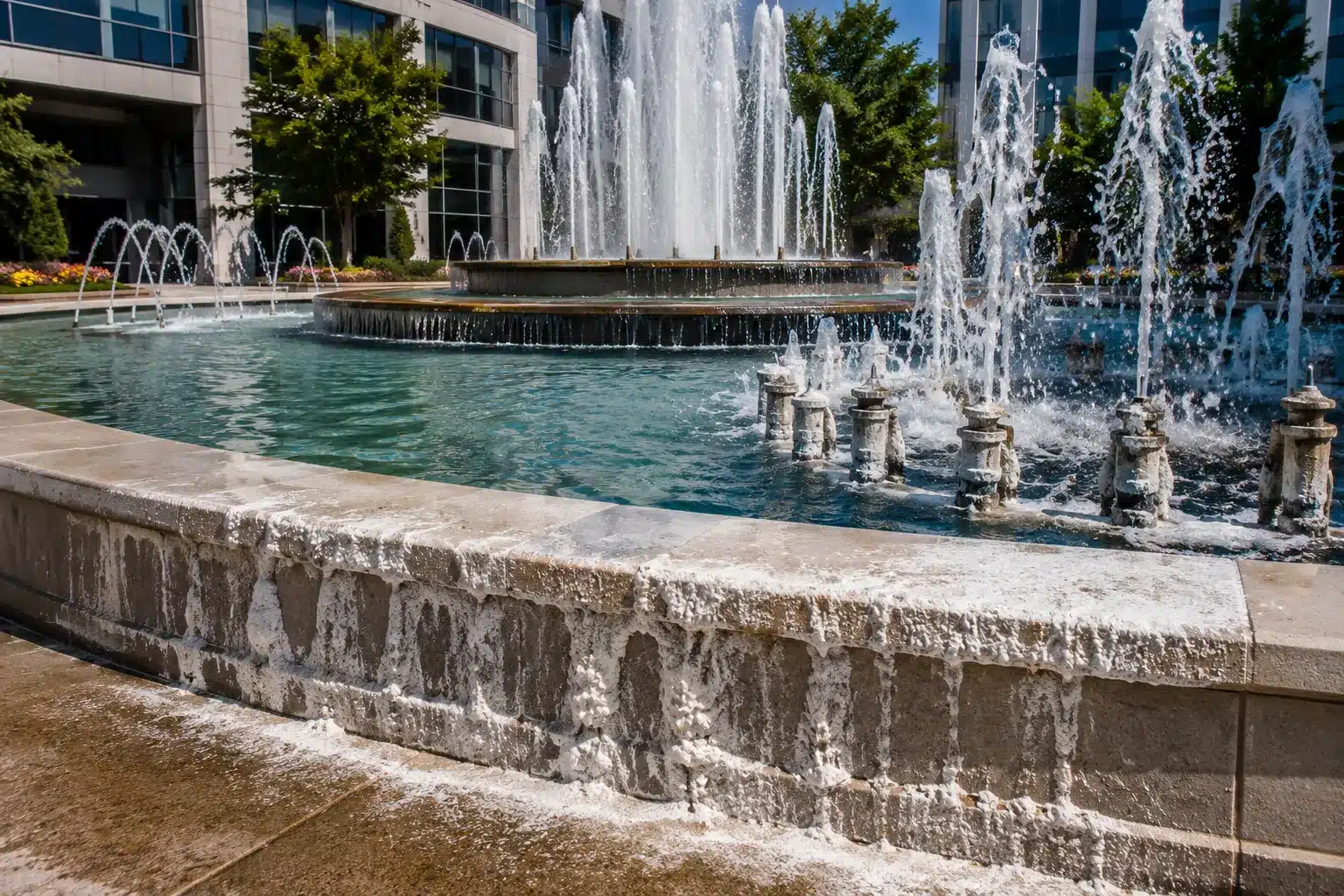
Water quality is essential to the long-term performance of commercial fountains. While pH balance, filtration, and sanitizer levels are often prioritized, water hardness consistently impacts maintenance costs, equipment lifespan, and the appearance of water features.
In many parts of the United States, naturally occurring calcium and magnesium create hard water, which leaves mineral deposits as water evaporates. Without proper management, these deposits accumulate on fountain surfaces, clog nozzles, reduce pump efficiency, and increase maintenance needs.
Untreated hard water shortens equipment lifespan and diminishes the visual quality of even well-designed fountains.
Architects, developers, facility managers, and maintenance professionals must consider water hardness during design and operation to protect both the appearance and long-term performance of fountain systems.
Many modern commercial fountains include water hardness management in their treatment strategies. Proactive mineral control reduces operating costs, protects equipment, and maintains consistent water quality throughout the installation’s life.
Quick Answer
Water hardness is the concentration of dissolved calcium and magnesium in water. In commercial fountains, hard water causes scale buildup on stone, stainless steel, pumps, nozzles, and piping. Managing hardness with pH control, scale inhibitors, automated blowdown, and softened make-up water reduces maintenance, improves performance, and extends equipment life.
Water Hardness at a Glance
Hardness Level | Calcium Carbonate (ppm) | Maintenance Impact |
Soft | 0–60 | Minimal mineral scale |
Moderately Hard | 61–120 | Light scale over time |
Hard | 121–180 | Routine scale management recommended |
Very Hard | Above 180 | Dedicated treatment strongly recommended |
Hard water is common in many U.S. regions, especially where municipal supplies come from limestone aquifers, mineral-rich rivers, or groundwater.
Assessing local water hardness before construction helps engineers select suitable materials, treatment systems, and maintenance schedules.
Why Water Hardness Matters
Water hardness remains relatively constant because it comes from naturally dissolved minerals, unlike temporary water-quality issues.
Each gallon of makeup water adds calcium and magnesium to the system. As water evaporates, these minerals remain, gradually forming scale deposits.
Without proper management, scale affects nearly every part of a commercial fountain.
Hard water contributes to:
- Mineral scale buildup
- Reduced hydraulic efficiency
- Distorted fountain spray patterns
- Increased pump wear
- Reduced UV sterilizer performance
- Surface staining
- Higher maintenance costs
- Shorter equipment lifespan
Since scale develops gradually, many operators do not notice the problem until performance declines.
Preventing mineral accumulation is usually less costly than removing established scale deposits.
What Is Water Hardness?
Water hardness measures the concentration of dissolved calcium and magnesium ions within the water supply. It is commonly expressed as parts per million (ppm) or grains per gallon (GPG), using calcium carbonate as the standard reference.
Hardness classifications generally include:
Water Classification | Hardness |
Soft | 0–60 ppm |
Moderately Hard | 61–120 ppm |
Hard | 121–180 ppm |
Very Hard | Above 180 ppm |
Municipal water systems in the western United States, the Great Plains, and limestone regions often exceed 200–400 ppm hardness, making proactive scale management essential for commercial fountains.
Since water chemistry varies by location, testing the local supply before finalizing specifications allows designers to choose appropriate materials and treatment equipment from the start.
Common Symptoms of Hard Water
Hard water rarely causes immediate equipment failure but leads to gradual performance issues that worsen over time.
Common warning signs include:
- White mineral deposits on stone or metal surfaces
- Reduced fountain nozzle performance
- Distorted laminar water streams
- Cloudy water despite proper chemical treatment
- Mineral buildup on stainless steel components
- Frequent pump seal failures
- Scale accumulation inside piping
- Increased maintenance costs
- Reduced hydraulic circulation
- Mineral deposits on UV sterilizer sleeves
If several of these symptoms occur simultaneously, water hardness should be evaluated before increasing chemical treatment.
Managing hardness addresses the underlying cause rather than simply treating the visible effects.
Does Your Fountain Need Hard Water Treatment?
Although every fountain operates under different conditions, certain factors significantly increase the need for dedicated hardness management.
Fountain Condition | Recommended Action |
Water hardness above 150 ppm | Begin routine scale management |
Water hardness above 250 ppm | Consider softened make-up water and scale inhibitors |
Precision laminar nozzles | Monthly inspection and cleaning |
Dark stone finishes | Routine mineral deposit removal |
Large evaporative fountains | Automated blowdown recommended |
Many custom fountains installed in hard-water regions include automated water treatment systems during the initial engineering phase, which significantly reduce maintenance over the life of the fountain.
Likewise, many metal fountains benefit from proactive hardness management to reduce mineral deposits that can affect appearance and conceal early signs of corrosion.
Why Early Planning Saves Money
Hard water is predictable. Unlike many water-quality issues that develop unexpectedly, mineral content is already known before construction begins through municipal water reports or simple hardness testing.
Designing for hard water from the outset enables engineers to specify appropriate materials, automated blowdown systems, scale-inhibitor dosing equipment, and maintenance schedules before mineral deposits become a costly operational problem.
As commercial fountain systems become larger and more architecturally complex, proactive hardness management becomes an investment in lower maintenance costs, improved hydraulic performance, and longer equipment life rather than an optional upgrade.
Next: Part 2 covers how hard water affects pumps, nozzles, stone, stainless steel, UV systems, and piping, followed by the most effective treatment strategies, a real-world case study, and maintenance best practices.
How Hard Water Affects Commercial Fountain Systems
Once dissolved, calcium and magnesium enter a fountain system; they remain in the water until removed through treatment or blowdown. As water evaporates, the concentration of these minerals increases, increasing the likelihood of scale formation.
Scale is more than a cosmetic issue. Over time, mineral deposits reduce hydraulic efficiency, interfere with mechanical equipment, and increase maintenance costs throughout the entire fountain system.
Understanding where scale develops first helps operators identify problems before they become expensive repairs.
Scale Buildup on Fountain Surfaces
The most visible effect of hard water is the formation of mineral scale.
Scale consists primarily of calcium carbonate and magnesium compounds that accumulate anywhere water evaporates or repeatedly splashes onto surfaces.
Common locations include:
- Stone coping
- Basin walls
- Overflow edges
- Decorative sculptures
- Fountain nozzles
- Stainless steel trim
- Waterline surfaces
As evaporation leaves minerals behind, white, chalky deposits gradually thicken and become more difficult to remove.
Dark architectural finishes, such as black granite or slate, tend to show mineral deposits much more prominently than lighter materials.
Large commercial fountains that experience significant evaporation often require ongoing scale management to maintain their appearance.
Pump Wear and Hydraulic Efficiency
Scale doesn’t remain only on visible surfaces.
Mineral deposits also accumulate inside:
- Pump impellers
- Pump housings
- Mechanical seals
- Piping
- Valves
- Heat exchangers
- Flow meters
Even thin layers of scale reduce water flow and increase hydraulic resistance.
As pumps work harder to overcome these restrictions, operators may notice:
- Reduced flow rates
- Higher electrical consumption
- Increased vibration
- Premature bearing wear
- Seal failures
- Shorter equipment lifespan
One of the most common maintenance issues in hard-water fountains is premature pump seal failure due to mineral deposits forming on the seal faces.
Routine inspection combined with preventive pump care for continuous-run commercial fountains helps minimize these long-term maintenance issues.
Precision Nozzles and Water Display Performance
Fountain nozzles are among the first components affected by hard water.
Even a thin ring of calcium deposits around a nozzle orifice can alter the intended water pattern.
Hard water commonly causes:
- Reduced nozzle flow
- Distorted spray patterns
- Uneven streams
- Reduced display height
- Increased splash
- Poor laminar performance
Precision laminar nozzles are particularly sensitive because they rely on perfectly smooth water flow.
A small amount of mineral buildup may be enough to transform a crystal-clear stream into a turbulent spray.
Routine nozzle inspection should be included in every fountain maintenance program, especially in regions where hardness exceeds 150 ppm.
UV Systems and Water Treatment Equipment
Many commercial fountains rely on ultraviolet sterilization to supplement chemical treatment.
Unfortunately, UV equipment is especially vulnerable to mineral scale.
Deposits commonly accumulate on quartz sleeves surrounding UV lamps.
As scale thickens:
- UV light penetration decreases.
- Sterilization efficiency declines.
- Lamp operating temperatures increase.
- Maintenance intervals become more frequent.
Cleaning quartz sleeves before heavy mineral buildup develops helps maintain consistent disinfection performance.
Material-Specific Effects of Hard Water
Different fountain materials respond differently to mineral deposits.
Natural Stone
Limestone and travertine generally tolerate hard water well.
However, aggressive acid cleaning used to remove heavy scale can permanently etch polished stone surfaces.
Cleaning products should always be selected in accordance with the stone manufacturer’s recommendations.
Dark Stone Finishes
Black granite, slate, and dark basalt provide dramatic architectural contrast but also reveal mineral deposits more readily than lighter materials.
Routine cleaning becomes especially important to preserve their appearance.
Stainless Steel
Stainless steel resists corrosion extremely well.
However, mineral scale can:
- Hide developing corrosion
- Reduce aesthetic appearance
- Increase cleaning requirements
- Affect precision nozzle components.
Although the stainless steel itself is rarely damaged, accumulated deposits should still be removed periodically.
Decorative Metals
Many metal fountains incorporate stainless steel, bronze, copper, or specialty architectural metals.
Because different metals respond differently to water chemistry, hardness management becomes an important part of protecting decorative finishes over the long term.
Does Hard Water Always Require Treatment?
Not always.
Moderately hard water may require only routine monitoring and periodic cleaning.
However, treatment becomes increasingly important when:
- Hardness exceeds 150 ppm.
- Large evaporation losses occur.
- Precision nozzle displays are used.
- Dark architectural finishes are specified.
- Maintenance costs continue to increase.
Identifying these conditions early allows operators to address water chemistry before scale becomes difficult to remove.
Real-World Example
A mixed-use development in the Southwest operates a large architectural fountain supplied by municipal water measuring approximately 280 ppm hardness.
Within six months of operation, maintenance staff observed:
- White mineral deposits on black granite coping
- Distorted laminar nozzle streams
- Increased pump maintenance
- Scale accumulation on UV sleeves
Rather than increasing chemical treatment, the facility installed:
- Automated conductivity-controlled blowdown
- Continuous phosphonate scale inhibitor dosing
- Quarterly nozzle cleaning
Within one operating season:
- Mineral deposits declined significantly.
- Water displays returned to their original appearance.
- Pump maintenance intervals increased.
- Chemical consumption stabilized.
The project demonstrated that managing water hardness early is substantially less expensive than repeatedly removing established scale.
Water Treatment Strategies for Hard Water
Effective hardness management usually combines several complementary approaches.
No single treatment method solves every hard-water problem.
pH Management
Maintaining pH between 7.2 and 7.4 helps reduce calcium carbonate precipitation.
Although this does not remove hardness, it significantly slows the rate at which scale forms.
Because pH adjustment is relatively inexpensive, it remains one of the simplest strategies for managing hardness.
Automated Blowdown
Blowdown removes mineral-rich water from the basin and replaces it with fresh makeup water.
Automated conductivity controllers measure Total Dissolved Solids (TDS) and discharge water whenever the mineral concentration reaches a predetermined level.
Benefits include:
- Lower mineral concentration
- Reduced scaling
- Improved water clarity
- Better long-term equipment performance
Automated blowdown has become standard practice for many large commercial fountain systems.
Scale Inhibitors
Modern phosphonate- and polymer-based scale inhibitors interfere with the formation of calcium carbonate crystals.
Instead of allowing minerals to attach to surfaces, these products keep them suspended in solution until discharged through normal blowdown.
Scale inhibitors provide:
- Reduced mineral deposits
- Lower maintenance costs
- Better nozzle performance
- Improved pump protection
These products are commonly introduced through automated chemical dosing systems.
Softened Make-Up Water
When source water hardness exceeds 250 ppm, softened make-up water can significantly reduce mineral loading.
Water softeners replace calcium and magnesium ions with sodium ions before water enters the fountain.
While highly effective, softened water should be used with caution when fountains include copper, bronze, or zinc components.
Sustainability and Lifecycle Benefits
Managing water hardness benefits more than appearance.
Proper mineral control helps:
- Reduce chemical usage
- Improve pump efficiency
- Extend equipment lifespan
- Lower maintenance costs
- Improve hydraulic circulation
- Reduce emergency repairs
Over the lifespan of a commercial fountain, proactive hardness management often costs significantly less than repeatedly repairing scale-related damage.
Cleaning Scale Safely
Even well-maintained fountains eventually require scale removal.
Cleaning methods depend on the fountain material.
Stone
Use diluted phosphoric acid solutions.
Always test a small area before applying to the entire area.
Avoid aggressive acids that may permanently etch polished finishes.
Stainless Steel
Citric acid or dilute phosphoric acid generally provides effective cleaning while preserving finish quality.
Always rinse thoroughly after treatment.
Precision Nozzles
Remove nozzle heads and soak them in diluted acid until mineral deposits dissolve.
Never use wire brushes or abrasive tools on precision nozzle openings.
Work With Fountains.com
Water hardness should be considered long before a fountain begins operating.
Local water chemistry influences material selection, hydraulic design, equipment specifications, maintenance schedules, and long-term operating costs.
At Fountains.com, we work with architects, developers, contractors, and facility managers to incorporate water-hardness management at every stage of commercial fountain design.
Whether you’re planning a new commercial fountain or improving an existing installation, our team can recommend practical solutions that reduce scale, protect equipment, and improve long-term performance.
Explore our:
- Commercial Fountains
- Fountain Maintenance
- Maintenance Planning for Large-Scale Architectural Fountains
- Preventive Pump Care for Continuous-Run Commercial Fountains
- Metal Fountains
Contact our team to discuss the best water treatment strategy for your project’s local water conditions.
Frequently Asked Questions
Your local water utility publishes an annual Consumer Confidence Report (CCR) that typically includes information on hardness. You can also use a water hardness test kit or laboratory water analysis.
Scale becomes increasingly noticeable above approximately 150 ppm. When hardness exceeds 250 ppm, dedicated hardness management, such as automated blowdown, scale inhibitors, or softened make-up water, is generally recommended.
Hard water rarely directly damages stainless steel. However, mineral deposits can mask developing corrosion, degrade appearance, and impair nozzle performance and routine maintenance.
Both approaches are effective. Scale inhibitors are easier to implement and maintain existing water chemistry, while softened make-up water reduces the amount of hardness entering the fountain. Many commercial systems use both methods together.
In hard-water installations, inspect nozzle orifices monthly. Many commercial fountains require nozzle cleaning every three months, although frequency depends on hardness, temperature, evaporation, and operating conditions.
Untreated hard water gradually leads to scale buildup, distorted water displays, reduced pump efficiency, increased maintenance costs, shorter equipment life, and diminished fountain appearance. Addressing water hardness early is typically far more cost-effective than repairing scale-related damage later.
Key Takeaway
Water hardness is one of the most predictable factors affecting long-term commercial fountain performance. Left unmanaged, dissolved minerals gradually reduce hydraulic efficiency, increase maintenance costs, and diminish the appearance of architectural water features.
By combining thoughtful design, appropriate materials, automated blowdown, scale inhibitors, softened make-up water where appropriate, and routine maintenance, commercial fountain owners can minimize mineral buildup, extend equipment life, and preserve the beauty and performance of their water features for years to come.