...
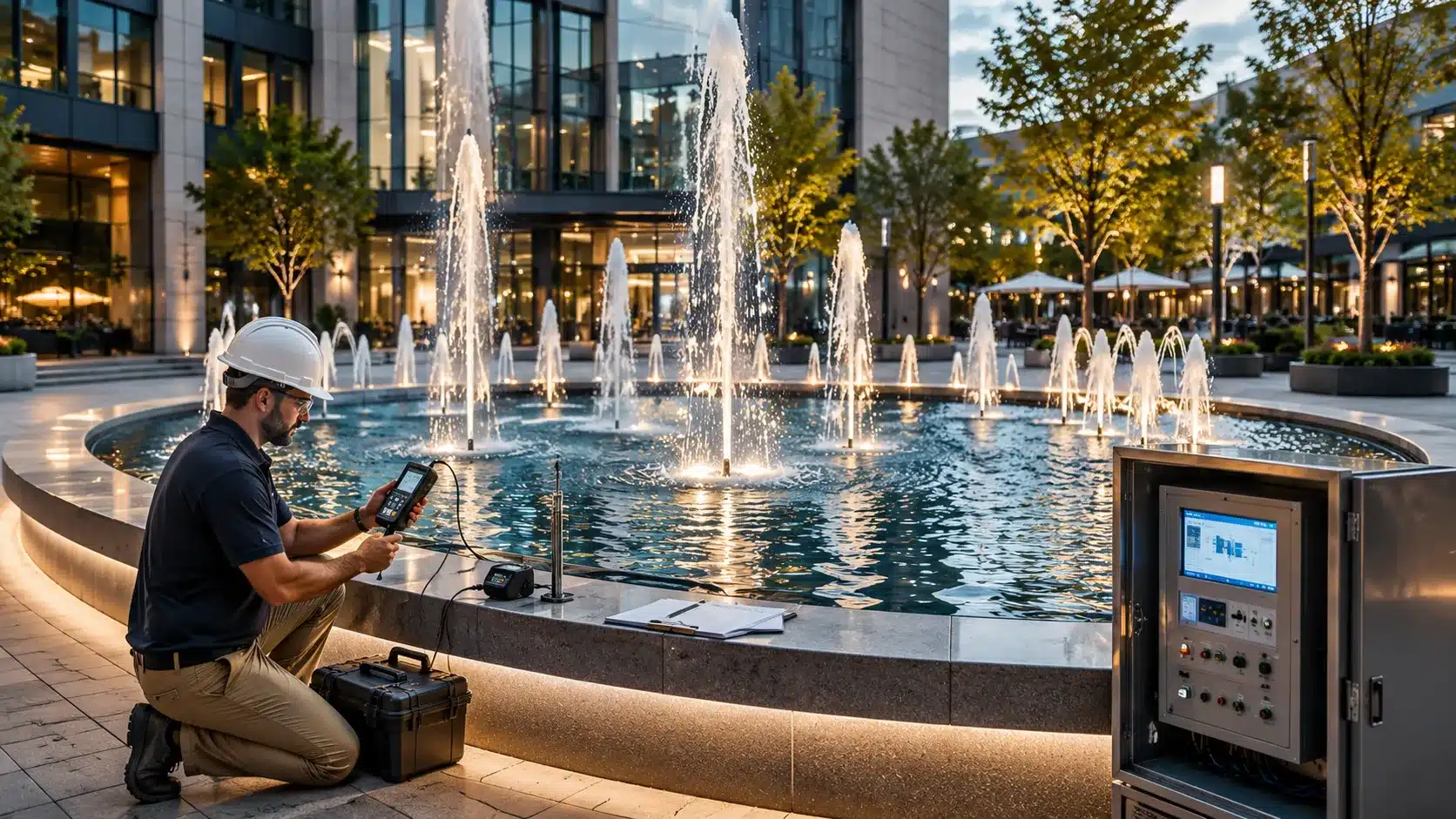
An engineer is commissioning a newly installed commercial fountain by testing hydraulic performance and water systems during startup.

How to Commission a New Commercial Fountain: The First 90 Days

Commissioning is one of the most important stages in the lifecycle of a commercial fountain.

It transforms a completed construction project into a fully operational, verified, and documented water feature, ready for years of reliable service.

Unfortunately, commissioning is also one of the most overlooked phases of a commercial fountain project.

When project schedules are compressed, commissioning is often shortened. While the fountain may appear operational during the final walkthrough, hidden issues can emerge within weeks. Problems such as uneven jet heights, unstable water chemistry, excessive pump vibration, programming errors, and untrained staff can quickly turn a successful installation into a maintenance challenge.

A properly commissioned commercial fountain performs differently.

Every hydraulic component is tested, every operating parameter is documented, every control sequence is verified, and every member of the maintenance team understands how to operate the system correctly before public operation begins.

This guide details the commissioning process for the first 90 days, helping developers, facility managers, architects, and maintenance teams establish a reliable foundation for long-term fountain performance.

Explore our collection of Commercial Fountains for examples of professionally engineered water features:

https://fountains.com/commercial-fountains/

Why Commercial Fountain Commissioning Matters

A commercial fountain is more than a decorative water feature.

It is an integrated mechanical, hydraulic, electrical, and architectural system that must operate continuously while maintaining precise water movement, safe electrical performance, balanced water chemistry, and an exceptional visual presentation.

Commissioning confirms that every one of these systems performs exactly as intended before the project reaches final acceptance.

Skipping or shortening commissioning can lead to costly operational problems affecting the fountain and surrounding property.

Commissioning Is Not a Final Walkthrough

Many people confuse commissioning with a contractor punch list.

These are distinct processes.

A punch list identifies incomplete construction items.

Commissioning verifies that every completed system performs in accordance with the design intent under actual operating conditions.

The goal is to verify performance, not conduct a cosmetic inspection.

Commissioning Protects Long-Term Investment

Commercial fountains represent a significant capital investment.

Proper commissioning protects that investment by identifying mechanical issues before they become expensive repairs.

It also creates a documented performance baseline that simplifies future maintenance and troubleshooting.

A complete commercial fountain commissioning process verifies:

  • Hydraulic system performance
  • Pump efficiency and balancing
  • Water chemistry stability
  • Filtration and water treatment
  • Lighting operation
  • Control system programming
  • Safety systems
  • Staff training
  • Maintenance documentation

Reliability begins during commissioning, not after opening day.

It begins during commissioning.

For long-term operational planning, read our guide on Maintenance Planning for Large-Scale Architectural Fountains:

https://fountains.com/maintenance-planning-for-large-scale-architectural-fountains/

Commercial Fountain Commissioning Timeline

The first 90 days establish the operational foundation for the fountain’s lifespan.

Professional commissioning follows a structured sequence, testing each system individually before evaluating overall performance.

Commissioning Phase

Typical Timeline

Pre-Commissioning Inspection

Before initial fill

Hydraulic Startup & Testing

Days 1–14

Water Chemistry Stabilization

Days 7–21

Lighting & Controls Verification

Days 14–30

Integrated System Testing

Days 30–60

Staff Training & Documentation

Days 45–60

Operational Monitoring

Days 60–90

Each phase builds on the previous, allowing issues to be identified and corrected before affecting overall system performance.

Phase 1: Pre-Commissioning Inspection

Before water is introduced into the basin, every component should undergo a comprehensive inspection.

Correcting problems before startup is far less expensive than repairing systems after the fountain is operational.

Structural and Waterproofing Verification

The basin should first be evaluated for structural integrity and waterproofing performance.

One of the most important commissioning procedures is the basin flood test.

The basin is filled to its operating level and monitored for at least 24 hours to verify that waterproofing membranes, penetrations, expansion joints, and construction joints remain watertight.

Leaks discovered after the finished materials are installed often require significantly more time and expense to repair.

Structural verification should include:

  • 24-hour basin flood test
  • Inspection of construction joints
  • Expansion joint verification
  • Equipment vault waterproofing
  • Drainage system inspection

Mechanical Pre-Startup Inspection

Before pumps begin operating, every mechanical component should be inspected for proper installation and readiness.

This prevents equipment damage during initial startup.

Mechanical verification includes:

  • Pressure testing all piping
  • Verifying pump rotation direction
  • Checking isolation valve positions
  • Inspecting strainer baskets
  • Confirming auto-fill operation
  • Verifying equipment labeling

These inspections ensure hydraulic testing can proceed safely.

Electrical System Verification

Electrical safety should always be verified before energizing mechanical equipment.

Because commercial fountains combine electricity and water, proper electrical commissioning is essential for safe operation.

Electrical inspections should verify:

  • Power distribution
  • Ground Fault Circuit Interrupter (GFCI) operation
  • Equipotential bonding
  • Control panel functionality
  • Emergency shutdown systems
  • Control interface operation

Commissioning teams document each inspection before authorizing initial startup.

The commercial fountain basin is undergoing a 24-hour flood test before commissioning begins.

Phase 2: Hydraulic Startup and Performance Testing (Days 1–14)

Once structural, mechanical, and electrical inspections are complete, the fountain can begin its first operational startup.

Hydraulic testing is a critical phase because it confirms that water movement matches the original design intent.

The objective is not simply to make the fountain run.

The objective is to verify that every pump, nozzle, valve, and circulation system performs exactly as specified.

Initial startup priorities include:

  • Controlled basin filling
  • Pump-by-pump startup
  • Operating pressure verification
  • Flow rate measurement
  • Pump motor current recording
  • Initial vibration assessment
  • Verification of Variable Frequency Drive (VFD) operation

A balanced hydraulic system delivers consistent jet heights, smooth water movement, reduced energy consumption, and improved equipment reliability.

Developers interested in extending equipment life should also review our guide on Preventive Pump Care for Continuous-Run Commercial Fountains:

https://fountains.com/preventive-pump-care-for-continuous-run-commercial-fountains/

Phase 2: Hydraulic Startup and Performance Testing (Days 1–14)

After the pre-commissioning inspection is complete and the basin has successfully passed its flood test, the commercial fountain is ready for hydraulic startup.

This phase verifies that every hydraulic component performs in accordance with the original engineering design. It is also the first opportunity to identify issues that could affect water displays, pump performance, or long-term reliability.

The objective is not simply to make water flow.

The objective is to ensure the hydraulic system operates efficiently, safely, and consistently under real operating conditions.

Initial Basin Fill

The basin should be filled gradually while technicians continuously inspect for leaks, abnormal water loss, and proper operation of the automatic fill system.

During the initial fill, commissioning personnel verify that the fountain reaches its intended operating level without overflowing or exposing suction components.

Initial fill verification includes:

  • Monitoring all waterproofing penetrations
  • Confirming automatic fill valve operation
  • Testing overflow systems
  • Checking expansion joints
  • Recording initial water levels

Documenting these baseline conditions provides valuable reference data for future maintenance.

Pump Startup and Verification

Rather than energizing every pump simultaneously, each pump should be started individually.

Starting pumps individually allows technicians to isolate problems before they affect the entire hydraulic system.

During startup, commissioning teams verify:

  • Operating pressure
  • Flow rate
  • Motor current draw
  • Pump rotation
  • Bearing noise
  • Vibration levels
  • Variable Frequency Drive (VFD) performance

Motor amperage should remain within the manufacturer’s specified Full Load Amperage (FLA), while pressure and flow rates should closely match the engineered hydraulic calculations.

Unexpected vibration, excessive noise, or cavitation should always be investigated before commissioning proceeds.

Hydraulic Balancing

Hydraulic balancing is often overlooked in commercial fountain commissioning.

Without proper balancing, fountain displays rarely perform as designed.

Water jets may vary in height, spillways may appear uneven, and some nozzle zones may receive significantly more water than others.

Technicians adjust balancing valves until every nozzle, cascade, and water effect matches the design intent.

Hydraulic balancing includes:

  • Adjusting balancing valves
  • Verifying jet heights
  • Confirming display symmetry
  • Recording valve positions
  • Documenting operating pressures

The final valve settings are included in the Operations and Maintenance (O&M) Manual for future servicing.

Filtration Performance Verification

Before commissioning progresses, the filtration system must demonstrate that it can maintain the required water turnover rate.

Filters should operate within their intended pressure range while providing consistent circulation throughout the fountain.

Commissioning personnel establish baseline readings for future maintenance comparisons.

Filtration verification includes:

  • Confirming design flow rate
  • Testing backwash procedures
  • Recording differential filter pressure
  • Inspecting strainers
  • Verifying circulation patterns

Reliable filtration during commissioning improves long-term water quality and equipment life.

Phase 3: Water Chemistry Establishment (Days 7–21)

Hydraulic performance and water quality are inseparable.

Even a balanced fountain will experience operational problems if water chemistry is not stabilized during the first weeks of operation.

Water chemistry should not be treated as an afterthought.

Instead, it should follow a structured commissioning plan that establishes baseline values, verifies treatment equipment, and documents every adjustment.

Establishing Baseline Water Quality

Before chemical treatment begins, technicians should evaluate the incoming water supply.

Source water characteristics vary considerably depending on geographic location and municipal water systems.

Testing establishes baseline conditions for chemical treatment.

Typical baseline measurements include:

  • pH
  • Total alkalinity
  • Calcium hardness
  • Total Dissolved Solids (TDS)
  • Water temperature
  • Conductivity

Understanding these values determines the appropriate treatment program for the fountain.

Initial Chemical Treatment

After baseline testing, treatment chemicals are gradually introduced until the target operating ranges are achieved.

Commercial fountains commonly use automated dosing systems that regulate sanitizer levels and pH with minimal manual adjustment.

During commissioning, these systems require close observation and calibration.

Initial water treatment includes:

  • Sanitizer adjustment
  • pH balancing
  • Alkalinity stabilization
  • Scale prevention
  • Sensor calibration

The goal is to create stable water chemistry that protects visitors and equipment.

Daily Water Monitoring

Water chemistry should be tested daily throughout the first two weeks of operation.

Frequent monitoring allows commissioning teams to observe fountain performance and make adjustments before larger problems develop.

Every test result should be documented as part of the commissioning record.

This historical data is an important reference for facility managers after project handover.

UV Sterilization Verification

Many modern commercial fountains include ultraviolet sterilization systems as part of their water treatment process.

Commissioning verifies that:

  • UV lamps operate correctly.
  • Flow rates remain within design limits.
  • Sensors report accurate intensity levels.
  • Controllers communicate properly with the automation system.

Proper UV operation reduces sanitizer demand and improves overall water quality.

Technician performing water chemistry testing during the commissioning of a commercial fountain.

Phase 4: Lighting and Control System Commissioning (Days 14–30)

Once hydraulic performance and water chemistry are stable, attention shifts to lighting, automation, and system controls.

These systems determine how the fountain operates, responds to changing conditions, and delivers the intended visual experience.

LED Lighting Verification

Every fixture should be inspected individually before full programming begins.

Technicians verify:

  • Fixture operation
  • Waterproof seals
  • Beam alignment
  • Color temperature
  • Dimming capability
  • Lighting scenes

Correct any inconsistencies before the system enters normal operation.

Control System Programming

Modern commercial fountains often rely on programmable logic controllers (PLCs) and Human Machine Interfaces (HMIs) to automate daily operation.

During commissioning, technicians verify that every programmed sequence performs correctly.

Control system testing includes:

  • Startup schedules
  • Shutdown sequences
  • Low-water shutdown protection
  • High-temperature responses
  • Pressure fault alarms
  • Remote monitoring
  • Alarm notifications

Test every operating mode multiple times before progressing with commissioning.

Variable Frequency Drive Optimization

Variable Frequency Drives allow pumps to operate only at the speed required for each display mode.

Commissioning verifies:

  • Ramp-up times
  • Ramp-down times
  • Speed setpoints
  • Energy-saving modes
  • Wind compensation (where applicable)

Proper VFD programming reduces energy consumption and extends pump life.

At the conclusion of Phase 4, the fountain should be capable of operating automatically under every programmed condition while maintaining the visual quality established during hydraulic balancing.

Phase 5: Integrated System Testing (Days 30–60)

After commissioning each system individually, the next step is to verify they operate as a single integrated system.

This phase simulates real-world operation under normal and abnormal conditions to confirm the fountain performs exactly as designed.

Integrated testing ensures every component communicates properly, transitions smoothly between operating modes, and responds correctly to unexpected events.

Verifying Complete Operating Cycles

Rather than testing individual components, commissioning teams now evaluate the fountain as a complete system.

The fountain should successfully perform every programmed sequence throughout a normal operating day.

Integrated operational testing includes:

  • Morning startup sequence
  • Normal daytime operation
  • Evening lighting transition
  • Nighttime shutdown
  • Scheduled operating modes
  • Automatic restart after power interruption

Each transition should occur smoothly, without unexpected alarms or interruptions.

Testing Safety and Fault Responses

Every commercial fountain should respond automatically when abnormal operating conditions occur.

Rather than waiting for an actual equipment failure, commissioning teams intentionally simulate faults to verify that safety systems function correctly.

Common commissioning tests include:

  • Low-water level shutdown
  • Pump failure simulation
  • Pressure sensor faults
  • Communication failures
  • Emergency stop operation
  • Remote monitoring alerts

Each simulated event should trigger the correct response and generate the appropriate alarm notifications.

Verifying Design Performance

The commissioning team also confirms the fountain delivers the intended architectural experience.

This includes evaluating:

  • Jet heights
  • Water symmetry
  • Lighting scenes
  • Sound levels
  • Splash management
  • Overall visual presentation

Document and correct any differences between design intent and actual performance before final acceptance.

Reliability is not accidental.

It is engineered, tested, and verified before the fountain enters daily operation.

Phase 6: Staff Training and Documentation (Days 45–60)

Even the most advanced commercial fountain relies on knowledgeable operators.

A successful commissioning process includes comprehensive training for the facility team responsible for operating and maintaining the fountain.

Without proper training, small issues can become expensive repairs.

Operator Training

Training should combine classroom instruction with hands-on demonstrations.

Every operator should understand both routine procedures and emergency responses.

Staff training should cover:

  • Daily startup and shutdown procedures
  • Routine inspections
  • Water chemistry testing
  • Cleaning schedules
  • Control panel operation
  • Manual overrides
  • Alarm response procedures
  • Emergency shutdown procedures

Hands-on practice gives operators confidence to manage the fountain safely after project handover.

Documentation Handover

Proper documentation is as valuable as proper training.

Complete project records simplify maintenance, troubleshooting, and future equipment replacement.

Documentation should include:

  • As-built drawings
  • Equipment schedules
  • Operations and Maintenance (O&M) Manual
  • Pump performance data
  • Control system backups
  • Hydraulic balancing records
  • Water treatment recommendations
  • Warranty information

Comprehensive documentation helps facility managers maintain consistent performance throughout the fountain’s lifecycle.

Facility staff are receiving operational training during commercial fountain commissioning.

Phase 7: Operational Monitoring (Days 60–90)

Commissioning continues after construction is complete.

The final phase is a structured operational monitoring period that confirms consistent performance under everyday operating conditions.

Most commercial fountain projects include approximately 30 days of monitored operation before final acceptance.

During this period, commissioning specialists review system performance, evaluate maintenance records, and resolve any issues that emerge during normal use.

Performance Monitoring

Daily observations establish confidence in long-term reliability.

Technicians monitor:

  • Pump performance
  • Water quality
  • Lighting operation
  • Control system logs
  • Energy consumption
  • Equipment alarms

Tracking this data allows small issues to be corrected before they become larger maintenance problems.

Final Acceptance

At the conclusion of the monitoring period, the commissioning team prepares a comprehensive final report documenting:

  • Verified operating parameters
  • Hydraulic balancing results
  • Water chemistry records
  • Equipment performance
  • Training completion
  • Outstanding warranty items

The project should receive formal acceptance only after these items have been reviewed.

Common Commissioning Mistakes

Even experienced project teams can compromise long-term performance if commissioning is rushed or incomplete.

  1. Compressing the Commissioning Schedule

Problem:

Shortening commissioning to meet construction deadlines often leaves mechanical and control system issues undiscovered until after the fountain opens.

Solution:

Allow sufficient time for hydraulic testing, water chemistry stabilization, integrated system testing, and operational monitoring before final acceptance.

  1. Skipping Staff Training

Problem:

Facility personnel may inherit sophisticated equipment without understanding proper operation or maintenance.

Solution:

Provide comprehensive hands-on training and detailed documentation before project turnover.

  1. Ignoring Water Chemistry During Startup

Problem:

Improper water chemistry during the first weeks of operation can damage equipment and create long-term maintenance challenges.

Solution:

Establish baseline water quality, monitor daily during startup, and document every adjustment.

  1. Failing to Document Baseline Performance

Problem:

Without baseline commissioning data, future troubleshooting becomes significantly more difficult.

Solution:

Record pump performance, hydraulic balancing, lighting settings, water chemistry, and control system configurations as part of the final commissioning report.

Final Thoughts

A successful commercial fountain commissioning process is not just the final step before opening; it is the foundation for decades of reliable operation.

By verifying hydraulic performance, water chemistry, lighting, controls, safety systems, and operator readiness during the first 90 days, project teams reduce operational risks and protect their investment.

Commissioning transforms a completed construction project into a dependable architectural water feature that performs exactly as designed.

The result is greater reliability, lower maintenance costs, improved visitor experiences, and longer service life for every major system.

Frequently Asked Questions

Most commercial fountain commissioning programs take approximately 60 to 90 days, depending on the installation’s size and complexity. This timeframe allows for hydraulic testing, water chemistry stabilization, integrated system verification, staff training, and operational monitoring before final acceptance.

Commissioning verifies that every hydraulic, mechanical, electrical, lighting, and control system performs according to the original design. It also establishes baseline operating data, reduces future maintenance issues, and prepares facility staff to operate the fountain safely and efficiently.

Skipping commissioning often leads to uneven water displays, unstable water chemistry, equipment failures, programming errors, and increased maintenance costs. A structured commissioning process identifies and resolves these issues before the fountain enters regular operation.

Related Resources

Continue exploring luxury water feature inspiration and design resources:

SUMMER SALE: 10% OFF ALL PRODUCTS
Use Code: SUMMER10